Posted on October 28, 2026 by Greg Dye, Duke Lemur Center Executive Director
For more than 60 years, the Duke Lemur Center has been a global leader in lemur care, conservation, education, and scientific discovery. Today, it is home to the most diverse population of lemurs outside of Madagascar, serving as an irreplaceable resource for researchers, students, conservationists, and the future survival of some of the world’s most endangered primates.
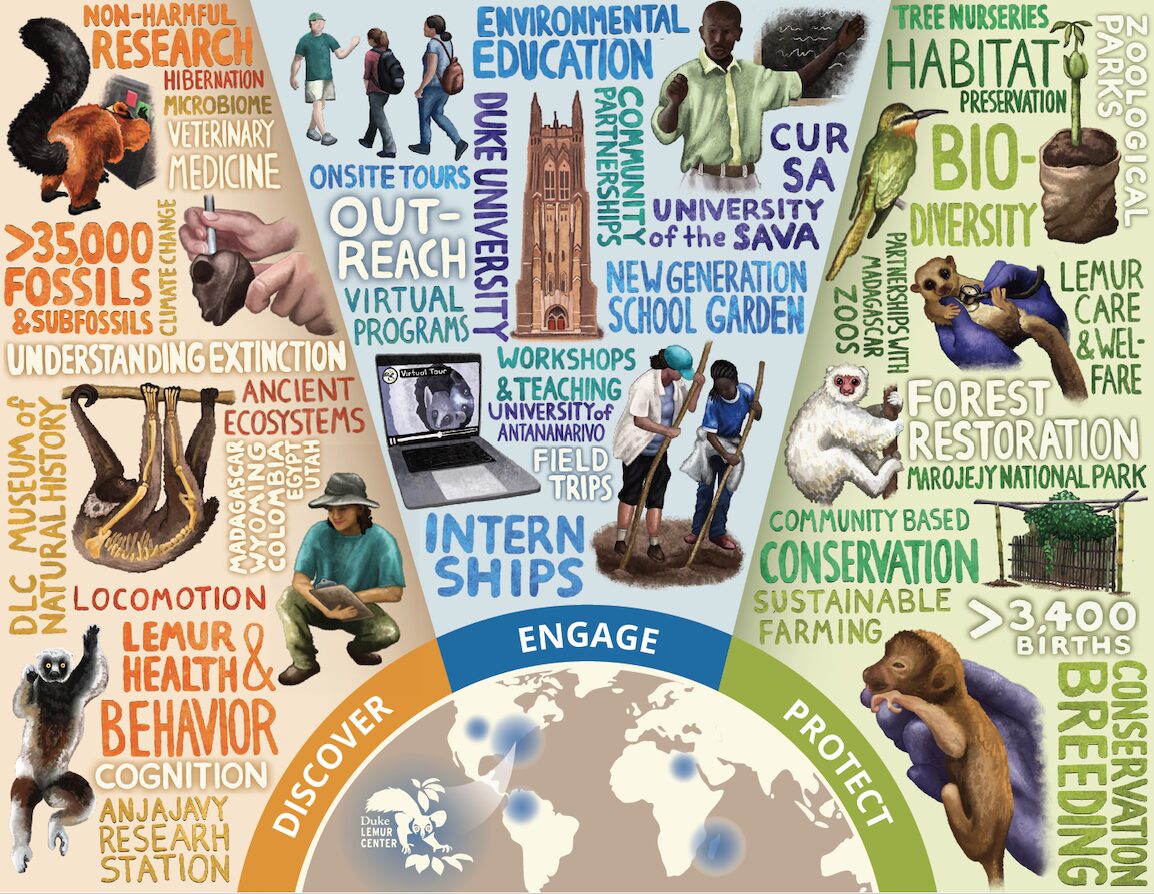
Artwork by Talia Felgenhauer, 2023-24 Undergraduate Fellow in Communications.
We are deeply grateful for the more than three decades of support from the National Science Foundation (NSF), which has been instrumental in advancing the Duke Lemur Center’s mission. The NSF recognized the extraordinary value of this work by providing annual support for the care and stewardship of the Duke Lemur Center’s colony. Those funds helped sustain the infrastructure and expertise that allow scientists from around the world to conduct groundbreaking research while ensuring exceptional care for the animals at the heart of that work. However, this funding mechanism has now concluded, from NSF and other similarly affected funding sources, we are facing a funding gap of almost $650,000 annually.
While challenging, this moment also presents an extraordinary opportunity.
The Duke Lemur Center’s future has never depended solely on Duke University or on grant funding. Its greatest strength has always been a community of visionary supporters who understand that resources of global importance deserve lasting protection. Federal partnerships have been a vital part of our story, and philanthropic investment will be central to our next chapter.
Why This Matters
The Duke Lemur Center’s colony is far more than a collection of animals.
It is a living library of evolutionary knowledge that has contributed to decades of scientific discovery. Research conducted at the Center has advanced our understanding of primate aging, cognition, genetics, behavior, maternal and infant health, and the evolutionary origins of human biology. The Center provides unparalleled opportunities for undergraduate and graduate students, postdoctoral scholars, veterinarians, and conservation scientists to conduct research and gain hands-on experience that shapes future careers in science and conservation.
Just as importantly, the colony serves as a critical genetic safety net for species facing increasing threats in the wild. As habitat loss, hunting, and climate pressures intensify across Madagascar, the Duke Lemur Center helps preserve species that could otherwise disappear forever.
A Philanthropic Opportunity
Private support will help sustain the people and programs that make this impact possible, including:
- Expert animal care staff and veterinarians who provide daily care for the Center’s lemurs
- Scientific resources that support non-invasive research and discovery
- Educational and training opportunities for students and emerging scientists
- Conservation programs that protect lemurs and their habitats in Madagascar
- Strategic investments that build long-term financial sustainability through endowment growth
An investment at this moment would not simply sustain today’s operations. It would help create a stronger, more resilient future for one of the world’s most important centers for primate conservation and research.
Looking Forward
The Duke Lemur Center has overcome significant challenges throughout its history while continuing to advance its mission and expand its impact. With philanthropic partnership, the Center can emerge from this period stronger than before, ensuring that future generations benefit from the knowledge, inspiration, and conservation leadership that the Duke Lemur Center provides.
At a time when the future of many scientific and conservation programs is uncertain, your support can help secure something truly extraordinary: a world-class resource that protects endangered species, advances discovery, trains future leaders, and inspires people around the globe to care about the natural world.
The opportunity before us is not simply to close a funding gap. It is to safeguard a global resource and ensure that its impact endures for generations to come.
To explore ways you can help, visit the pages shown below, or contact Mary Paisley, Development Director, at mary.paisley@duke.edu.
