Click the image above to view full, printable PDF of this article.
By Matthew Burkhart, Communications and Education Assistant, Undergraduate, North Carolina State University. With Ehsan Dehghan-Niri, Ph.D., Associate Professor, School of Manufacturing Systems and Networks, Arizona State University. Originally published in LEMURS Magazine: Reasons for Hope in February 2026.
Non-destructive testing (NDT) is a technique for evaluating the structural integrity of a component or product without impairing its functionality. NDT enables the inspection of machines and structures that are currently in use, such as oil pipelines and airplanes, by allowing for routine maintenance and safety assurance over time without disrupting their service.
Tapping into Nature
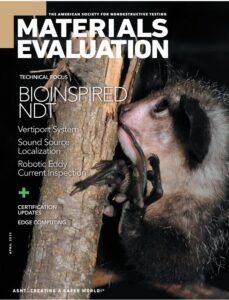
Elphaba, an aye-aye born at the Duke Lemur Center, graces the cover of the journal Materials Evaluation in April 2025. Ehsan sees the aye-aye as an ambassador for both technological innovation and nature’s genius. Photo by David Haring.
The aye-aye, a nocturnal lemur known for its distinctive tap-foraging technique, has become the unlikely muse for cutting-edge engineering research.
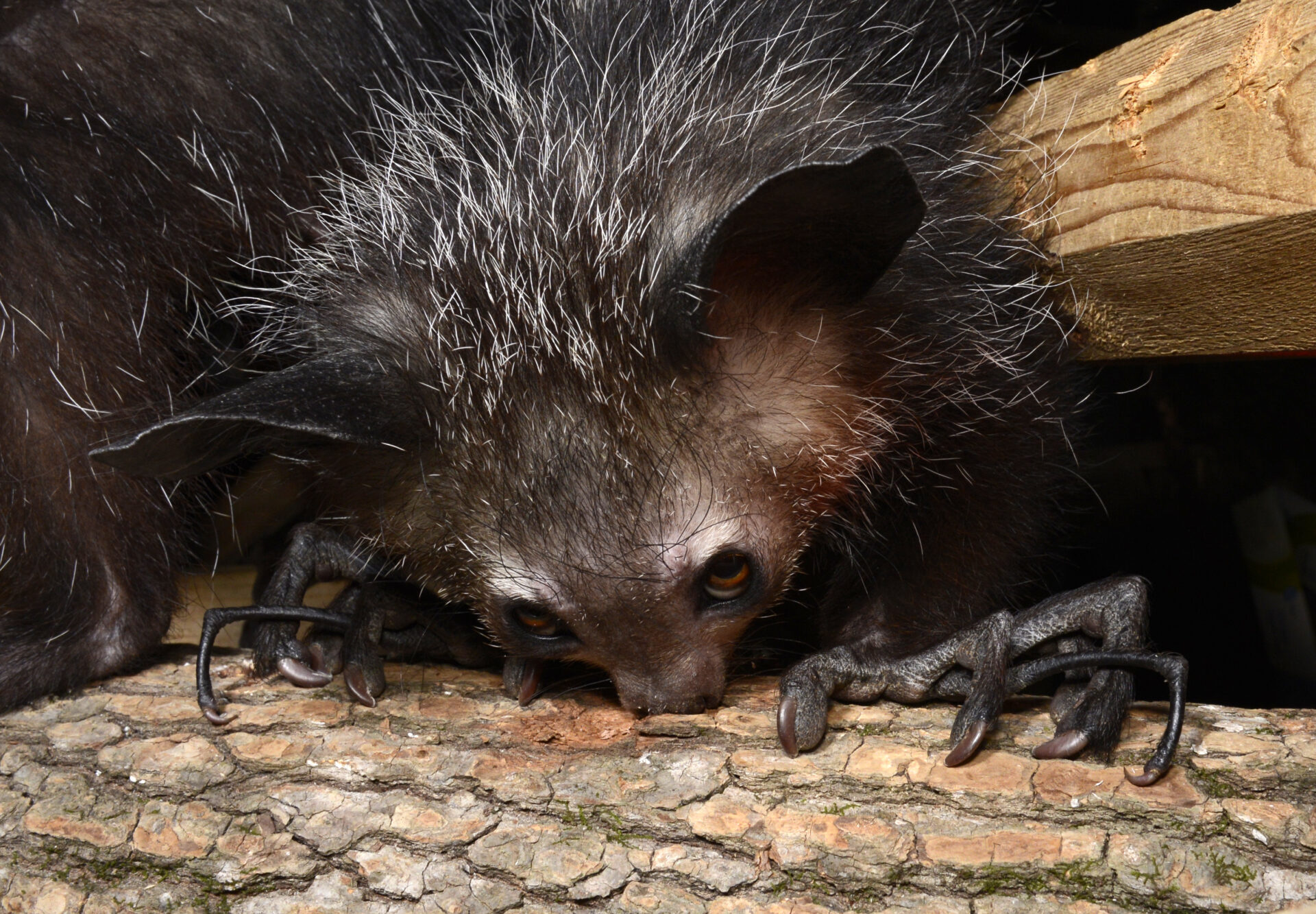
Over millions of years, the aye-aye has evolved a unique foraging behavior known as percussive or tap-foraging. This remarkable technique involves the aye-aye tapping on tree bark while bending its large, cupped pinnae (external ear structures)—the largest among all primates—forward to detect acoustic cues that reveal hidden cavities beneath the bark’s surface. Once a cavity is located, the aye-aye gnaws into the wood using its specialized rodent-like teeth and inserts its long, slender middle finger to extract grubs from inside.
Ehsan Dehghan-Niri has been studying aye-ayes to unlock insights that could revolutionize non-destructive testing technologies used to inspect aging infrastructure like pipelines and aircraft composites.
Ehsan first became aware of the aye-aye when watching the National Geographic channel with his four-year-old son. He was instantly captivated by aye-ayes’ unique foraging technique, especially their ability to tap through nearly an inch of wood to hear echoes from cavities that indicate the presence of insects inside.
“I knew that the wood structure is very similar to composites, and I knew finding deep cavities in such a complex material and geometry is extremely difficult,” says Ehsan. “And we are talking about thicknesses of half an inch, one inch. How can they do it?”
In engineering, non-destructive testing (NDT) allows inspectors to test materials without damaging them, often using ultrasound, sound waves, and tapping to detect cavities, cracks, or flaws.
Inspired by the aye-aye’s percussive foraging, Ehsan’s research uses biomimicry, simulation tools, and behavioral studies—learning from biology to innovate technology—to advance acoustic-based NDT techniques.
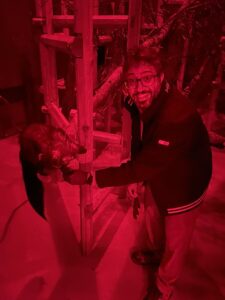
Ehsan’s enthusiasm for the aye-aye shines through his work. “If I had to focus on one topic and wasn’t allowed to do anything else, I would pick studying aye ayes. That’s it,” he says. “For the rest of my life, I can do that.” Pictured: Ehsan at the Duke Lemur Center, feeding a mealworm to an aye-aye. Photo courtesy of Ehsan Dehgan-Niri.
At the Duke Lemur Center, he and his team have developed a specialized observation box equipped with high-tech acoustic, video, and thermal imaging systems to capture aye-ayes’ movements during their nocturnal foraging. Using CT scans, they also created 3D-printed models of the aye-aye’s head, external ear structures, and hand for detailed mechanical and acoustic analysis.
Their comprehensive data revealed that the aye-aye’s foraging behavior is more complex than simple tapping. In addition to drumming on wood with its elongated middle finger, the lemur performs rubbing and gliding motions that generate distinct acoustic signals.
“Now we know that aye-ayes do not just tap,” Ehsan says. “They perform both tapping and rubbing. When they perform rubbing, they generate another acoustic field, another frequency.”
“That’s so important for them,” he explains. “For smooth versus rough surfaces, for example, you need to use a different type of friction, a different angle of attack.”
This insight led Ehsan to develop and patent a new method for inspecting composite materials in engineering. Inspired by the friction-based signals created by the aye-aye, his team’s approach improves the sensitivity and resolution for detecting flaws.
“The aye-aye is a natural non-destructive testing specialist,” says Ehsan.
“This is the value of looking at nature for engineering. The aye-aye’s tapping system has evolved and been optimized over tens of millions of years. It would be very difficult, if not impossible, for us to design a system like this from scratch in our lifetime.
“You can see a story from biology, how humanity can be helped.”
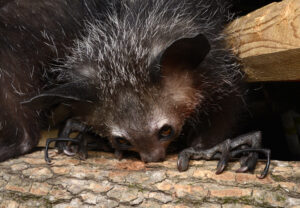
The significance of Ehsan’s research extends beyond engineering. The aye-aye is an endangered species with only a few thousand individuals estimated in the wild. Ehsan hopes his research can raise awareness and aid conservation efforts. His research team is exploring ways to facilitate aye-aye communication and breeding in fragmented rainforest habitats in Madagascar, and he routinely mentions the aye-aye when presenting to students. “Any time I mention the aye-aye, students start asking questions. They immediately become more engaged.” Photo by David Haring.