Click the image above to view full, printable PDF of this article.
By Abby Flyer, M.A., Communications and Education Specialist. Originally published in LEMURS Magazine: The “Where” Issue in February 2025.
Aracus was a stud in the fall of 2003.
He lived in one of the Duke Lemur Center’s free-ranging forest habitats in a troop with six other ring-tailed lemurs, three of whom were breeding females. At 12 years old, Aracus would’ve been approaching the end of his lifespan had he grown up in the spiny desert of southern Madagascar; but as a lemur born at the DLC, he was barely old enough for a mid-life crisis.
Aracus was born into this troop in 1991. By 2003, he had worked his way up the hierarchy of males and was judged by the females—the dominant sex—to be the ideal mate choice. “Aracus was seen breeding with Dory on Sunday afternoon,” husbandry staff noted, “keeping Agnostes and Selaucius at a distance. Philocles, too, had sense enough to stay away.”
While the three males gave Aracus a wide berth, the females did not. Aracus bred with all three—Dory, Cleis, and Sosiphanes—and even earned a spot in the girls’ lemur ball, a sleeping arrangement in which lemurs curl up and huddle together like eggs in a nest. The other males were excluded, forced to sleep solo on the forest floor a few feet away.
By the time he was transferred to a new group in September 2005, Aracus had dominated his troop’s gene pool, producing nine offspring with his three breeding partners. Charles Darwin would have been proud.
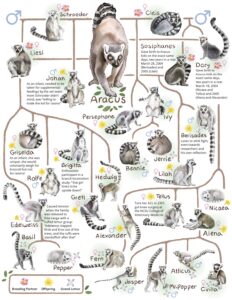
Lemurs are the most endangered group of mammals in the world, and at least 17 species have already gone extinct. In partnership with the Association of Zoos and Aquariums, the DLC’s conservation breeding program works to create a genetic safety net for lemur species threatened with extinction. By fathering over a dozen offspring with five breeding partners, Aracus contributed to a genetically diverse population of ring-tailed lemurs in human care that will survive and thrive for decades after his passing. Illustration by Talia Felgenhauer, 2023-25 DLC Undergraduate Fellow in Communications.
When I started working at the DLC in January 2023, it was hard for me to imagine Aracus in his prime. As the second-oldest resident of the Lemur Center, he carried a mythos and a reverence, as if he had always been old and wise. (His age was eclipsed only by that of Poe, a 37-year-old aye-aye.) Diving into Aracus’s past feels like seeing your dad’s high school yearbook photos—slicked-back hair and aviators, a rakish grin that feels foreign on the face of the man who raised you.
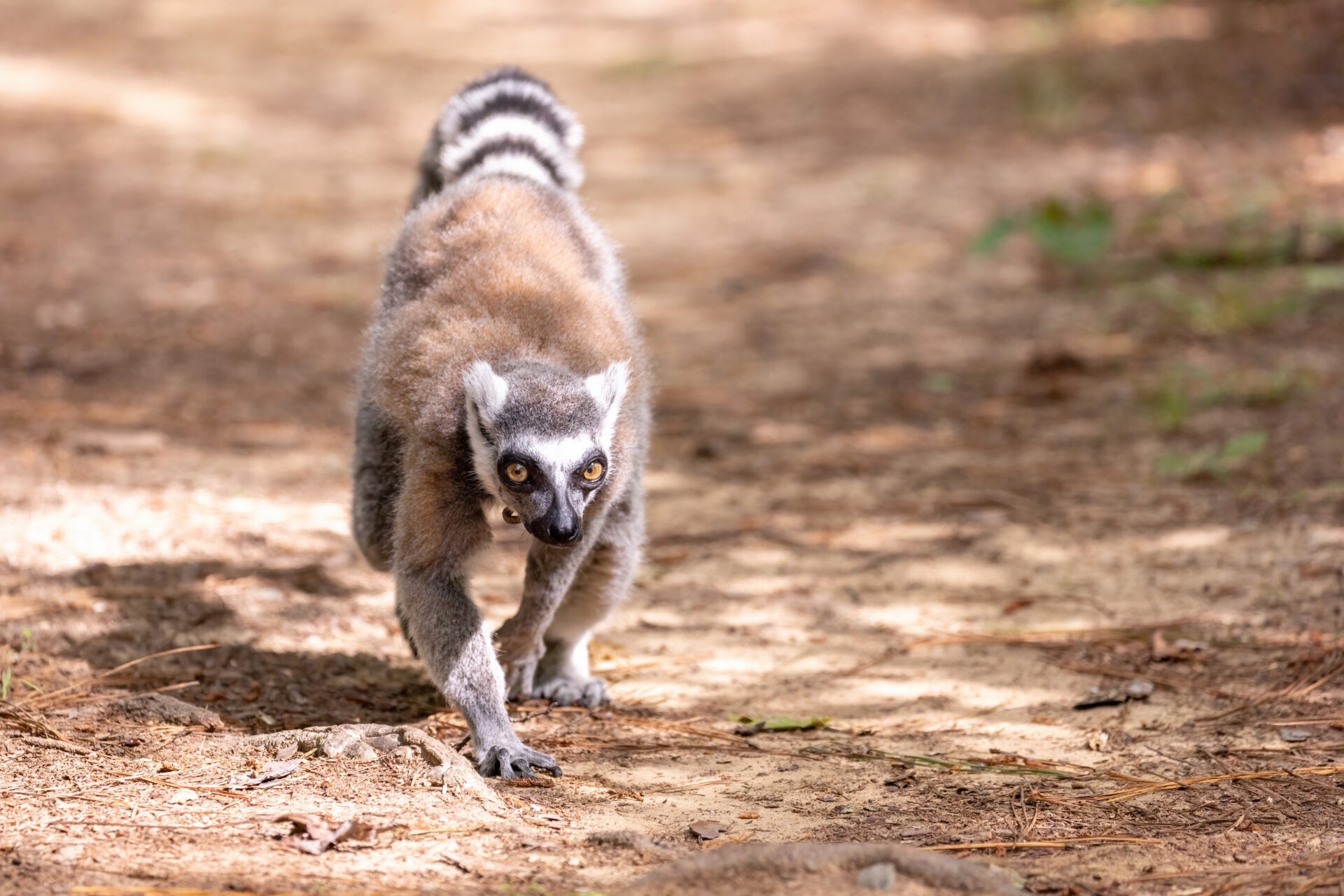
Though two decades past his reproductive peak, Aracus was as charismatic as ever. When I crouched with my notebook in the family’s outdoor enclosure, he spotted me and broke into a gallop. He could gallop much faster than his age suggested, and the gentle triplet patter of his hands and feet hitting the ground sounded like a horse the weight of a house cat approaching.
Aracus had two speeds: the rhythmic amble that betrayed his age, and the spirited gallop that seemed to defy it. He stopped inches from where I stood, rising up onto his hind legs. Though his hands shook and his fingers were gnarled with age, he reached for my notebook to mark its pages with scent from the glands on his wrists. This is mine, he was saying, a message to his peers that I didn’t have the nose to fully comprehend.

Aracus free-ranging, 2020. Photo by Sara Sorraia.
But a contact call from Liesl, the troop’s dominant female, drew him away. Ring-tailed lemurs communicate with a language seemingly Frankensteined from the sounds of other animals: the clucking grunts of hens, the whines of an impatient puppy, an owl’s gentle coo, loud mewls from a cat determined to wake its owners at midnight. Ring-tailed lemurs are one of the most vocal primates, with at least 28 distinct calls, and Liesl and her daughters are particularly chatty. Their enclosure often erupts into a chorus of clucks and whines, like a group of friends reuniting, armed with an arsenal of gossip.
Aracus locked his eyes on me for a moment—soft, pale yellow irises dotted with foggy pupils—and then turned tail, abandoning my notebook to gallop toward Liesl’s call.
Aracus became a father on March 18, 2004, when Dory delivered twin girls. Sosiphanes soon doubled his offspring with a pair of twin boys. Sosiphanes’ and Dory’s mother, Cleis, bore him another son in May. Aracus’s season of love had paid evolutionary dividends.
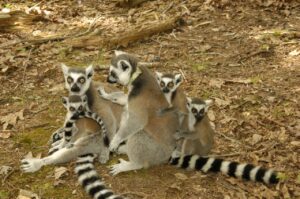
Aracus’s breeding partners with their infants, 2004. Photo by David Haring.
Aracus was a hands-off dad. In Madagascar, ring-tailed lemur troops range from six to 24 individuals, with most females mating with multiple males in quick succession. Because males have no way of confirming the genetic relatedness of any infants born within the troop, from a Darwinian standpoint it doesn’t behoove a male to invest energy into caring for kids that might not share his DNA. This evolutionary pragmatism drives these primates to absentee fatherhood, stepping back and letting the females shoulder the duty of infant care.
Females are dominant in ring-tailed lemur society. When I knew him, 33-year-old Aracus took his marching orders from 15-year-old Liesl, the mother of seven of the 17 offspring Aracus had sired over the course of his life. Aracus and Liesl lived with their three youngest daughters: Gretl, Griselda, and Hedwig. As the only male in the troop, Aracus occupied the bottom rung of the social ladder. Even if he had lived with his sons, he was still likely to be the lowest-ranking member. Hierarchy in ring-tailed lemur troops is largely determined by the dominant female: Who will she back in a fight? Given the choice between her offspring and her breeding partner, the matriarch will almost always side with her kids.
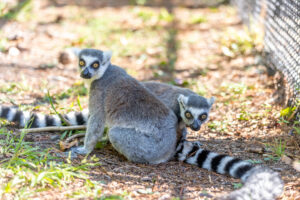
Aracus and Liesl met in 2009. He was recommended for breeding with Liesl’s mother, Shroeder, but it was the juvenile female who took a shine to 19-year-old Aracus. Photo by Sara Nicholson.
Liesl has ears that stick straight out from the side of her head like airplane wings. A shaved section in the middle of her tail helps less-familiar observers single her out, but I know her so well that I can spot her in pictures taken over a decade ago. As the dominant female, Liesl has premiere access to the tastiest food, the warmest sunbathing locales, and the undivided attention of the rest of her troop.
Danielle Lynch, Assistant Curator at the Duke Lemur Center, describes her as a “subtle matriarch.”
“If you don’t know that group, you wouldn’t realize she’s in charge,” says Danielle, who has worked with Liesl and family in a consistent capacity since 2018. “She doesn’t have to do much, and the girls follow her.” While Liesl will occasionally enforce her reign using physical aggression, more often she controls the troop through something as understated as a quick glance.
Having lost interest in my presence, Aracus joined Liesl on a sunny branch in their forested enclosure. Liesl was “sun worshiping,” sitting up tall on her haunches like an obedient kindergartener during circle time, arms raised laterally to expose her belly to the light. Aracus ambled along branch in pursuit of warmth, settling a short but respectable distance away from her. He leaned to his left just far enough to groom the nape of Liesl’s neck. She angled her head to reciprocate, tooth comb running one, two, three times through his scruffy gray fur. From my vantage point, the pair were haloed in the gentle late morning light, a blinding white silhouette tickling the tips of their ears.
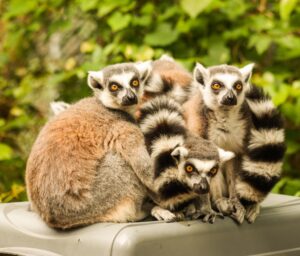
Aracus, his longtime partner Liesl, and their three youngest daughters rest in a “lemur ball” on a late spring morning, 2023. Photo by Crystal Silva.
Every lemur at the DLC visits the Borruel Center, our state-of-the-art veterinary facility, at least once a year for a routine physical exam. Geriatric animals like Aracus tend to visit more frequently. He had a tumor removed from one of his scent glands and was repeatedly treated for severe spondylosis, a condition caused by age-related wear on the spine that caused his tail to droop. He took gabapentin for joint pain. But he remained healthy and spry enough to free-range, and even in his 30s, the husbandry notes describe him as “climbing and trotting through the woods, keeping up with his ladies.”
He needed to be separated from the girls during mealtimes. “Most geriatric lemurs that I have worked with, especially ring-tails, are not good eaters,” explained Danielle. “Getting Aracus to eat was the biggest challenge.” Feeding him separately gave him ample time to pick at his food bowl without the girls swooping in and devouring his leftovers.
Even so, it was hard to keep Aracus focused on eating for long. “He was old, but he was still very fiery,” Danielle laughed. “Sometimes he’d get distracted while he was eating, and I’d be like, ‘No, no! You were eating! Go back and finish eating!’ But no, he wanted to chase after the girls, because even though they’re contracepted, he doesn’t understand that he can’t breed them. The breeding urge is usually the last thing to go.”
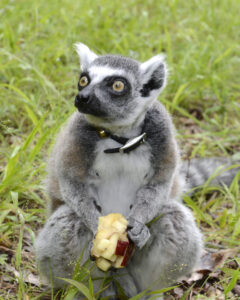
Aracus with a sliced apple, 2020. Photo by David Haring.
In late June 2024, a series of diagnostic tests determined that Aracus was on the brink of complete liver failure. “His bloodwork has shown us that his disease is progressing,” noted DLC veterinarian Brendan Johnson, D.V.M., Ph.D. “While outwardly he may seem okay, his liver is worsening.” To prevent him from suffering, the animal care team made the decision to humanely euthanize Aracus on July 10, 2024.
On my last day of observations with the family, I left my notebook in my office. As I stood, quiet and still, I was approached by eight-year-old Hedwig, the youngest of Aracus’s 17 offspring. She plopped down in front of me, legs stretched, back feet closed into loose fists, hands flat against the ground. She wasn’t sniffing me, or eating, or scent-marking, or sun-worshiping. I was seeing her as she exists in the moments in between—blinking, breathing, wind gently rustling her fur. So much of my writing and my work with lemurs centers around stories, facts, and behaviors. Usually, when I observe the lemurs, they’re running around with one another, and I exist outside of the action, a silent voyeur. But for a couple of minutes, we were just two primates, two feet apart, watching the world turn.
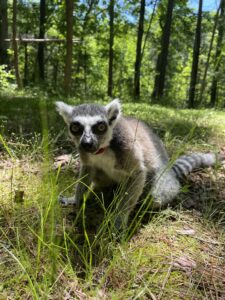
Aracus, 2024, just six weeks before his humane euthanasia. Photo by Abby Flyer.
Aracus’s legacy lives on beyond beloved memories. DLC husbandry staff, veterinarians, and researchers keep detailed notes on each animal over the course of their lives, and Aracus’s 200-page document tells the story of three decades of attention and care. Insight gained throughout his life could impact the lives of other lemurs at the DLC for years to come, and many his 17 offspring and 10 grandkids still live at zoos across America and continue to bring joy to visitors in every corner of the country. In the words of DLC Colony Curator Britt Keith, “What a great animal. What a great life he has had.”
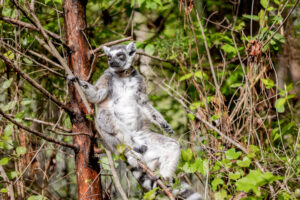
Aracus sun-worshipping in his forest enclosure, 2022. Photo by Sara Nicholson.