Click the image above to view full, printable PDF of this article.
By Matthew Burkhart, Communications and Education Assistant, Undergraduate, North Carolina State University. With Martin Kratt, Duke ‘89. Originally published in LEMURS Magazine: Reasons for Hope in February 2026.
Few animals have inspired children and conservationists alike as profoundly as Jovian, the Coquerel’s sifaka who brought primate conservation into living rooms around the world as the star of the children’s television show Zoboomafoo. Born in 1994 at the Duke Lemur Center, Jovian’s charm and playful energy captivated audiences and made him an enduring symbol for Earth’s most endangered mammals.
The Show That Exposed the World to Lemurs
Zoboomafoo debuted on PBS Kids in 1999 with a fresh, innovative format combining live animals, puppetry, and education. Co-created by brothers Martin and Chris Kratt, the show highlighted Jovian as a lovable, inquisitive lemur co-host alongside the Kratts. Its 65 episodes not only entertained, but also opened doors for children worldwide to engage with wildlife and conservation. The brothers’ decision to star a Coquerel’s sifaka, a charismatic lemur with an expressive face and bipedal sideways hopping, helped create an unforgettable character.
“We’re so happy that so many kids have connected to animals, nature, and science through Zoboomafoo,” says Martin. “We hear pretty often from people who credit the show for inspiring them to pursue career paths in science and conservation.”
The Kratt brothers were inspired by the Duke Lemur Center’s research and conservation efforts, which made it possible to showcase lemurs authentically. Martin notes that prior to the show, most people had little awareness of lemurs, much less the breadth of diversity found in Madagascar. Through storytelling and Jovian’s charm, they created a lasting emotional connection with audiences.
“Kids understand and retain information the best when it’s presented within a story,” Martin says. “And when you have a lovable lemur like Jovian, aka Zoboomafoo, as a main character, it becomes a great way to engage kids and introduce them to all the amazing animals with whom we share this planet.”
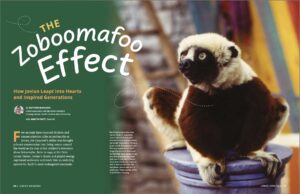
Chris (left) and Martin (right) Kratt with Jovian in their portable “Animal Junction” set onsite at the Lemur Center. Martin is a Duke alumnus and became involved with the DLC during his time as a student. “The truth is,” says Martin, “Zoboomafoo would never have happened without the Duke Lemur Center and all the great researchers like Elwyn Simons, Pat Wright, and Ken Glander, who helped us and worked in lemur conservation at Duke and in Madagascar.” Photo courtesy of the Kratt Brothers Company.
Jovian’s Family and Legacy at the DLC
Jovian was not just a star on screen; he was also a key figure in the Duke Lemur Center’s conservation breeding program. Over his lifetime, he sired 12 offspring, contributing directly to the genetic diversity and future of his critically endangered species.
Jovian was born in 1994 to Flavia, a female who had been imported from Madagascar in 1986, and Nigel, who was born at the DLC in 1972. When the Kratt brothers visited in 1997 in search of a live-action co-star for their show, Jovian and his family’s playful personalities and ease with people made them an obvious choice—a perfect fit for the role of “a little leaping lemur who liked to bounce and play.” For weeks, cameras captured Jovian’s leaps and gentle interactions on set, infusing the on-screen Zoboomafoo with his real-life curiosity and grace.
“I remember Jovian was very inquisitive and interactive,” recalls Martin. “And his hands were so soft when he took a garbanzo bean from you at the pedestal where he’d snack.”
Chris Smith, coordinator of current science programs at the North Carolina Museum of Natural Sciences and former keeper and education manager at the Lemur Center, was Jovian’s secondary keeper and guided guests to see Jovian and his family on tours.
Chris remembers Jovian most for his exceptional love of peanuts and his calm and submissive demeanor, which he credits for Jovian’s success as the long-term mate to Pia, with whom he had nine offspring.
“Pia was bigger than all the other members of the family; she was strong, and she was strong-willed,” Chris says. “And Jovian was down there, kind of like a thinner old man lemur, and he was just trying to keep it all chill… He used to be on TV, but in this hierarchy, Jovian was at the bottom, and I’d say he played the part well.”
Britt Keith, longtime DLC colony curator and Jovian’s primary keeper, remembers Jovian most for his role as a father.
“He was wonderful with the babies,” says Britt. “They would ride on him, and he would get annoyed with them once they were starting to be weaned because they wouldn’t get off. He would nip at their hands on his shoulders, and they wouldn’t let go! He would just give up when he couldn’t reach right around his back.”
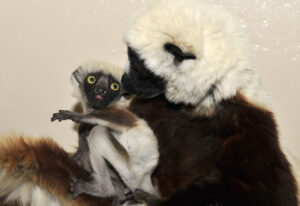
Jovian was born at the Lemur Center in 1994. As a young adult, he became famous as Zoboomafoo—the leaping, prancing co-star of the PBS Kids show by the same name. Photo by David Haring of Jovian with infant daughter Gisela.
Of Jovian’s direct descendants, daughter Gisela (13), son Ferdinand (12), grandsons Silas (4) and Arcadius (1), granddaughters Francesca (10) and Cassia (5), and great-grandson Radama the Great (9 months) live at the Duke Lemur Center. Other family members have been moved to AZA-accredited zoos across the country and Europe, particularly in Germany, to diversify the genetics of the species worldwide.
Jovian’s contributions extended well beyond public engagement. His calm temperament and comfort around humans made him ideal for a range of non-invasive behavioral and physiological studies. The DLC’s Director of Research, Erin Ehmke, Ph.D., says that Jovian participated in 17 projects during his lifetime and 10 projects post-mortem.
She noted his involvement in cognitive studies, a surprise given that sifakas are not generally studied for their intelligence. Jovian also helped researchers study gut microbiomes and stress responses, revealing insights critical to captive care and conservation.
Erin remembers Jovian for his unique eye color, as most Coquerel’s sifakas have yellow-orange eyes.
“I’ll always remember his brilliant silvery green eyes,” she says.
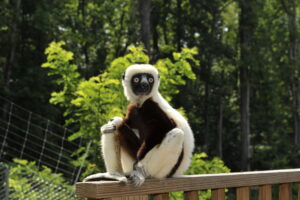
Jovian (pictured at age 18) and his family “were the most distinctly beautiful sifakas in our colony, and the easiest and most delightful animals to work with,” recalls David Haring, the DLC’s longtime registrar and photographer. Photo by David Haring.
Zoboo Made Leaps and Bounds in Making Learning Fun
Ethan Moore, a professional educator at the DLC, grew up watching Zoboomafoo and was a self-proclaimed “big PBS kid.” He believes part of what made the show so impactful was the excitement the Kratt brothers shared for lemurs.
“They were just a blast to listen to, the level of energy and excitement they had,” says Ethan. “You could hear the true love and appreciation they have for the animals. They were having a great time.”
The Kratts’ excitement came easily, thanks to the sifakas’ spunky nature.
“Of all the lemurs I’ve worked with, sifakas are the most expressive and playful,” Ethan says. “People are drawn to them.”
Visitors to the DLC often react with delight when they realize they are seeing the real-life Zoboomafoo. Ethan noted that millennials and older Gen Zs, those who grew up watching the show, are particularly excited. “Guests squeal with excitement, saying things like, This is his grandchild! This is his daughter!’” For many guests, the connection to Zoboomafoo makes lemur conservation feel more immediate and personal.
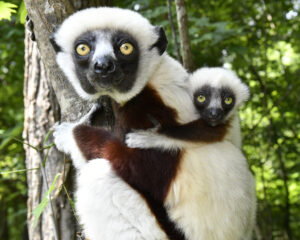
Jovian’s granddaughter, Cassia, and great-grandson, Radama the Great. Photo by David Haring.
The Day the World Said Goodbye
The news of Jovian’s death in November 2014 sent shockwaves well beyond the Duke Lemur Center, quickly reaching fans around the world. Within the DLC itself, the sadness was palpable, with keepers and staff reflecting on the end of an era for one of their most significant animal ambassadors.
Preparations for announcing his passing showed just how much Jovian meant to people everywhere. As Chris, who managed the Center’s social media at the time, recounted, the staff anticipated overwhelming interest.
“We knew that when we said, this animal has passed away, we were going to make headlines. Just intuitively, this is a story that a lot of people are going to see and pick up on,” he recalls.
The Center worked closely with Duke’s communications team to carefully craft a public response, drafting an obituary, staging press releases, and preparing social media posts so that admirers worldwide could mourn and celebrate Jovian’s legacy.
The public response was immediate and intense. So many people flocked to the Lemur Center’s website to read the obituary and share condolences that the server crashed almost instantly, prompting staff to temporarily redirect visitors to the Duke University homepage just to handle the flood of traffic. Messages came pouring in from across the globe as parents, scientists, and children who had grown up with Zoboomafoo sent tributes and recalled moments of discovery sparked by the PBS show and Jovian’s joyous leaps.
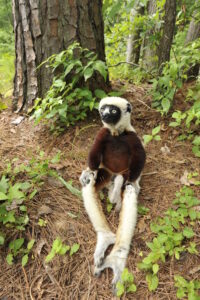
Jovian (pictured at age 20) lounging in the woods. Photo by David Haring.
Those who worked most closely with Jovian spoke about the mixture of grief and gratitude.
“Every lemur that you lose breaks your heart,” says Chris. “The Coquerel’s sifaka has a special place in everyone’s minds because the Lemur Center puts so much special attention into their care, because they’re such a specialized animal.”
Jovian’s passing did not mark the end of his influence. The DLC, and its extended network of educators and fans, continues to see the ripple effects, both in the enduring “Zoboomafoo moment” that greets visitors each day as they see Jovian’s descendants and in the ongoing work to protect lemurs and their habitats for future generations.
Media, Conservation, and Jovian’s Broader Influence
For keepers, educators, and visitors, Jovian has always been more than just a famous face. “His day job was being a lemur at the Duke Lemur Center. His side project was being a TV superstar,” Ethan said. After his passing, he “rose to legendhood,” with staff noting that his fame grew as newer generations of keepers and educators arrived.
The depth of Jovian’s influence runs throughout conservation. When asked to quantify his impact, Britt Keith pointed to his unique contributions.
“His level of education to the world, the way he made people aware of what interesting animals Coquerel’s sifakas are—this rare, critically endangered species from Madagascar,” says Britt. “People didn’t know much about lemurs, certainly not the rarer species like the sifakas. Jovian brought that awareness.”
Staff members saw firsthand how having a named, real animal was vital for connecting people to conservation.
“Animals that have names and stories do a better job of building empathy for wildlife and for conservation than animals that do not have names and stories,” Chris explains. “Which doesn’t mean we anthropomorphize, but having a mascot seems to matter.”
Me and You and Zoboomafoo
The story of Jovian and Zoboomafoo endures in every tour, every educational program, and every new lemur born at the Center. The lasting effect of a charismatic character and a story told with authenticity continues to inspire new generations of scientists, educators, and advocates.
“We hoped Zoboomafoo would inspire kids to help endangered species throughout their lives,” Martin Kratt says.
With Jovian’s family thriving and new generations still drawing inspiration from Zoboomafoo, the Duke Lemur Center remains not just a place of non-invasive research, but a living testament to how storytelling, education, and a single lemur can change the world for the better.
Just as every Zoboomafoo episode ended: “Go make an animal friend today!”
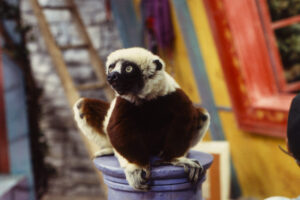
“We filmed Jovian at the Duke Lemur Center in a specially constructed enclosure with one-third of the Animal Junction set inside,” says Martin. “It was a great month of hanging out with this very lovable lemur. Don’t forget that his mom Flavia and his dad Nigel were always on set too, and sometimes they took their turn in the role of Zoboo! If you look closely, you might be able to tell; but the main star was Jovian, and he was such a sweet guy.” Photo courtesy of the Kratt Brothers Company.
Q&A with Martin Kratt
Looking back, what do you think is the biggest impact Zoboomafoo has had on public attitudes toward lemurs?
Back in the 80s and 90s, lemurs weren’t really known to the general public. I worked as a lemur caretaker at the Duke University Primate Center (that’s what the Lemur Center was called back then!) as a student in the late 80s, and that’s when I was first introduced to this unique animal group. Then in 1992, Chris and I spent a year in Madagascar filming lemurs, camping across the island in the habitats of indri, aye-ayes, ring-tails, mouse lemurs, and of course sifakas! So we got to know lemurs very well. After Kratts’ Creatures, when it came time to create a new show, we knew lemurs had to be a part of it! We wanted kids around the world to know how great lemurs are, and to get involved in protecting them. We’re so happy that so many kids have connected to animals, nature, and science through Zoboomafoo.
In the years since Zoboomafoo aired, have you encountered conservationists, scientists, or educators who directly credit the show, or Jovian, with inspiring their career paths?
We hear pretty often from people who credit Zoboomafoo for inspiring them to pursue career paths in science and conservation. When we were performing a Wild Kratts live show at Iowa State, 15 students from the ecology program came to say hello and told us stories of how much Zoboomafoo and Wild Kratts meant to them, as well as share that the shows were why they are pursuing their science careers. It’s an outcome that means a lot to us.
Are there aspects of lemur behavior or conservation that you wish you could have highlighted more on Zoboomafoo but couldn’t due to time, format, or audience? How do you address those topics in your current work?
We would’ve loved to do more Zoboomafoo episodes, 65 just wasn’t enough! What about highlighting the diademed sifaka, crowned lemurs, avahi, and so many more! But seriously, we’re so happy that Zoboomafoohad the run that it did. We also continued highlighting lemurs after Zoboomafoo. For example, we returned to Madagascar for six episodes of Wild Kratts that featured different species of lemurs.
I’m really glad we produced Zoboomafoo when we did, and in the way we did. I think today, it would be hard to pitch a character created with a mash-up of a real lemur and a puppet, and there’d be a lot of pressure to do it with CGI given all the advances. But the very reason we chose a sifaka lemur as a co-star is because they looked so much like a puppet in the first place! And I think going back and forth between the real lemur and the puppet gave Zoboomafoo his charm and has made it such a nostalgic, classic show.
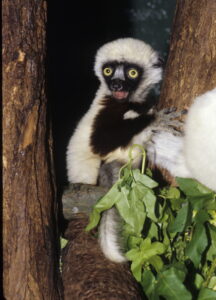
“We wanted kids around the world to know how great lemurs are and to get involved in protecting them,” says Martin. 27 years later, Zoboomafoo remains a testament to how storytelling, education, and a single lemur can change the world for the better. Pictured: Infant Jovian. Photo by David Haring.