Click the image above to view full, printable PDF of this article.
By Matt Borths, Ph.D., Curator of the DLC Museum of Natural History. Originally published in LEMURS Magazine: Reasons for Hope in February 2026.
I was a dinosaur kid. I loved getting books from the library filled with weird dinosaur names and fun facts. This blizzard of ancient Greek and solid numbers led me to believe that paleontology—and science in general—was basically complete. I assumed that all of the important sites had been found, all of the important questions answered. I may have been a dinosaur kid, but I couldn’t be a paleontologist adult. There was no future in the past.
But then, after exploring history, linguistics, medicine, and political science, I took a geology class in college. It was taught by a paleontologist. I learned there were indeed sites to discover, and fossils waiting to reveal their secrets. I charted my path, cautiously optimistic that there were still big questions to answer. I could hope that maybe I’d get to work on a new and important site. Someday.
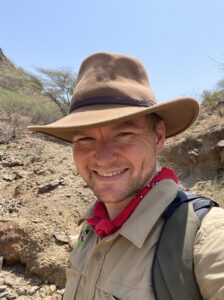
“There are still mysteries to solve,” says Matt Borths. “Science isn’t finished.”
In 2019, a geology team working on the shores of Lake Turkana in northern Kenya ran an analysis on volcanic rocks from an area called Topernawi. They wanted to figure out how old the the basalt was so they could date the fossils sandwiched between the volcanic layers.
Turkana is a massive area that paleontologists have been exploring for decades because some layers of sediment preserve fossils of our bipedal ancestors (mostly from 1 to 5 million years old). But the fossils near the undated basalt did not include classic early-human neighbors like rhinos and antelope, a clue the site was a little older. Maybe 10 or 15 million years old?
Then the date came back: 29 million years old. Shockingly old. No mammalian fossils from anytime close to that had ever been discovered near Lake Turkana. In fact, no productive fossil site near the equator in Africa had ever been dated to this crucial window of time, when genetic and sparse fossil evidence suggests that apes originated. If paleontologists could find more fossils from this area, maybe they could piece together the environment that shaped our tail-less ancestors.
In 2021, the paleontology team—led by Patricia Princehouse (SUNY-Oswego), Isaiah Nengo (Turkana Basin Institute), and Natasha Vitek (Stony Brook University)—contacted me about the discovery. The Duke Lemur Center Museum of Natural History has a large collection of fossils from the Fayum Depression in Egypt. The Fayum preserves African fossils that are between 37 and 29 million years old. The Egyptian fossils are essential for sorting out the identities of the creatures stalking or climbing through the Kenyan forest 29 million years ago.
Here it was. A new window into an ancient world, filled with previously unknown, extinct animals. Maybe we could catch a glimpse of our ape-like ancestors, or even the ancestors of lemurs before they drifted over the Mozambique Channel to Madagascar. We worked on a grant to fund expeditions to Topernawi, securing support from the National Science Foundation to spend a few weeks each year crawling the buttes and gullies for scraps of our ancient ancestors.
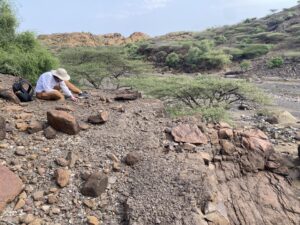
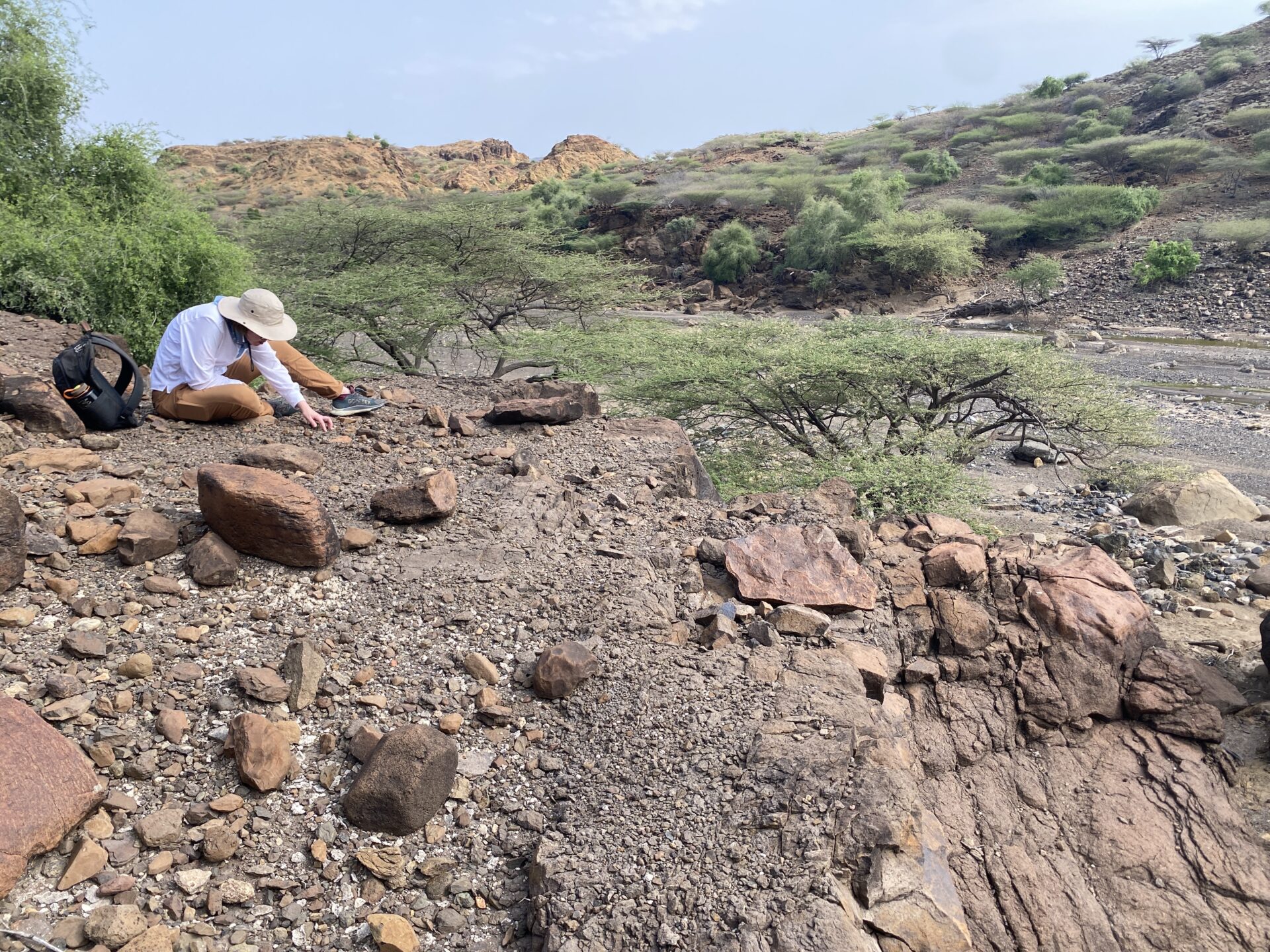
Kate Neely, Digital Collections Manager at the DLC Museum, searches for fossils at Topernawi. This was their first fossil-finding expedition. Most of the rocks at Topernawi are volcanic, including the entire ridgeline in the background.
Meanwhile, as the Topernawi project was getting organized in 2021, my wife and I were figuring out how to be a new family of three. Then we welcomed a second baby in 2024. My expanding family meant that traveling to Topernawi myself wasn’t possible for a few years. Instead, I helped identify new species of hyraxes, elephants, and primates from Topernawi from my office at the DLC Museum.
In July 2025, thanks to generous logistical support from my family, I was finally able to travel to the western shores of Lake Turkana, getting my boots dusty at Topernawi. The DLC Museum’s Digital Collections Manager Kate Neely also joined the team. Since starting at the DLC Museum in 2024, Kate has helped the Topernawi team make fossil comparisons by creating 3-D scans of Fayum fossils in the microCT lab at the Shared Materials Instrumentation Facility at Duke. Now, Kate was on their first fossil expedition, learning to recognize fragments of enamel and how to read the rocks while prospecting for new localities.
Turkana is not an easy place to work. We were there during the “cool” dry season, when daytime temperatures still soar over 90°F and humidity is high from the lake. At night it barely cools off. I’d drink a liter of water before bed, then wake up thirsty from sweating it all out overnight. Tent zippers clog from the fine lake dust, and acacia spines pierce every kind of fabric. But the dry, dusty conditions are worth it for the fossils, which we searched for with help from local Turkana fossil hunters who have generations of experience combing the rocks in search of early human fossils.
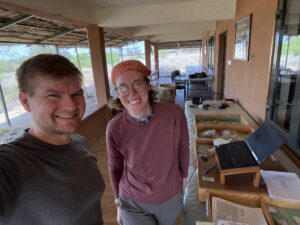
Matt and Kate working in the collections at the Turkana Basin Institute in Kenya. We use collections in Kenya and collections at the DLC Museum to identify the creatures at Topernawi.
The fossils themselves are not much to look at. Most were deposited during churning flood events that shattered bone, leaving behind petrified logs and only the densest parts of the skeleton: teeth and the occasional ankle chunk. But even fragmentary teeth are enough to help a crew of paleontologists and geologists resurrect horse-sized hyraxes, hippo-sized elephants, and dog-sized ape relatives.
To find these fragments, the team walks the badlands, our eyes trained on the ground. From a distance, it looks like a dozen people who lost their keys among the acacia roots and basalt cobbles. When someone spots a glint that could be a tooth, or a rock with a suspiciously biological curve, they stoop down to investigate. If it’s a fossil, they clear the area around it and call over the field manager, who takes photographs of the specimen and collects exact GPS coordinates along with a preliminary ID.
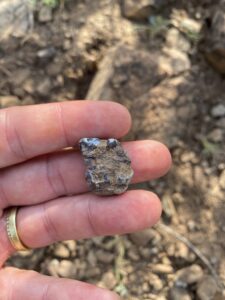
Not all fossils are pretty. Matt holds an upper molar of a zebra-sized giant hyrax.
Usually the ID is a species of hyrax. Today hyraxes are small, football-sized mammals with tiny tusks, evidence of their ancient connection to elephants. But 29 million years ago, some hyraxes were massive, filling niche space occupied today by antelope, zebras, and rhinos.
Hyraxes are not primates, but it is still thrilling to find scraps of these strange beasts. Fossils at Topernawi are neither abundant nor pretty. There’s a reason the site took so long to be discovered. But without Topernawi, we would have no evidence of what was happening near the equator during a time of massive environmental change. 29 million years ago in places like Europe, Asia, and North America, lush forests were transforming into open, dry habitats, and glaciers were expanding across Antarctica.
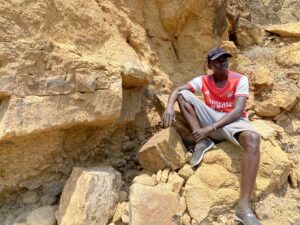
John Lonyala, sitting on the volcanic rock that was dated to 29 million years, is a second-generation Turkana fossil hunter at the Turkana Basin Institute (TBI). TBI was founded by Richard and Maeve Leakey to support research near Lake Turkana.
Ongoing research will tell us if places like Topernawi were a refuge for our ancestors, insulating them from the climatic upheaval that lead to the extinction of primates on the northern continents. Ongoing research is also probing how the fragmentary primate fossils the team has unearthed connect to the larger primate family tree. Have we found ancient apes? Are there lemur relatives hidden among the hyraxes that could help us date the primate colonization of Madagascar?
We have years of research ahead of us at Topernawi. More fossils to find. More researchers to collaborate with. More sites to discover. If I had known there were places like Topernawi out there when I was surrounded by my fossil fact books, I would have imagined a career in science much earlier than I did. Now, I hope this discovery shows aspiring paleontologists, biologists, and geologists that there are still mysteries to solve.
Science isn’t finished.
And we need your help.
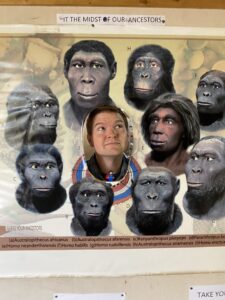
Matt at the Nairobi National Museum, surrounded by some of his extended family. Turkana is most famous for preserving hominin fossils, artifacts, and footprints. The Topernawi primates were ancient history to our oldest bipedal ancestors.
Did you know?
The DLC Museum of Natural History houses the largest and most diverse collection of fossil primates in North America—and you can come and meet your distant kin! Visit our website to schedule a visit, contact us for a virtual tour, or keep an eye out for weekend open house events.
Learn more at lemur.duke.edu/fossils.