
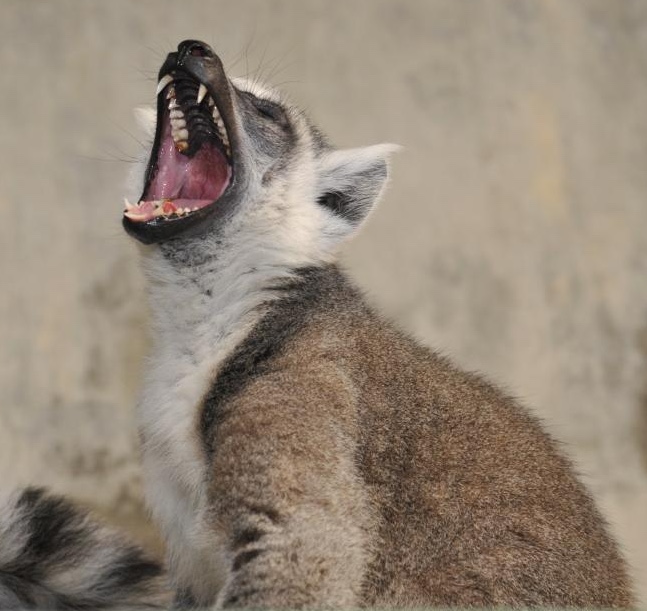
First record of an adult female ring-tailed lemur (Lemur catta) making a male-specific howl vocalization
Tellus, a female ring-tailed lemur at the Duke Lemur Center, is the star of this newly-published research! Photo by David Haring.
New research published on July 14 in Primates (2026) features data collected here at the Duke Lemur Center!
Dr. Lisa Paciulli and her team discovered that female ring-tailed lemur Tellus, who lived at the DLC with companion Licinius, produced a previously-believed male-specific howl vocalization. While collecting data for another study, Dr. Paciulli’s team opportunistically captured video and audio of Tellus howling.
The team examined body posture and acoustic structure of the call by analyzing spectrograms of the female’s calls and compared these features to male howls. Body posture comparison revealed similarities in the female’s position and orientation of the body to males when howling. A linear discriminant function analysis (DFA) failed to distinguish the female’s calls from male howls.
Given how rarely female ring-tailed howling has been observed in the wild and that it has never previously been recorded, these data provide an important contribution. The last comprehensive survey of the ring-tailed lemur vocal repertoire was more than 30 years ago by Macedonia (1993). Given the results of this study, the researchers suggest that ring-tailed lemur vocalizations need to be revisited to better account for sex-specific vocal patterns and contexts, both in human care and in the wild.
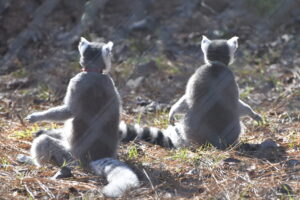
Ring-tailed lemurs Tellus and Licinius sun themselves in their forest enclosure. Photo by David Haring.
Paciulli, L.M., Verdolin, J.L., Guajardo, D.G. et al. First record of an adult female ring-tailed lemur (Lemur catta) making a male-specific howl vocalization. Primates (2026). https://doi.org/10.1007/s10329-026-01270-3