By Marie Claire Chelini and Owen Covington, Trinity Communications, with additional reporting by Robin Smith, Ph.D. Posted June 11, 2026.
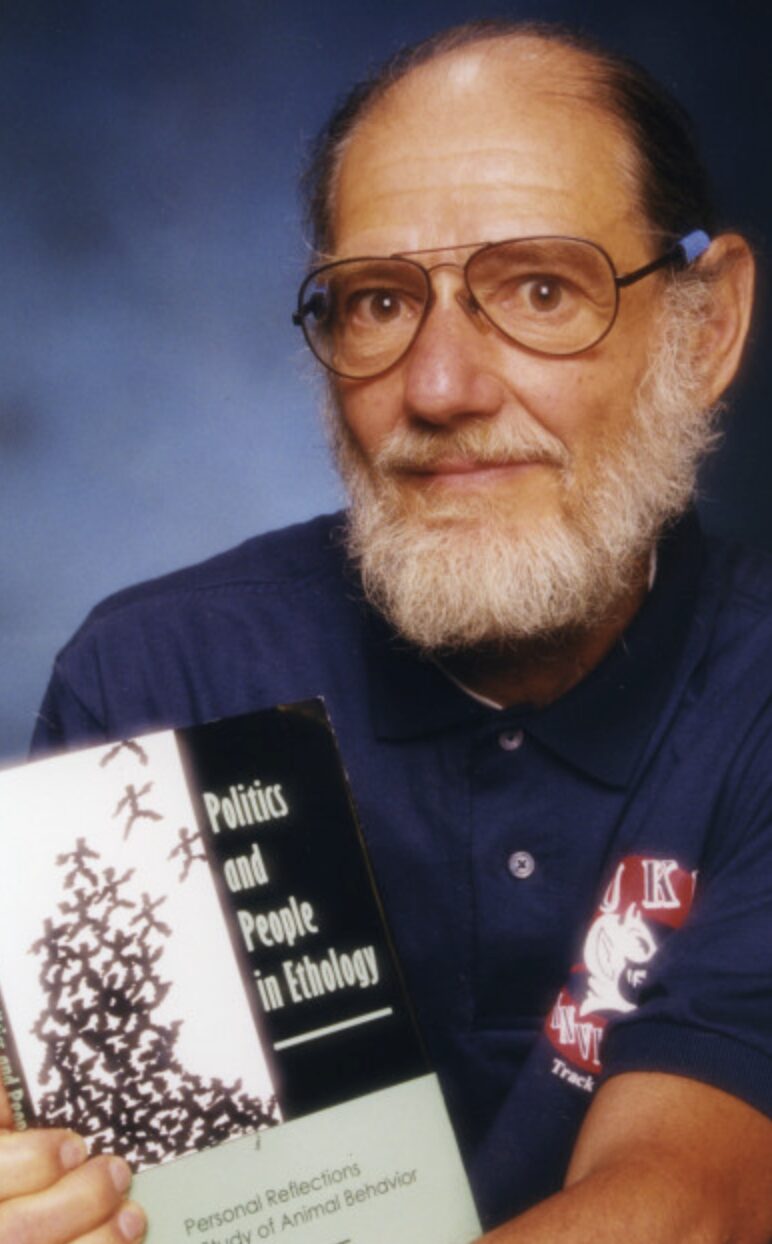
Peter Klopfer, pictured here with his 1999 memoir, helped develop the field of behavioral ecology. Photo courtesy of Duke University Communications and Marketing.
Peter Klopfer, professor emeritus of Biology, civil rights activist and co-founder of the Duke Lemur Center, died on June 5 at the age of 95. He is survived by his wife, Martha, and their three daughters.
Peter helped develop the field of behavioral ecology—the study of animal behavior and its evolution—and made seminal contributions to our understanding of mother-offspring bonding. His research helped elucidate the now well-known role played by the hormone oxytocin in mediating affective bonds.
He later developed a passion for dwarf lemurs’ ability to hibernate, and led a multidisciplinary team including sleep specialists, geneticists, field ecologists, and physiologists, all focused on the causes and consequences of lemur hibernation.
Anne Yoder, Braxton Craven Distinguished Professor of Evolutionary Biology and former director of the Duke Lemur Center, describes Klopfer as a visionary. “The brilliance of Peter’s mind was exceeded only by the warmth and generosity of his heart.”
His impact extended well beyond research. Shocked by the segregationist policies still in place when they arrived in North Carolina in the late 1950s, the Klopfers co-founded one of the first integrated schools of the South, the Carolina Friends School.
His civil rights activism also led to the U.S. Supreme Court ruling that the Sixth Amendment right to a speedy trial applies to state courts as well as federal courts, a victory that impacted thousands of cases around the country. In 2009, Klopfer was awarded Duke’s Samuel DuBois Cook Award in honor of his civil activism.
“What I respected most about Peter was that he lived his values,” said Gregory Dye, executive director of the Duke Lemur Center. “He stood up for what he believed was right, even when the consequences were potentially severe. He looked out for others, mentored students and junior colleagues, and provided guidance when I was first appointed the Lemur Center’s executive director.”
Peter’s full obituary can be found on the Trinity College of Arts and Sciences website.
In the video below, Peter recalls the founding of the Duke Lemur Center in 1966.