From Durham to Madagascar and Back Again: Conservationist and Curator Andrea Katz Retires After 43 Years
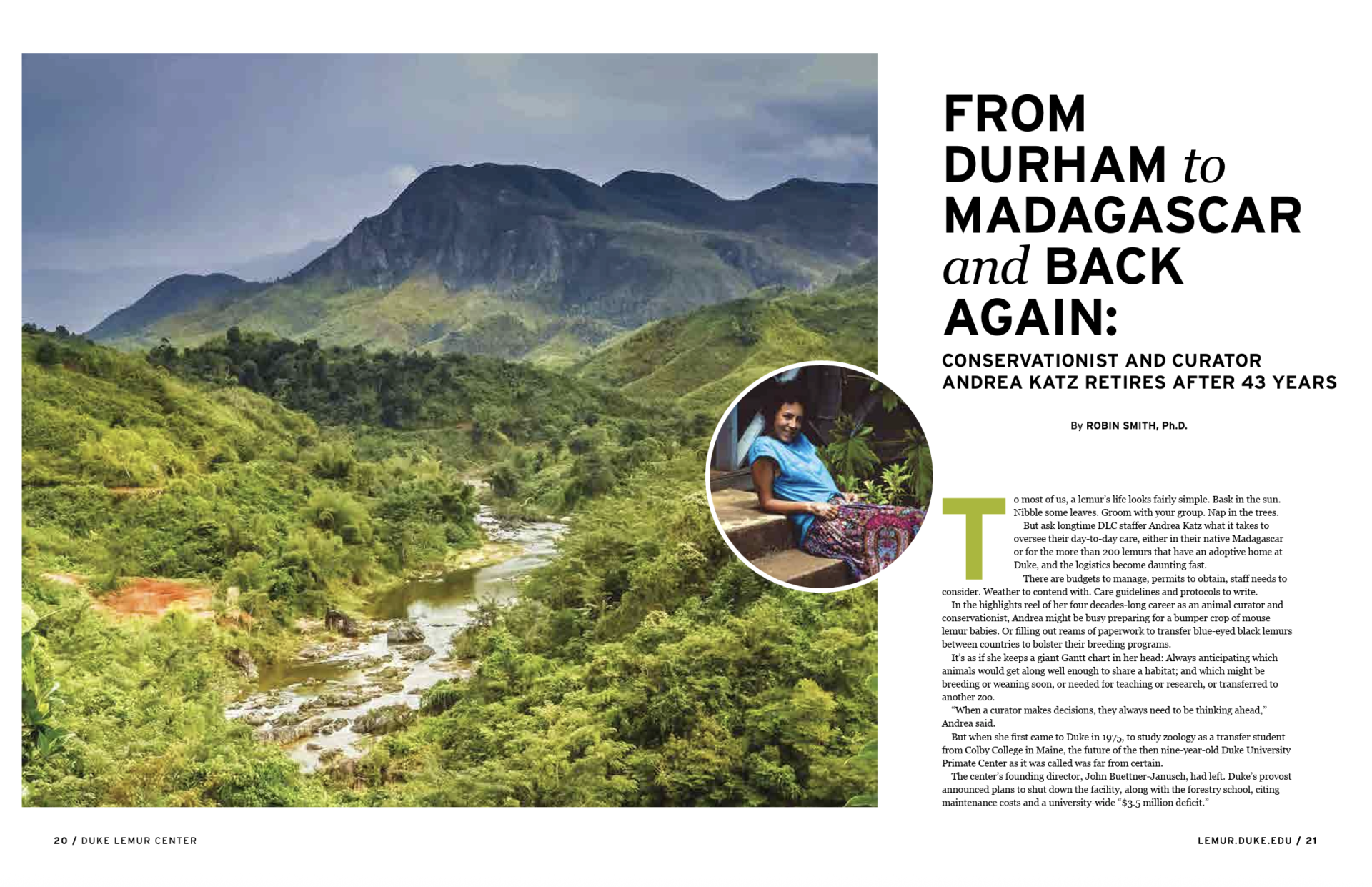
Click the image for a larger view.
By Robin Smith, Ph.D., Senior Science Writer, Duke University. Published January 2022 in the DLC Annual Magazine.
To most of us, a lemur’s life looks fairly simple. Bask in the sun. Nibble some leaves. Groom with your group. Nap in the trees.
But ask longtime DLC staffer Andrea Katz what it takes to oversee their day-to-day care, either in their native Madagascar or for the more than 200 lemurs that have an adoptive home at Duke, and the logistics become daunting fast.
There are budgets to manage, permits to obtain, staff needs to consider. Weather to contend with. Care guidelines and protocols to write.
In the highlights reel of her four decades-long career as an animal curator and conservationist, Andrea might be busy preparing for a bumper crop of mouse lemur babies. Or filling out reams of paperwork to transfer blue-eyed black lemurs between countries to bolster their breeding programs.
It’s as if she keeps a giant Gantt chart in her head: Always anticipating which animals would get along well enough to share a habitat; and which might be breeding or weaning soon, or needed for teaching or research, or transferred to another zoo.
“When a curator makes decisions, they always need to be thinking ahead,” Andrea said.
But when she first came to Duke in 1975, to study zoology as a transfer student from Colby College in Maine, the future of the then nine-year-old Duke University Primate Center as it was called was far from certain.
The center’s founding director, John Buettner-Janusch, had left. Duke’s provost announced plans to shut down the facility, along with the forestry school, citing maintenance costs and a university-wide “$3.5 million deficit.”
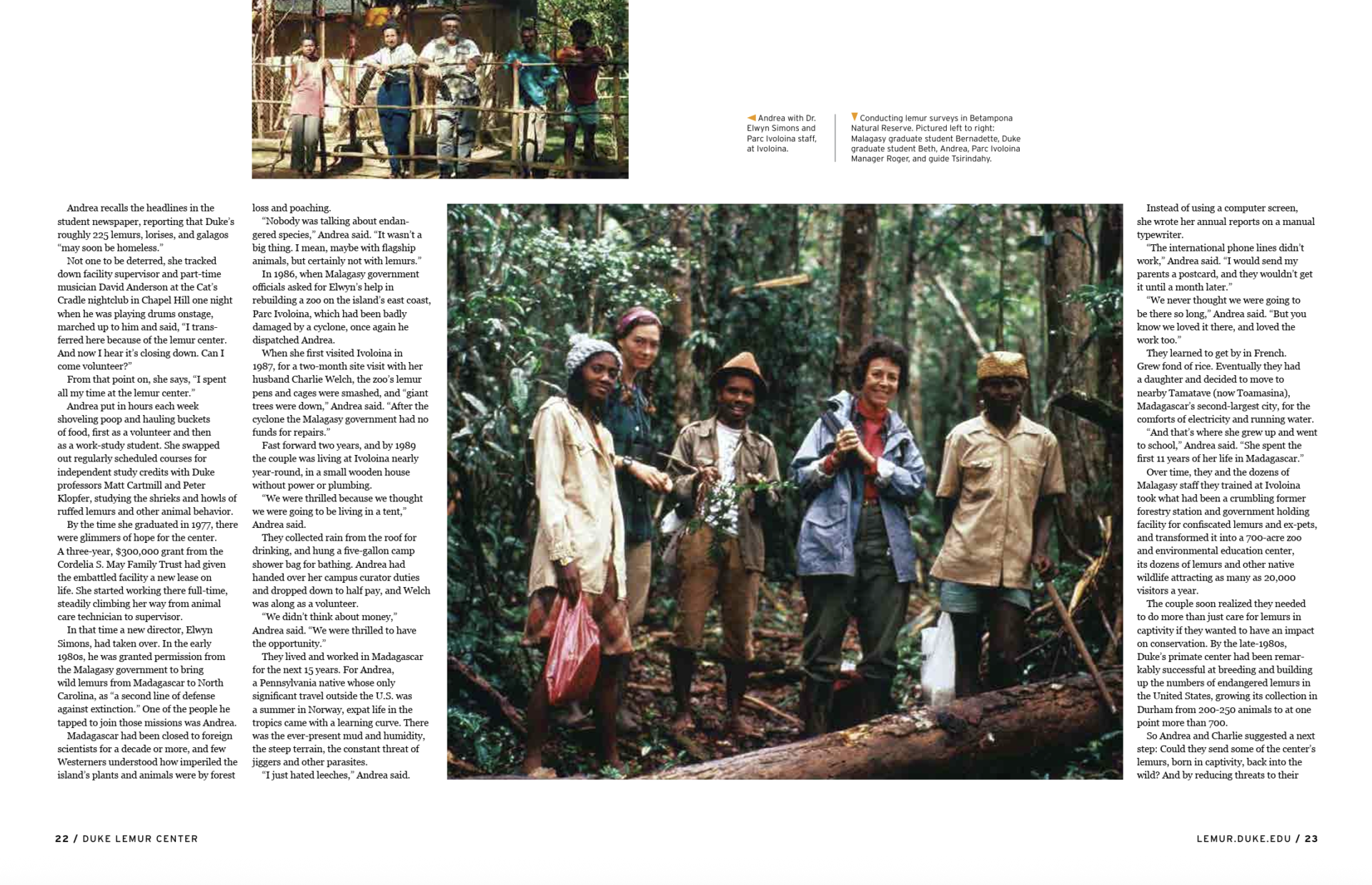
Top: Andrea with Dr. Elwyn Simons and Parc Ivoloina staff, at Ivolina. Bottom: Conducting lemur surveys in Betampona Natural Reserve. Pictured left to right: Malagasy graduate student Bernadette, Duke graduate student Beth, Andrea, Parc Ivoloina Manager Roger, and guide Tsirindahy. Click the image for a larger view.
Andrea recalls the headlines in the student newspaper, reporting that Duke’s roughly 225 lemurs, lorises, and galagos “may soon be homeless.”
Not one to be deterred, she tracked down facility supervisor and part-time musician David Anderson at the Cat’s Cradle nightclub in Chapel Hill one night when he was playing drums onstage, marched up to him and said, “I transferred here because of the lemur center. And now I hear it’s closing down. Can I come volunteer?”
From that point on, she says, “I spent all my time at the lemur center.”
Andrea put in hours each week shoveling poop and hauling buckets of food, first as a volunteer and then as a work-study student. She swapped out regularly scheduled courses for independent study credits with Duke professors Matt Cartmill and Peter Klopfer, studying the shrieks and howls of ruffed lemurs and other animal behavior.
By the time she graduated in 1977, there were glimmers of hope for the center. A three-year, $300,000 grant from the Cordelia S. May Family Trust had given the embattled facility a new lease on life. She started working there full-time, steadily climbing her way from animal care technician to supervisor.
In that time a new director, Elwyn Simons, had taken over. In the early 1980s, he was granted permission from the Malagasy government to bring wild lemurs from Madagascar to North Carolina, as “a second line of defense against extinction.” One of the people he tapped to join those missions was Andrea.
Madagascar had been closed to foreign scientists for a decade or more, and few Westerners understood how imperiled the island’s plants and animals were by forest loss and poaching.
“Nobody was talking about endangered species,” Andrea said. “It wasn’t a big thing. I mean, maybe with flagship animals, but certainly not with lemurs.”
In 1986, when Malagasy government officials asked for Elwyn’s help in rebuilding a zoo on the island’s east coast, Parc Ivoloina, which had been badly damaged by a cyclone, once again he dispatched Andrea.
When she first visited Ivoloina in 1987, for a two-month site visit with her husband Charlie Welch, the zoo’s lemur pens and cages were smashed, and “giant trees were down,” Andrea said. “After the cyclone the Malagasy government had no funds for repairs.”
(Charlie Welch retired from the DLC in 2025 after 35 years in lemur conservation.)
Fast forward two years, and by 1989 the couple was living at Ivoloina nearly year-round, in a small wooden house without power or plumbing.
“We were thrilled because we thought we were going to be living in a tent,” Andrea said.
They collected rain from the roof for drinking, and hung a five-gallon camp shower bag for bathing. Andrea had handed over her campus curator duties and dropped down to half pay, and Welch was along as a volunteer.
“We didn’t think about money,” Andrea said. “We were thrilled to have the opportunity.”
They lived and worked in Madagascar for the next 15 years. For Andrea, a Pennsylvania native whose only significant travel outside the U.S. was a summer in Norway, expat life in the tropics came with a learning curve. There was the ever-present mud and humidity, the steep terrain, the constant threat of jiggers and other parasites.
“I just hated leeches,” Andrea said.
Instead of using a computer screen, she wrote her annual reports on a manual typewriter.
“The international phone lines didn’t work,” Andrea said. “I would send my parents a postcard, and they wouldn’t get it until a month later.”
“We never thought we were going to be there so long,” Andrea said. “But you know we loved it there, and loved the work too.”
They learned to get by in French. Grew fond of rice. Eventually they had a daughter and decided to move to nearby Tamatave (now Toamasina), Madagascar’s second-largest city, for the comforts of electricity and running water.
“And that’s where she grew up and went to school,” Andrea said. “She spent the first 11 years of her life in Madagascar.”
Over time, they and the dozens of Malagasy staff they trained at Ivoloina took what had been a crumbling former forestry station and government holding facility for confiscated lemurs and ex-pets, and transformed it into a 700-acre zoo and environmental education center, its dozens of lemurs and other native wildlife attracting as many as 20,000 visitors a year.
The couple soon realized they needed to do more than just care for lemurs in captivity if they wanted to have an impact on conservation. By the late-1980s, Duke’s primate center had been remarkably successful at breeding and building up the numbers of endangered lemurs in the United States, growing its collection in Durham from 200-250 animals to at one point more than 700.
So Andrea and Charlie suggested a next step: Could they send some of the center’s lemurs, born in captivity, back into the wild? And by reducing threats to their survival in their native habitat, protect other species at the same time?
It was a risky experiment. Similar programs had partially restored wild populations of other species on the verge of extinction, such as the bald eagle, Plains bison and the Galapagos tortoise, but success with primates was elusive.
Would the transplants have the skills to fend for themselves in unfamiliar surroundings? They would need to learn how to find food, avoid danger, and infuse some new genes into the local population to bring it back from the brink.
For a site Andrea and Charlie proposed a 5,500-acre patch of lowland rainforest 25 miles from Parc Ivoloina called Betampona Reserve. Their initial surveys in 1991 and 1992 revealed that there were only 30 to 35 ruffed lemurs left in the area, a number so small that a single storm or bout of disease could wipe them out.
After seven years of research and planning, a total of 13 captive-bred black and white ruffed lemurs were released into Betampona Reserve between 1997 and 2001 as part of a first-of-its-kind reintroduction program coordinated by the DLC and the Madagascar Fauna and Flora Group.
Andrea remembers the awe she felt when the first group to be released, three males and two females nicknamed the “Carolina Five,” finally made it to Madagascar after months of “lemur boot camp” training in Duke Forest, extensive medical exams, and 72 hours of travel.
“I’ll never forget seeing the Duke animals arrive at our house in Tamatave in their kennels,” Andrea said.

Charlie (left) and Andrea (right) first proposed the reintroduction program in 1992. They had found just 35 black and white ruffed lemurs in an area of Madagascar that could support far more. The forest of the reserve was relatively undisturbed, but for long-term survival a population needs at least 50 adults to prevent inbreeding and to maintain genetic diversity.
The releases were not without problems. In the first five years of the program, one reintroduced lemur disappeared from the reserve, one died from malnutrition, and five others fell prey to a fossa, a cousin of the mongoose about the size of a bobcat.
A decade after the initial release, three of the 13 captive-bred lemurs were still alive, and four had reproduced with wild mates. But what she’s most proud of, she says, is that as a result of the introductions, Betampona Reserve was saved from destruction.
(Read more: “Into the Wild: Surviving Pioneer Lemurs Celebrate a Decade in the Rainforest,” by Karl Bates, 2007.)
“It has been continuously managed and protected by the Madagascar Fauna and Flora Group and Madagascar National Parks and is one of [the country’s] most important conservation research sites,” Andrea said.
Eventually, years of splitting their lives between two countries some 9,000 miles apart began to take its toll. Madagascar’s simmering political crises had begun to heat up again after the disputed 2001 presidential elections. By that point, operations at Parc Ivoloina and Betampona Reserve were running well and in good local hands. They had been considering a return to the U.S. for their daughter’s education, so in 2004 they reluctantly decided to head home.
In recognition of their work, Andrea and Charlie were “knighted” by the Malagasy government that summer. Andrea remembers the thrill of sitting in the stands as guests of honor during Madagascar’s Independence Day celebrations—watching the parades of fire trucks and school groups march by, and getting their medals pinned on by the president of the province.
Not long after the couple’s return to North Carolina, the Duke Lemur Center’s then-incoming director Anne Yoder persuaded Andrea to reprise her role as curator. Andrea managed the Duke colony from 2006 to 2018, before finally shifting her focus back to conservation partnerships with Madagascar.
She has another return trip to Madagascar planned. This time it’s to deliver hard copies of a 76-page lemur care manual she developed, in French and with Malagasy collaborators, setting national standards for Madagascar’s 14 zoos and animal parks, but the trip has been on hold due to the pandemic.
In the meantime, Andrea says she doesn’t want any fuss or fanfare for her retirement.
“Let’s just get Miller Lite and Enzo’s pizza and I’ll be happy.”
The Charlie Welch and Andrea Katz Fund
The Duke Lemur Center has created an endowment fund to commemorate the retirements of Charlie Welch and Andrea Katz, and we invite you to donate in honor of their tremendous impact on the protection of the flora and fauna of Madagascar. Thank you so much for your support!
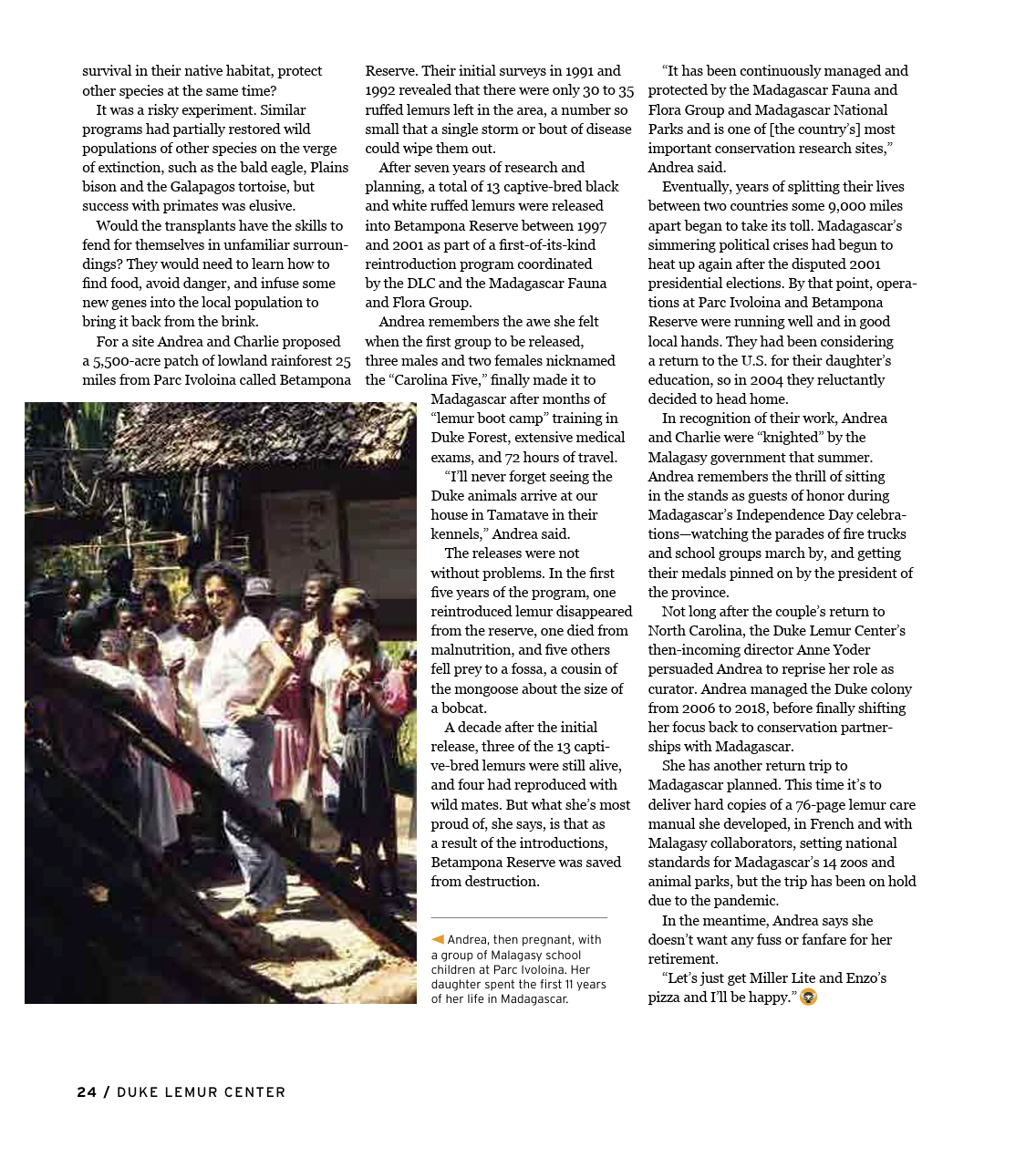
Andrea, then pregnant, with a group of Malagasy school children at Parc Ivoloina. Her daughter spent the first 11 years of her life in Madagascar. Click the image for a larger view.