After planting thousands of trees and helping thousands of people while overseeing the Lemur Center’s conservation programs in Madagascar for 35 years, Charlie is retiring in 2025.
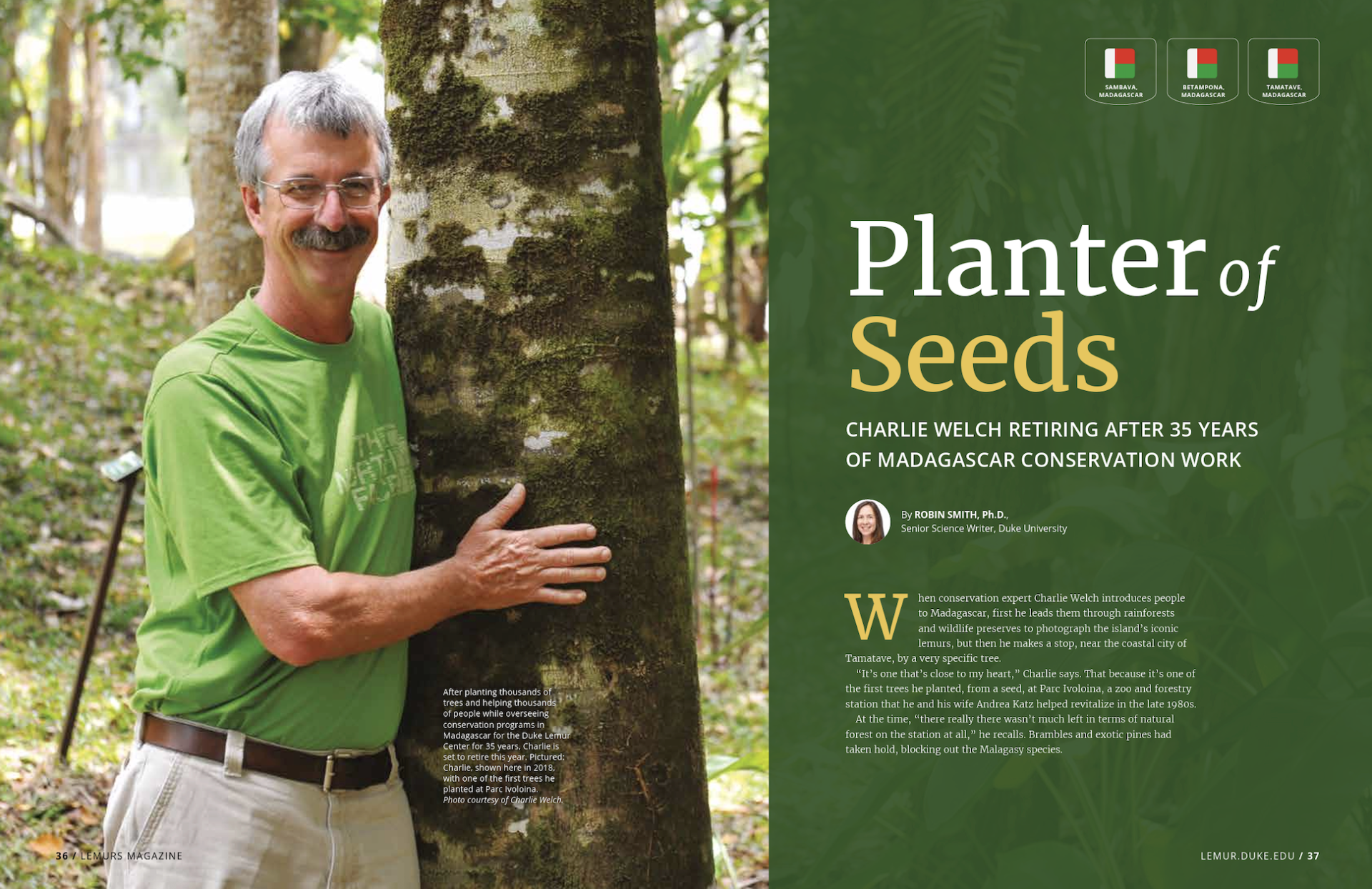
Charlie, shown here in 2018, with one of the first trees he planted at Parc Ivoloina. Click the image for a larger view.
By Robin Smith, Ph.D., Senior Science Writer, Duke University. Published February 2025 in the LEMURS Magazine: The “Where” Issue.
When conservation expert Charlie Welch introduces people to Madagascar, first he leads them through rainforests and wildlife preserves to photograph the island’s iconic lemurs, but then he makes a stop, near the coastal city of Tamatave, by a very specific tree.
“It’s one that’s close to my heart,” Charlie says. That because it’s one of the first trees he planted, from a seed, at Parc Ivoloina, a zoo and forestry station that he and his wife and conservation partner Andrea Katz helped revitalize in the late 1980s.
(Andrea retired from the DLC in 2022 after 43 years of lemur care and conservation.)
At the time, “there really there wasn’t much left in terms of natural forest on the station at all,” he recalls. Brambles and exotic pines had taken hold, blocking out the Malagasy species.
Now some 40 feet tall, the tree—known locally as hafopotsy—is one of tens of thousands of native species he and others have planted over the years on the 700-acre station.
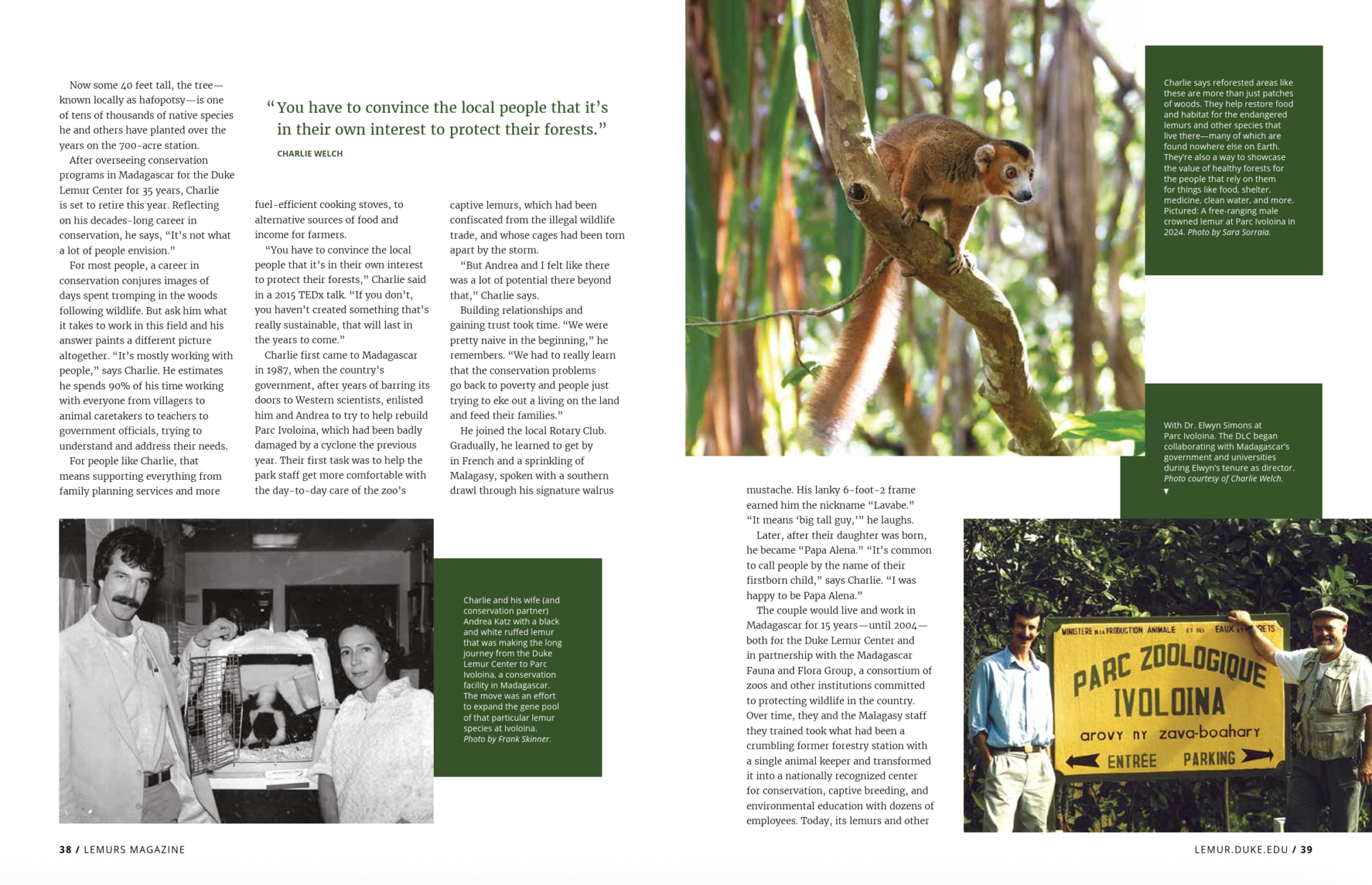
Left: Charlie and his wife (and conservation partner) Andrea Katz with a black and white ruffed lemur that was making the long journey from the Duke Lemur Center to Parc Ivoloina, a conservation facility in Madagascar. The move was an effort to expand the gene pool of that particular lemur species at Ivoloina. Top right: Charlie says reforested areas like these are more than just patches of woods. They help restore food and habitat for the endangered lemurs and other species that live there—many of which are found nowhere else on Earth. They’re also a way to showcase the value of healthy forests for the people that rely on them for things like food, shelter, medicine, clean water, and more. Pictured: A free-ranging male crowned lemur at Parc Ivoloina in 2024. Bottom right: With Dr. Elwyn Simons at Parc Ivoloina. The DLC began collaborating with Madagascar’s government and universities during Elwyn’s tenure as director. Click the image for a larger view.
After overseeing conservation programs in Madagascar for the Duke Lemur Center for 35 years, Charlie is set to retire this year. Reflecting on his decades-long career in conservation, he says, “It’s not what a lot of people envision.”
For most people, a career in conservation conjures images of days spent tromping in the woods following wildlife. But ask him what it takes to work in this field and his answer paints a different picture altogether. “It’s mostly working with people,” says Charlie. He estimates he spends 90% of his time working with everyone from villagers to animal caretakers to teachers to government officials, trying to understand and address their needs.
For people like Charlie, that means supporting everything from family planning services and more fuel-efficient cooking stoves, to alternative sources of food and income for farmers.
“You have to convince the local people that it’s in their own interest to protect their forests,” Charlie said in a 2015 TEDx talk. “If you don’t, you haven’t created something that’s really sustainable, that will last in the years to come.”
Charlie first came to Madagascar in 1987, when the country’s government, after years of barring its doors to Western scientists, enlisted him and Andrea to try to help rebuild Parc Ivoloina, which had been badly damaged by a cyclone the previous year. Their first task was to help the park staff get more comfortable with the day-to-day care of the zoo’s captive lemurs, which had been confiscated from the illegal wildlife trade, and whose cages had been torn apart by the storm.
“But Andrea and I felt like there was a lot of potential there beyond that,” Charlie says.
Building relationships and gaining trust took time. “We were pretty naive in the beginning,” he remembers. “We had to really learn that the conservation problems go back to poverty and people just trying to eke out a living on the land and feed their families.”
He joined the local Rotary Club. Gradually, he learned to get by in French and a sprinkling of Malagasy, spoken with a southern drawl through his signature walrus mustache. His lanky 6-foot-2 frame earned him the nickname “Lavabe.” “It means ‘big tall guy,’” he laughs.
Later, after their daughter was born, he became “Papa Alena.” “It’s common to call people by the name of their firstborn child,” says Charlie. “I was happy to be Papa Alena.”
The couple would live and work in Madagascar for 15 years—until 2004—both for the Duke Lemur Center and in partnership with the Madagascar Fauna and Flora Group, a consortium of zoos and other institutions committed to protecting wildlife in the country. Over time, they and the Malagasy staff they trained took what had been a crumbling former forestry station with a single animal keeper and transformed it into a nationally recognized center for conservation, captive breeding, and environmental education with dozens of employees. Today, its lemurs and other wildlife attract as many at 20,000 visitors a year.
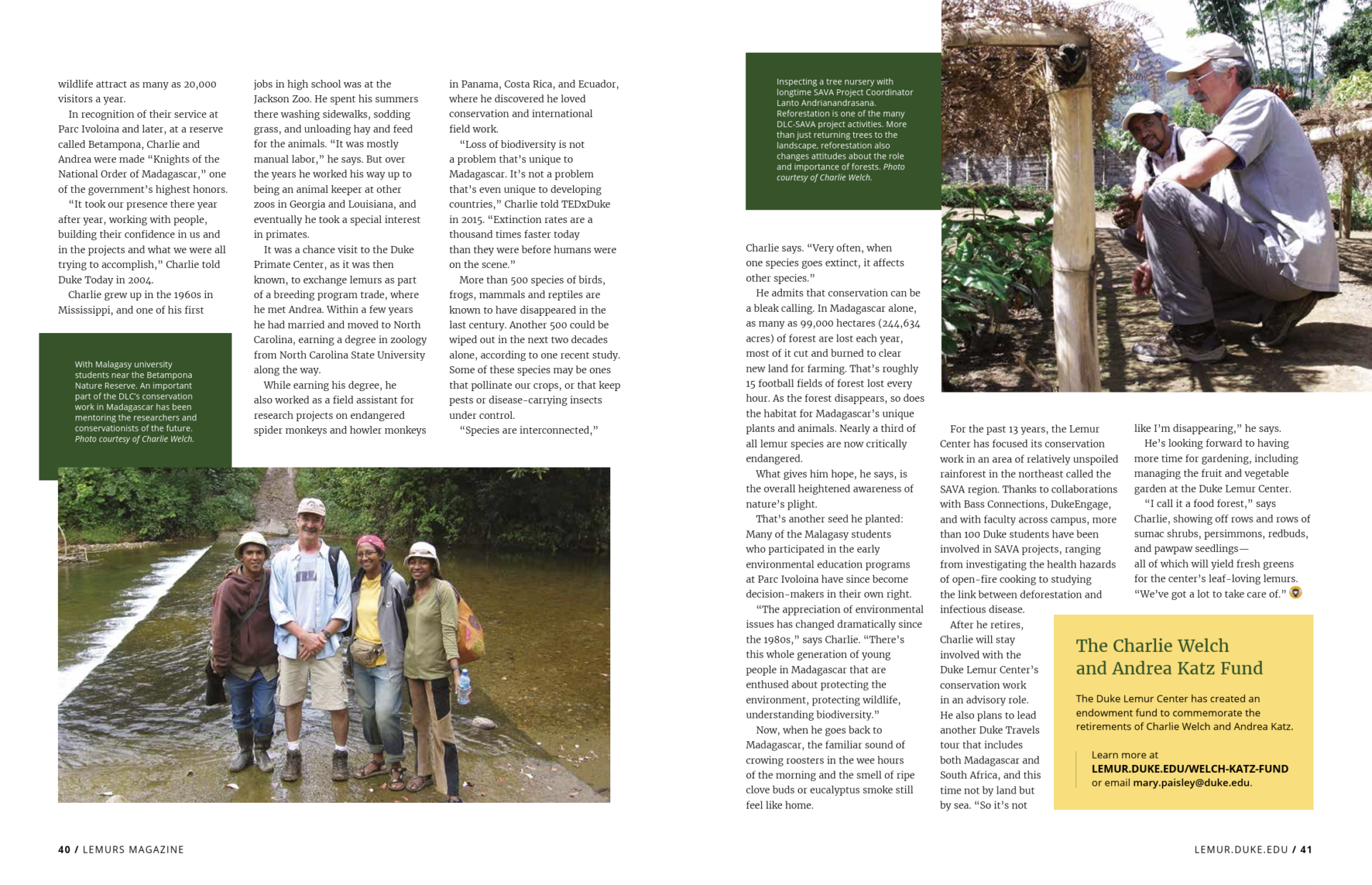
Left: With Malagasy university students near the Betampona Nature Reserve. An important part of the DLC’s conservation work in Madagascar has been mentoring the researchers and conservationists of the future. Right: Inspecting a tree nursery with longtime SAVA Project Coordinator Lanto Andrianandrasana. Reforestation is one of the many DLC-SAVA project activities. More than just returning trees to the landscape, reforestation also changes attitudes about the role and importance of forests. Click the image for a larger view.
In recognition of their service at Parc Ivoloina and later, at a reserve called Betampona, Charlie and Andrea were made “Knights of the National Order of Madagascar,” one of the government’s highest honors.
“It took our presence there year after year, working with people, building their confidence in us and in the projects and what we were all trying to accomplish,” Charlie told Duke Today in 2004.
Charlie grew up in the 1960s in Mississippi, and one of his first jobs in high school was at the Jackson Zoo. He spent his summers there washing sidewalks, sodding grass, and unloading hay and feed for the animals. “It was mostly manual labor,” he says. But over the years he worked his way up to being an animal keeper at other zoos in Georgia and Louisiana, and eventually he took a special interest in primates.
It was a chance visit to the Duke Primate Center, as it was then known, to exchange lemurs as part of a breeding program trade, where he met Andrea. Within a few years he had married and moved to North Carolina, earning a degree in zoology from North Carolina State University along the way.
While earning his degree, he also worked as a field assistant for research projects on endangered spider monkeys and howler monkeys in Panama, Costa Rica, and Ecuador, where he discovered he loved conservation and international field work.
“Loss of biodiversity is not a problem that’s unique to Madagascar. It’s not a problem that’s even unique to developing countries,” Charlie told TEDxDuke in 2015. “Extinction rates are a thousand times faster today than they were before humans were on the scene.”
More than 500 species of birds, frogs, mammals and reptiles are known to have disappeared in the last century. Another 500 could be wiped out in the next two decades alone, according to one recent study. Some of these species may be ones that pollinate our crops, or that keep pests or disease-carrying insects under control.
“Species are interconnected,” Charlie says. “Very often, when one species goes extinct, it affects other species.”
He admits that conservation can be a bleak calling. In Madagascar alone, as many as 99,000 hectares of forest are lost each year, most of it cut and burned to clear new land for farming. That’s roughly 15 football fields of forest lost every hour. As the forest disappears, so does the habitat for Madagascar’s unique plants and animals. Nearly a third of all lemur species are now critically endangered.
What gives him hope, he says, is the overall heightened awareness of nature’s plight.
That’s another seed he planted: Many of the Malagasy students who participated in the early environmental education programs at Parc Ivoloina have since become decision-makers in their own right.
“The appreciation of environmental issues has changed dramatically since the 1980s,” says Charlie. “There’s this whole generation of young people in Madagascar that are enthused about protecting the environment, protecting wildlife, understanding biodiversity.”
Now, when he goes back to Madagascar, the familiar sound of crowing roosters in the wee hours of the morning and the smell of ripe clove buds or eucalyptus smoke still feel like home.
For the past 13 years, the Lemur Center has focused its conservation work in an area of relatively unspoiled rainforest in the northeast called the SAVA region. Thanks to collaborations with Bass Connections, DukeEngage, and with faculty across campus, more than 100 Duke students have been involved in SAVA projects, ranging from investigating the health hazards of open-fire cooking to studying the link between deforestation and infectious disease.
After he retires, Charlie will stay involved with the Duke Lemur Center’s conservation work in an advisory role. He also plans to lead another Duke Travels tour that includes both Madagascar and South Africa, and this time not by land but by sea. “So it’s not like I’m disappearing,” he says.
He’s looking forward to having more time for gardening, including managing the fruit and vegetable garden at the Duke Lemur Center.
“I call it a food forest,” says Charlie, showing off rows and rows of sumac shrubs, persimmons, redbuds, and pawpaw seedlings—all of which will yield fresh greens for the center’s leaf-loving lemurs. “We’ve got a lot to take care of.”
The Charlie Welch and Andrea Katz Fund
The Duke Lemur Center has created an endowment fund to commemorate the retirements of Charlie Welch and Andrea Katz, and we invite you to donate in honor of their tremendous impact on the protection of the flora and fauna of Madagascar. Thank you so much for your support!