Coquerel’s Sifaka Conservation Breeding Program in Europe, Madagascar, and the USA
Click the image for a larger view.
By DLC staff. Originally published in February 2026 in LEMURS Magazine: Reasons for Hope.
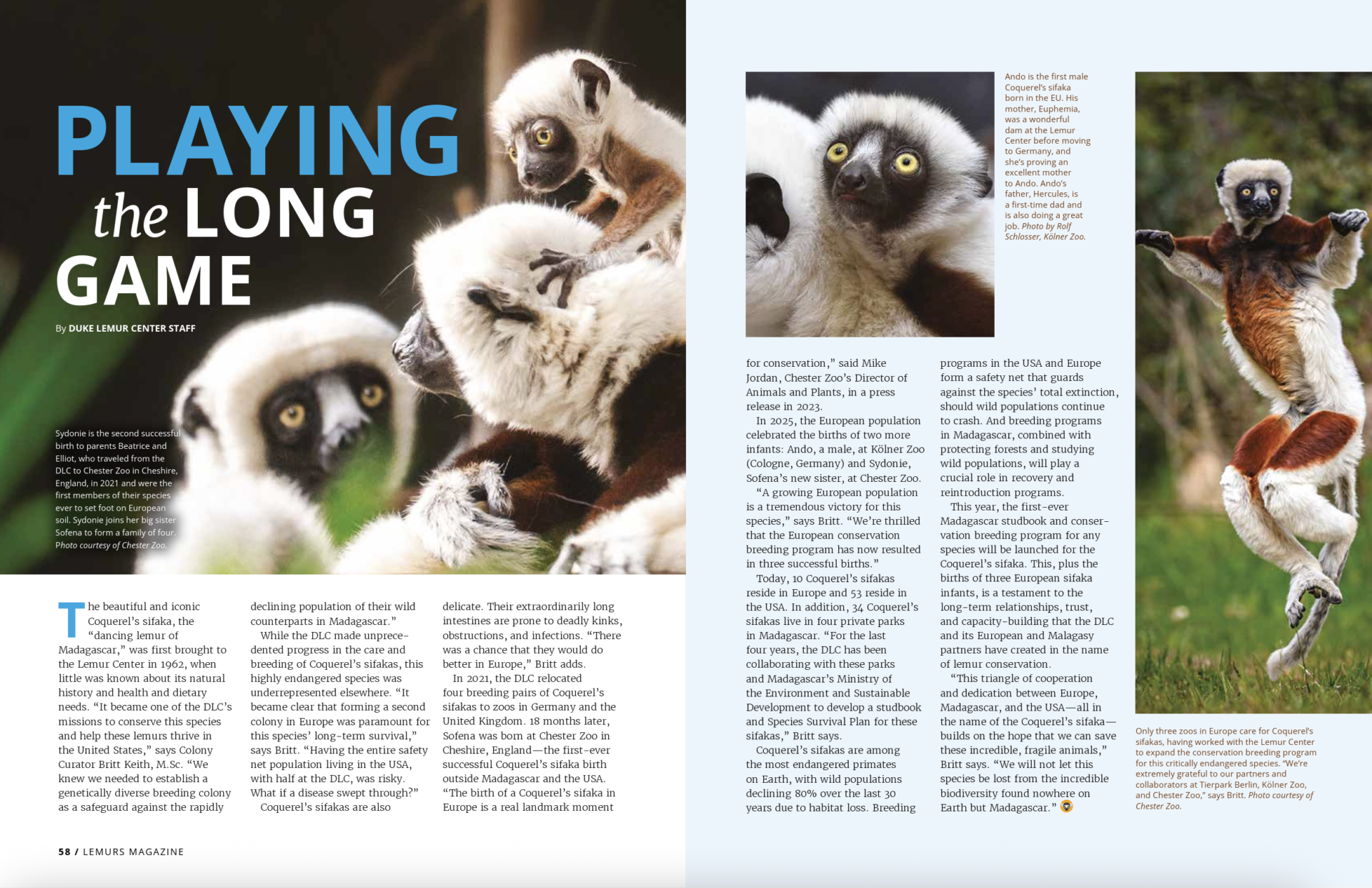
Captions:
Left: Sydonie is the second successful birth to parents Beatrice and Elliot, who traveled from the DLC to Chester Zoo in Cheshire, England, in 2021 and were the first members of their species ever to set foot on European soil. Sydonie joins her big sister Sofena to form a family of four. Photo courtesy of Chester Zoo.
Center: Ando is the first male Coquerel’s sifaka born in the EU. His mother, Euphemia, was a wonderful dam at the Lemur Center before moving to Germany, and she’s proving an excellent mother to Ando. Ando’s father, Hercules, is a first-time dad and is also doing a great job. Photo by Rolf Schlosser, Kölner Zoo.
Right: Only three zoos in Europe care for Coquerel’s sifakas, having worked with the Lemur Center to expand the conservation breeding program for this critically endangered species. “We’re extremely grateful to our partners and collaborators at Tierpark Berlin, Kölner Zoo, and Chester Zoo,” says Britt. Photo courtesy of Chester Zoo.
The beautiful and iconic Coquerel’s sifaka, the “dancing lemur of Madagascar,” was first brought to the Lemur Center in 1962, when little was known about its natural history and health and dietary needs. “It became one of the DLC’s missions to conserve this species and help these lemurs thrive in the United States,” says Colony Curator Britt Keith, M.Sc. “We knew we needed to establish a genetically diverse breeding colony as a safeguard against the rapidly declining population of their wild counterparts in Madagascar.”
While the DLC made unprecedented progress in the care and breeding of Coquerel’s sifakas, this highly endangered species was underrepresented elsewhere. “It became clear that forming a second colony in Europe was paramount for this species’ long-term survival,” says Britt. “Having the entire safety net population living in the USA, with half at the DLC, was risky. What if a disease swept through?”
Coquerel’s sifakas are also delicate. Their extraordinarily long intestines are prone to deadly kinks, obstructions, and infections. “There was a chance that they would do better in Europe,” Britt adds. “We needed to find out.”
In 2021, the DLC relocated four breeding pairs of Coquerel’s sifakas to zoos in Germany and the United Kingdom. 18 months later, Sofena was born at Chester Zoo in Cheshire, England—the first-ever successful Coquerel’s sifaka birth outside Madagascar and the USA. “The birth of a Coquerel’s sifaka in Europe is a real landmark moment for conservation,” said Mike Jordan, Chester Zoo’s Director of Animals and Plants, in a press release in 2023.
In 2025, the European population celebrated the births of two more infants: Ando, a male, at Kölner Zoo (Cologne, Germany) and Sydonie, Sofena’s new sister, at Chester Zoo.
“A growing European population is a tremendous victory for this species,” says Britt. “We’re thrilled that the European conservation breeding program has now resulted in three successful births.”
Today, 10 Coquerel’s sifakas reside in Europe and 53 reside in the USA. In addition, 34 Coquerel’s sifakas live in four private parks in Madagascar. “For the last four years, the DLC has been collaborating with these parks and Madagascar’s Ministry of the Environment and Sustainable Development to develop a studbook and Species Survival Plan for these sifakas,” Britt says.
Coquerel’s sifakas are among the most endangered primates on Earth, with wild populations declining 80% over the last 30 years due to habitat loss. Breeding programs in the USA and Europe form a safety net that guards against the species’ total extinction, should wild populations continue to crash. And breeding programs in Madagascar, combined with protecting forests and studying wild populations, will play a crucial role in recovery and reintroduction programs.
In September 2026, the first-ever Madagascar studbook and conservation breeding program for any species will be launched for the Coquerel’s sifaka. This, plus the births of three European sifaka infants, is a testament to the long-term relationships, trust, and capacity-building that the DLC and its European and Malagasy partners have created in the name of lemur conservation.
“This triangle of cooperation and dedication between Europe, Madagascar, and the USA—all in the name of the Coquerel’s sifaka—builds on the hope that we can save these incredible, fragile animals,” Britt says. “We will not let this species be lost from the incredible biodiversity found nowhere on Earth but Madagascar.”