
By James Herrera, Ph.D., DLC Director of Conservation. Posted June 26, 2026.
On the 26th of June in 1960, Madagascar officially gained its independence from its colonizer, France. The struggle for independence has a long history that continues to shape the country today. In 1896, France officially annexed Madagascar. Colonial rule imposed major political, economic, and social chains that bound the country. In 1947, a widespread uprising occurred that was brutally suppressed with significant loss of life. It wasn’t until 1958 that negotiations for autonomy began, and in 1960, Madagascar’s independence was declared.
Over the last 66 years, the people of Madagascar demonstrated their resilience and indefatigable spirit as they weathered political upheavals, economic depressions, and neocolonial forces in a globalizing economy. Through it all, and despite the world’s view that Madagascar is an impoverished nation, the country is rich in terms of culture, biodiversity, and natural resources [1]. Thousands of people from around the world visit Madagascar every year, and hundreds of millions of dollars in international aid are spent for sustainable development.
It is immediately evident from Madagascar’s rich culture that the country is characterized by diversity. On an island the size of Texas, more than 18 ethnic groups have their own cultural identity such as dialects, customs, and kingdoms.
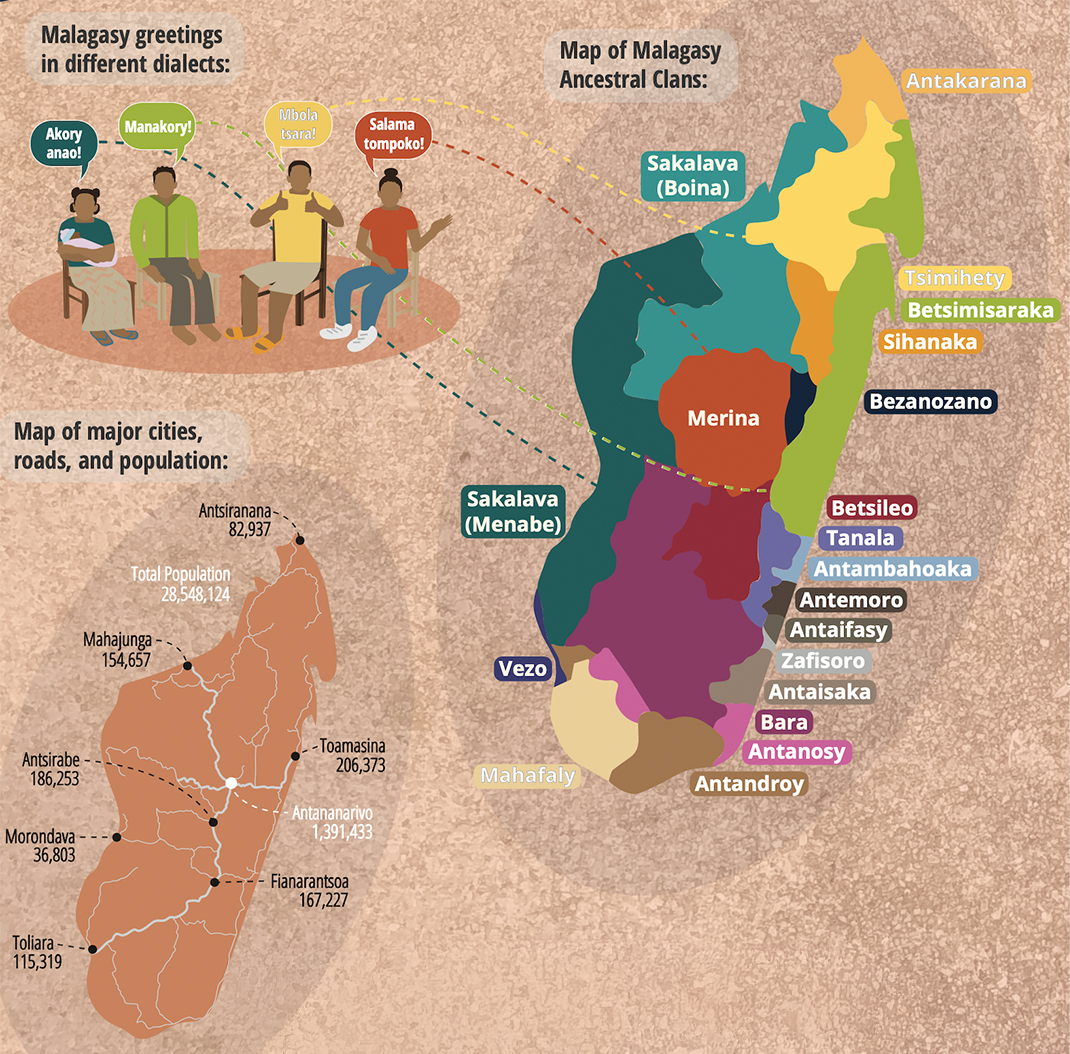
Illustration by Karie Whitman for the Duke Lemur Center.
The history of settlement likely started around 2,000 years ago when the first people of Madagascar, called Malagasy, likely arrived on the island from Austronesia (especially Borneo) and Africa. The language, also Malagasy, is anything but homogenous; a mixture of Indonesian and Bantu with hints of Arabic, fusing with French, each ethnic group has its own distinct dialect. The unique dress, hair styles, song and dance, and even hats signify their ethnic identities.

Traditional song and dance in southwestern Madagascar. Photo by James Herrera.
Traditionally, Malagasy religions revered the spirits of their ancestors who are a connection between the living and a single deity. Many natural spaces like lakes, waterfalls, and forests are sacred places where the spirits of the ancestors reside. Religious practices commemorating the ancestors include exhumation and benediction, usually associated with sacrificing zebu, hump-backed cattle from India and/or Africa.
Multiple autonomous kingdoms occupying distinct zones of the island existed until the late 18th century when the Merina kingdom began conquering parts of the island, especially in the mid-19th century with support from the British, who were vying for power over African colonies. The Merina leaders of the time sought political and trade alliances with European nations, but in 1885 Western powers carved up Africa at the Berlin Conference, and decided France would gain control of Madagascar. While the Malagasy fought against French colonization for three years, they were ultimately overcome and their reigning queen, Ranavalona III, was banished into exile to the neighboring island of La Reunion and later transferred to Algeria (both French territories), where she died. Overcoming these obstacles, Malagasy ethnic groups retained their cultural identities, and some maintain royal lineages and leaders to this day who uphold their unique traditional values.
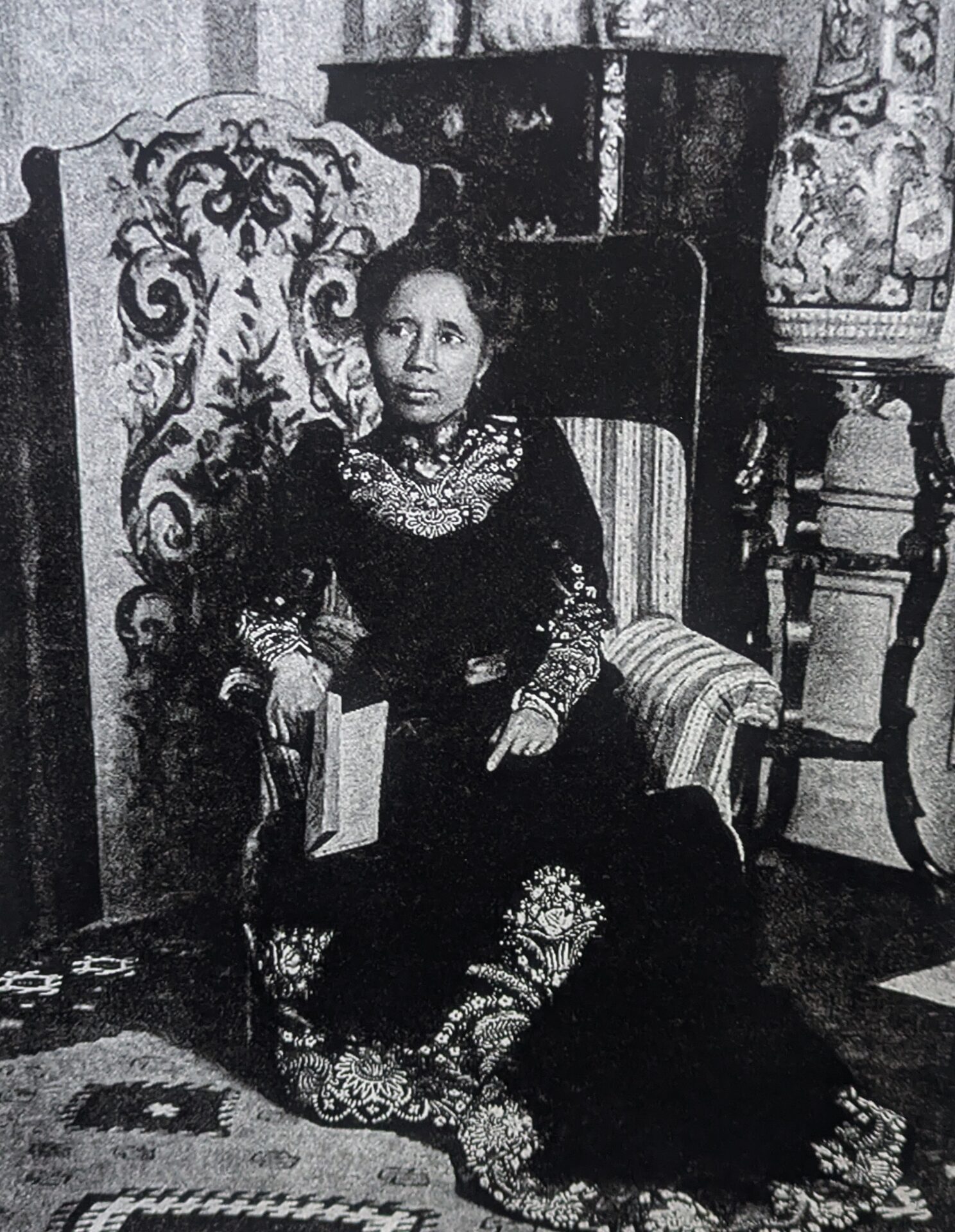
Queen Ranavalona III after she was exiled. Photo in the Madagascar Photography Museum.
Considering biological richness, Madagascar is home to at least 20,000 species (though likely many more to be described), 80-90% of which are found nowhere else on earth. Most famous for its lemurs, the endemic primates, Madagascar also has most of the world’s chameleons and almost 800 species of reptiles and amphibians total, almost 300 bird species, and at least 14,000 species of plants. Insect diversity highlights the vast species richness, with more than 1,000 species of ants alone. People from around the globe visit Madagascar every year to see these world-renowned species.
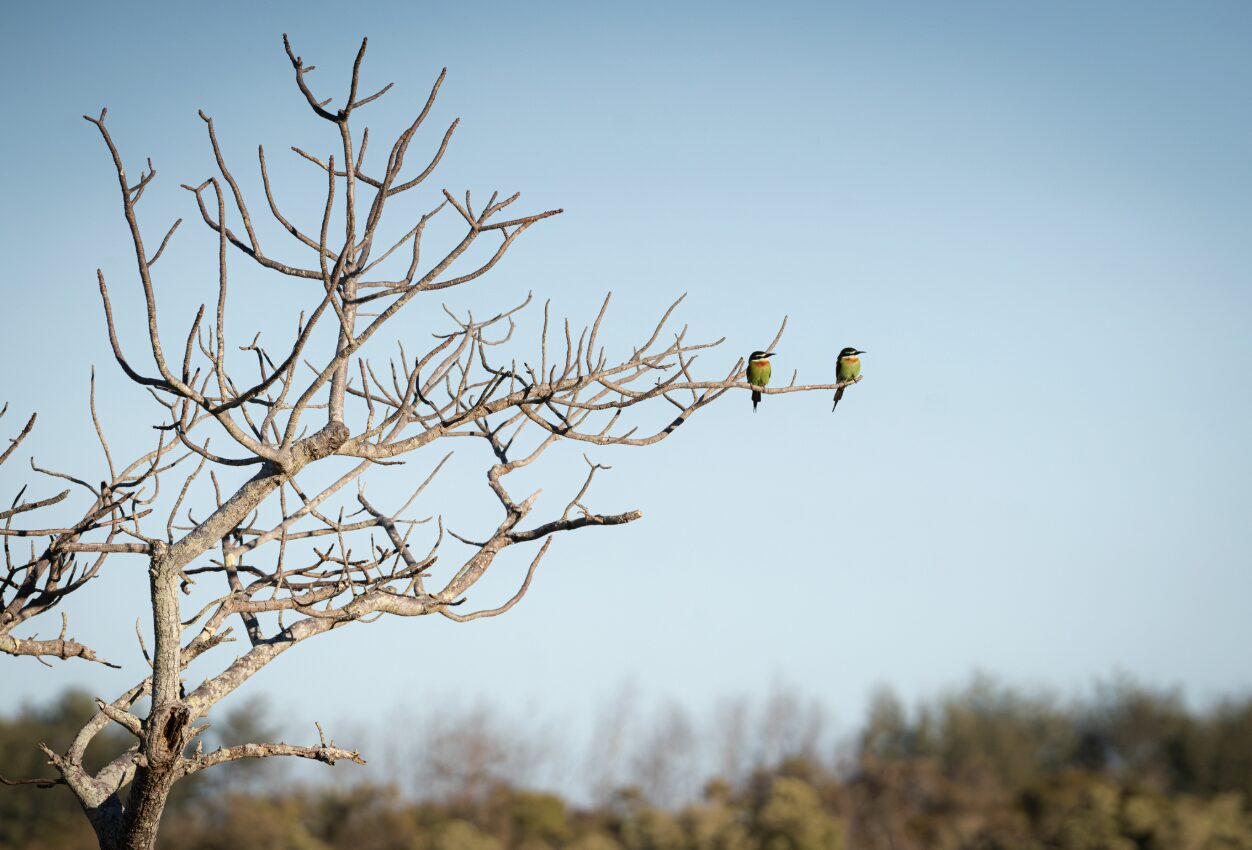
Madagascar is home to more than 300 species of birds, including the Madagascar bee-eater. Photo by Sara Sorraia.
One reason the biodiversity of Madagascar is so high is because there are so many habitat types: rainforests festoon the mountains of the east, dry deciduous forests with towering baobabs stud the savannahs of the west, spiny thickets are sprinkled throughout the unique deserts of the south, and a vast grassland covers the central high plateau.

Madagascar’s sheer size, plus its varied topography and four regional climates, creates such a vast array of habitats for animals and plants that Madagascar is often called the “Eighth Continent.” Illustration by Talia Felgenhauer for the Duke Lemur Center.
Geologically, Madagascar is ancient; unlike volcanic islands such as Hawaii that emerged from the sea relatively recently, Madagascar was part of the supercontinent Gondwana over 200 million years ago. Previously sandwiched between Africa and India, Madagascar became an independent land mass more than 80 million years ago. Since the mass extinction event that wiped out the diverse dinosaurs which once roamed Madagascar, most of the species on the island today arrived via dispersal from elsewhere. With so much time in isolation, the flora and fauna diversified into the rich menagerie we see today.
The ancient island, often referred to as the “Eighth Continent,” is rich in natural resources. Gold, silver, and semi-precious gemstones are only the tip of the iceberg; nickel, graphite, cobalt, and chromium make up an enormous mineral wealth. These resources play a significant role in Madagascar’s export economy, while significant efforts are needed to ensure that their benefits are more broadly shared. During the colonial period, the French opened logging concessions to extract timber like rosewood, palisander, and ebony for export, converted forests to export crops like vanilla, and sourced raw materials for the new railroad system. The riches of Madagascar continue to make foreign nations wealthy.
On this 66th anniversary of Madagascar’s independence, I wish to highlight the many ways in which this island nation has weathered countless storms and continues to be a source of patriotism for the 30+ million inhabitants, the Malagasy people. Despite all the challenges, Madagascar has many sources of pride, and the brave people are entering a new era in their political history. I hope that all our Duke Lemur Center supporters will join me in wishing Madagascar a happy Independence Day and well wishes for a courageous future!
[1] For supporting sources, see these links:
https://www.science.org/doi/full/10.1126/science.abf0869
https://www.pnas.org/doi/abs/10.1073/pnas.1704906114
https://data.worldbank.org/country/madagascar
https://eiti.org/countries/madagascar
https://www.africanhistoryextra.com/p/a-complete-history-of-madagascar
https://www.unicef.org/madagascar/en/stories/lets-celebrate-diversity