
By Dr. James Herrera, DLC Director of Conservation.
It is with great joy that we share the news: Nestorine has successfully completed her Ph.D.! Nestorine has been a collaborator with DLC since 2019, and starting in 2021, she has been a Ph.D. scholar studying nutrition and solutions to malnutrition in the SAVA region of Madagascar. Today, 22 May 2026, she gave a tremendous presentation that received an unanimous conclusion: Excellent!

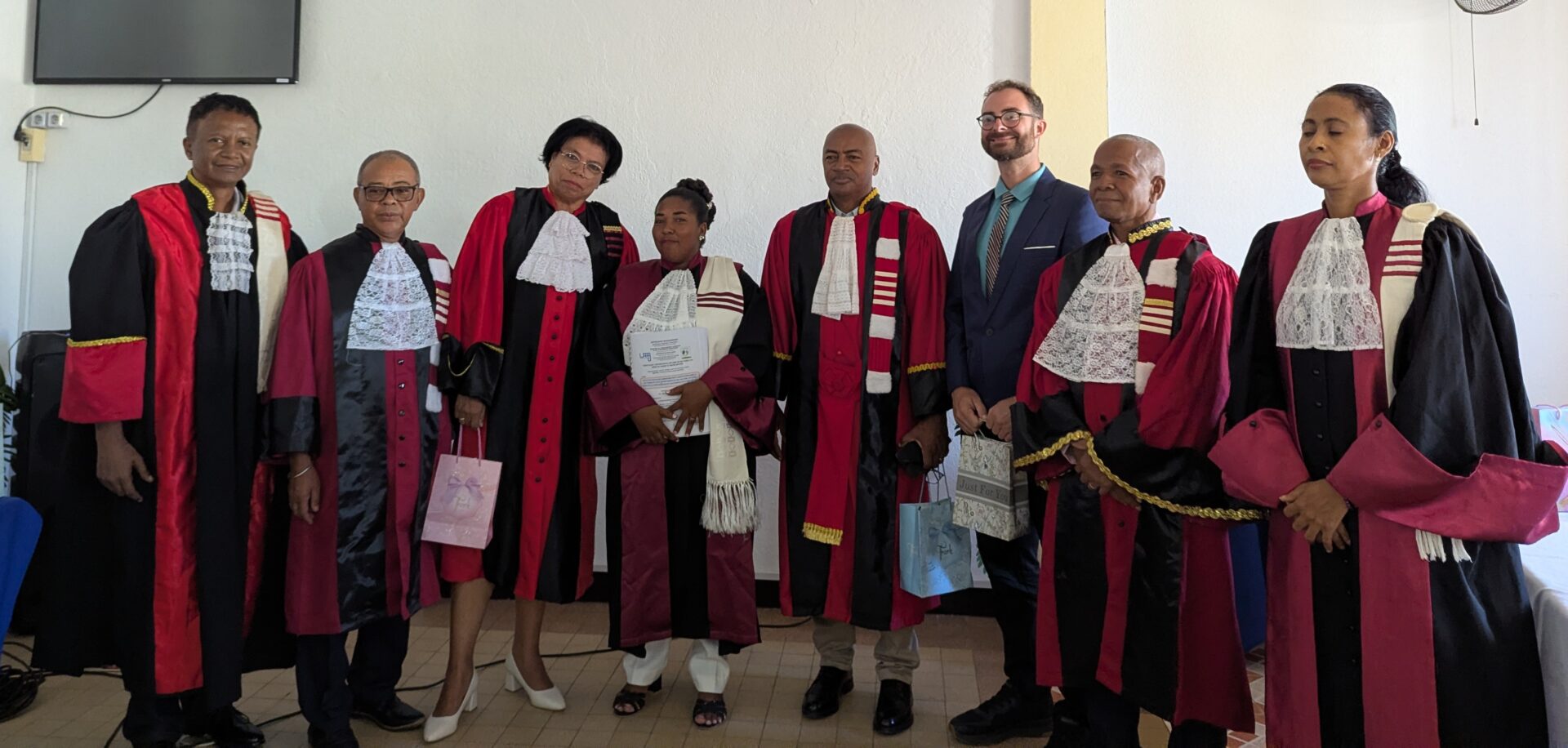
Nestorine (center) and James (right) at Nestorine’s PhD defense.
I first met Nestorine in 2019 at the University of SAVA Region when I first began my work in the region. Immediately I could tell that she and her colleagues at the University were extremely bright, motivated, ambitious, and creating a wonderful opportunity for the students of the SAVA region. I knew then that I wanted to collaborate with her because of our shared interest in human health, specifically nutrition. Then, the COVID-19 pandemic happened, and I was unable to come to Madagascar because the borders were closed. Despite that, we had many virtual meetings and email exchanges, discussing ideas and coming up with project topics together. That was how we began to design the study she presented today. Through her excellent connections at the University of Mahajanga, she was accepted into the doctoral program, and she piloted her study on her own.
In 2022, I was able to come back to Madagascar, and Nestorine and I could work together in person. It was a thrill to see her in action. When we conducted research and interviews together in the rural villages, I could tell she was a patient, understanding, and giving teacher and researcher. She mentored several students during her Ph.D. to be her research assistants and nurtured strong research skills and ethics in her assistants, encouraging them to be independent researchers too. She was caring and gentle while conducting interviews with people about sensitive topics, including their health. It is not easy to ask people about such sensitive topics as food insecurity and the health of their children, but Nestorine has a naturally gentle demeanor and friendly personality, and mothers accepted her in their homes and talked openly about their personal lives. She taught these skills to her colleagues and research assistants, and together they conducted over 600 interviews. She would have happily done more but I knew that she had enough data for a strong scientific article and that she had more work to do! She didn’t stop at interviews; directly after conducting research, she held training workshops with mothers about nutritional education with cooking classes that included nutrient-dense food for adults as well as hands-on demonstrations for creating a nutritional porridge for infants. She taught solutions to everyday problems that mothers could use in their daily lives.
Using statistical techniques of the highest caliber, Nestorine analyzed her data to discover that there were frighteningly high levels of food insecurity and malnutrition in the SAVA region. She analyzed more than 100 variables with over 600 data points following the most advanced multivariate statistics to discover unique patterns in the data that were not expected. She is a model for all the students that come after her. The nuanced understanding we have gained about the food insecurity landscape of the SAVA region guided her to develop the next stages of her research.
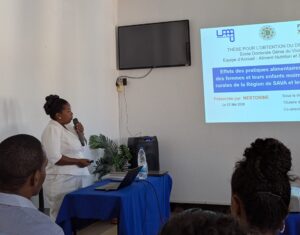
Nestorine presents her PhD research.
Nestorine didn’t stop in the field. She also developed her skills in the laboratory. She innovated techniques to dry common nutritious foods into flour which could be used as a nutritional supplement and complementary food for children; a product that even mothers in the rural countryside could make without spending any money. Once she mastered several different flours and their combinations, she brought them to the laboratory in Antananarivo to test their quality and their nutritional value. Months of hard work in the laboratory were successful; Nestorine found that the nutritional supplement she made is highly nutritious and safe to eat. She published an article about the nutritional value of her supplement in an international scientific journal. The next step was to see how people liked them.
After finishing her extensive laboratory research, she went back to the field, this time to test how people would like the nutritional flours she made and if those flours could help improve infant health. Using rigorous experimental methods, she gained valuable knowledge from the mothers and children who participated in her study; some flours were delicious, while others needed more work. The favorite flour was just as good as products found in the supermarkets, but with a huge advantage: the flour can be made at home by vulnerable mothers in the remote villages of Madagascar. The supplement also has the potential to increase the growth of the children, which is so important for the malnourished populations of Madagascar. This is truly holistic health research, combining theory, data, experiments, and direct applications to improving human health.

Nestorine defends her Ph.D. at at the University of Mahajanga.
While Nestorine conducted all this field and laboratory research, she was also a teacher, mentor and administrator at the University of SAVA. She trained hundreds of students over the years to do research and analyze data, she mentored dozens of students to conduct research and produce undergraduate theses for their license. Nestorine was a scholar at work, and a mother at home. She balanced conducting a PhD, getting married, raising a family, and being a friend. She has truly been a pleasure to work with, and I look forward to many more years of collaboration. Nestorine has innovative dreams to create a center for producing nutritional supplements from locally grown organic products to improve health and happiness in Madagascar. She also wants to extend her research in new directions; for example, she found that 20% of women in her sample were overweight or obese, a surprise result that requires further research. In addition, she wants to compare the diets of urbanites to those of their rural counterparts, as modernization of diets in the cities is reducing nutritional quality, as seen around the world. I know that she will do great things in her future, and it is with tremendous pleasure that I can call her my colleague. Thank you, Nestorine, for inviting me on your journey, thank you to her academic supervisors for nurturing a scientist of the highest caliber, and thank you to all the DLC supporters who make the dreams of Malagasy students a reality!