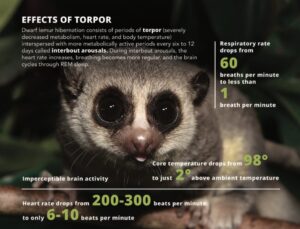

Written by Ana Breit, Ph.D., Research Scientist at the Duke Lemur Center. Originally published in LEMURS Magazine: The “Reasons for Hope” Issue in February 2026.

When people think of hibernation, they tend to picture animals in dens deep beneath a layer of snow, waiting out the winter. But this is just one example of what hibernation can be.
Although traditionally focused on arctic and temperate species, today the field of hibernation is hot, hot, hot—figuratively and literally. And because dwarf lemurs are the closest relatives to humans capable of hibernation, they’re the hottest topic of all.
When people think of hibernation, they think of cold weather
Traditional views of hibernation are based on studies conducted predominantly in North America and Europe. Marmots, bats, and ground squirrels all hibernate during the harsh winter months. To survive without eating or drinking, these small mammals greatly reduce their metabolic rates (the rates at which they convert food into energy), which allows their body temperatures to drop drastically, often reaching or hovering slightly above ambient temperature.

Traditionally, hibernation research has focused on cold weather species in North America and Europe, such as marmots (pictured), bats, and ground squirrels. Hibernation in these animals is punctuated by brief but energetically expensive periods of rewarming, called interbout arousals. Photo licensed from Wirestock Creators.
Take bats, for example. During winter, a bat’s body temperature drops to around 39°F, the temperature of the cave where it hibernates. The bat stays in this lowered metabolic state, called a torpor bout, for a few days or weeks. Then, its body spends energy rewarming for a short period of time (about 24 hours) before dropping back down into a torpid state. This brief period of rewarming is called an interbout arousal (IBA). The bat’s body continues this torpor-interbout arousal pattern for the entire winter, until its body rewarms and the bat flies from the hibernaculum in the spring.
Because IBAs are where most of the hibernating animal’s energy budget goes, it was believed that they must play a critical role in hibernation. Researchers are still debating what role: to flush waste? to restore sleep? to repair cellular damage? Why else would an animal engage in a process that is so energetically expensive?
For a long time, researchers thought that small hibernating mammals needed to have regular, active (energetically expensive) arousals to sustain their bodies through their winter hibernation. But that changed when we took a closer look at Madagascar.
Why tropical hibernation is so cool (er, hot)
Today, we know that hibernation doesn’t just happen in cold environments. It happens in the warmer tropics, too! Tropical hibernators, like Madagascar’s tenrecs (small hedgehog-like and shrew-like mammals) and dwarf lemurs, enter months-long hibernation periods not because of extreme cold, but because of the dry season and its accompanying reduction in food and water availability.
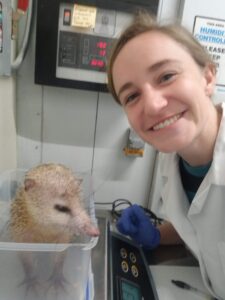
Unlike cold-weather hibernators, Madagascar’s tropical hibernators save huge amounts of energy by passively warming their bodies on warm days or when temperatures rise in the afternoons. Pictured: Ana with a tenrec, a Malagasy hibernating mammal. Photo courtesy of Ana Breit.
The most exciting part of this discovery is that unlike North American and European hibernators, these Malagasy hibernators don’t seem to need active, energetically expensive IBAs to warm their bodies. Why not?
During Madagascar’s dry season, temperatures can fluctuate widely, peaking at temperatures nearing dwarf lemurs’ and tenrecs’ active body temperatures. In the wild, hibernators need to have an IBA only when the temperature is below 86°F for multiple days in a row—something that always happens during the cold winters of higher latitudes but is much rarer in the warm tropical winters. In the tropics, on warm days or when temperatures rise in the afternoons, hibernating mammals can passively rewarm with the warming air, thus effectively getting a warm internal body temperature for “free.”
This is vital, as it saves the animal a huge amount of energy.
Her research at the DLC
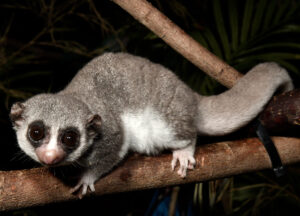
Dwarf lemurs, the closest relatives to humans capable of hibernation, hibernate at warm temperatures—likely a key component to human synthetic hibernation. Photo by David Haring.
Early hibernation research relied on measuring the difference between body temperature and ambient temperature to infer the depth of an animal’s hibernation; but this method was unable to show the true energetic cost of each IBA. Was the animal’s body doing the work of warming itself, or was it just riding the wave of the warm afternoon temperatures?
Today, using respirometry (measuring an animal’s breath composition), we can quantify the caloric cost of every minute of an animal’s hibernation.
At the DLC, we analyze the breath composition of each hibernating lemur by pulling the air from the nestbox into an oxygen and carbon dioxide analyzer, allowing us to measure how much oxygen the animal is consuming and how much carbon dioxide it is producing. By comparing those values to baseline air composition, we can quantify the VO2, a proxy for metabolic rate. In this way, we can calculate the caloric cost of the entire hibernation period, and even more interestingly, the cost of each torpor bout and IBA that an animal undergoes.
In this way, we’ve shown that by adjusting the ambient temperature of the hibernaculum, we can passively rewarm hibernators so they never have to actively rewarm during a hibernation season. Instead, the lemurs passively rewarm with the increasing temperatures, which is much less costly in terms of energy.
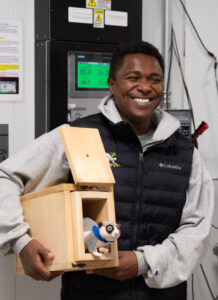
During hibernation, each dwarf lemur is given a nestbox (pictured, held by Ph.D. candidate Antonin Andriamahaihavana) outfitted with a camera taking regular screenshots and videos for behavioral analysis, a small tube drawing air from the nestbox to analyze the animal’s breath composition, and a small temperature sensor to record the hourly temperature of the nestbox. Photo by Sara Sorraia.
Why tropical hibernation matters
This research has enormous translational potential for human synthetic hibernation, with applications for both long-duration space missions and for biomedical insights into humans here on Earth.
Dwarf lemurs, the closest relative to humans capable of hibernation, hibernate at warm temperatures—likely a key component to synthetic hibernation. Why? Because primate hibernation was previously assumed to be impossible because of the brain and its high energetic demand. Cold temperatures would entail a myriad of potential complications, such as dysregulation of homeostatic processes (like gene expression and protein synthesis) and extreme reduction in cellular processes, that humans are not adapted to deal with. But dwarf lemurs can hibernate at high temperatures and still achieve huge energetic savings, which may ease those constraints.
During our next hibernation season, our team at the DLC will quantify the energetic costs and savings of hibernation and rewarming periods in different temperature conditions. We’ll also investigate immune and inflammatory responses (could astronauts get sick during hibernation?), fat composition (are different fats burned at different points during hibernation?), aging-related processes throughout the hibernation cycle (do warm hibernators live longer?), and cognitive effects of hibernation (after waking from a torpor-like state, will the astronauts still be able to fly the spacecraft?).
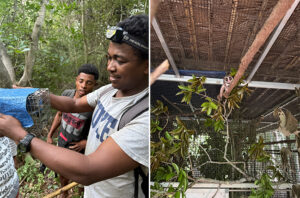
By conducting both lab and field studies, researchers at the DLC can answer questions ranging from broad population-level inquiries like “Who?” and “When?”, down to cellular-level questions like “How?” and “Why?” Pictured: Ph.D. candidate Antonin Andriamahaihavana and the research team humanely trapping wild dwarf lemurs in the Anjajavy forest (left). A wild dwarf lemur settles in for hibernation season at the Anjajavy Field Station (right). Photos by Miriam Gordan.
Besides its relevance to space travel, hibernation research has broad biomedical implications that could inform therapies for coma management, diabetes, cancer, heart disease, and trauma recovery. If we were able to safely induce torpor in humans, we could mitigate muscle atrophy and pressure injuries in immobilized patients, reduce metabolic demand, and slow disease progression.
Being a research scientist is an incredibly rewarding job. Not only do I get to do ground-breaking research that I get to nerd-out on (don’t even get me started on the evolution of endothermy!), but I also contribute to a greater understanding of physiological processes that can inform medical interventions and push the limits on human space travel.
The best part of being a scientist is that each exciting discovery leads to more questions. We’ll never stop exploring.