Eat Me: A Coevolution Story
by Education Programs Manager Megan McGrath
Let’s play two truths and a lie…
1 – Black and white ruffed lemurs are the world’s largest pollinators.
2 – Mouse lemurs are avid gardeners.
3 – Lemurs spread invasive species.
Okay, we cheated… All three of those statements are true, and the details may surprise you!
Black and white ruffed lemurs are the world’s largest pollinators.

A black and white ruffed lemur at the Duke Lemur Center enjoys a very ripe banana. Photo by David Haring
Black and white ruffed lemurs have a sweet tooth. In technical terms, they are frugivorous, or fruit-eating specialists. Sugars are a fantastic source of energy, and ruffed lemurs have adapted to prioritize foraging where sugar will be plentiful. But fruits aren’t the only sugary thing in the rainforest–nectar is an excellent option, too.

Traveller’s palm trees grow large, white flowers full of tasty nectar (source: Wikipedia)
The large flowers of the traveller’s palm (Ravenala madagascariensis) seem to fit the long snout and face of the ruffed lemur perfectly, almost as if they were designed that way. And in a sense, they were, through the process of coevolution. Traveller’s palms benefit from having large flowers that lemurs can fit their faces into, since the lemurs inevitably get some pollen on their furry faces. And the lemurs benefit from the regular source of crucial nutrients. Black and white ruffed lemurs spend up to 72% of their foraging time on nectar when other food sources are scarce!

A black and white ruffed lemur drinks nectar from a traveller’s palm flower in Manombo Forest, Madagascar. Photo by Daniel Austin
In fact, black and white ruffed lemurs are one of several lemur species that have been observed pollinating the flower of the Traveller’s palm–they just happen to be the largest ones to do it! But, coevolution is not a one-way street, so how have lemurs adapted to exploit this sugar-rich resource?

A young black and white ruffed lemur at the Duke Lemur Center shows off their tongue. Photo by David Haring
Well, it turns out that the tongues of pollinating lemurs may structurally differ from flower-destroying feeders like the infamous ring-tailed lemurs of southern Madagascar. Black and white ruffed lemur tongues differ from their ring-tailed lemur relatives in size, shape, and even papillae formation (those small bumps on your tongue that contain your tastebuds).
Mouse lemurs are avid gardeners.
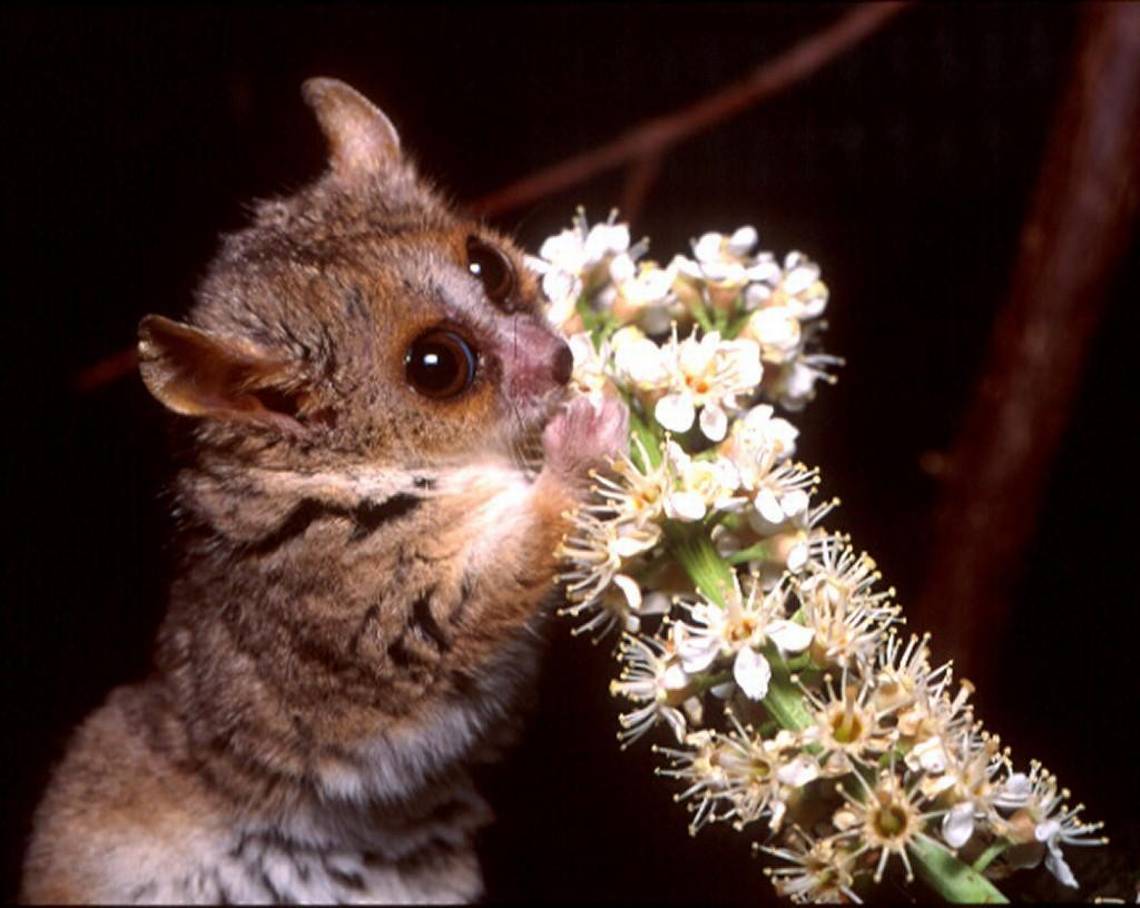
A gray mouse lemur snacks on some flower nectar. Photo by David Haring
Even among primates, lemurs are uniquely important as seed dispersers for Madagascar’s plants, since only 10% of birds on the island eat fruit, leaving a large evolutionary niche open to lemurs. Small, nocturnal lemurs are often overlooked as key seed dispersers in Madagascar’s ecosystems, and their complex social structures have fascinating effects on the plants around them.

Reddish-gray mouse lemur, Berenty Reserve, Madagascar. Photo by Arthur Grossett
Just like the matriarchal gray mouse lemurs (Microcebus murinus) housed at the Duke Lemur Center, female reddish-gray mouse lemurs (Microcebus griseorufus) tend to stay within their family units, giving young males the boot when they reach maturity. These female mouse lemur groups (let’s call them “the girls” for short) tend to stick to the foraging grounds they know, and as they move through their usual routes, the girls disperse the seeds of their favorite fruits in their feces along the way.

Mistletoe growing from a host tree (source: Wikipedia)
One of the girls’ favorite snacks is a Malagasy member of the mistletoe family. This parasitic plant actually grows best when its seeds have passed through the digestive tract of a reddish-gray mouse lemur and are then deposited in a fresh little pile of mouse-lemur-fertilizer. So, how is this any different than your regular, everyday seed dispersal?

A gray mouse lemur at the Duke Lemur Center nibbles on tiny fruits. Photo by David Haring
As the girls make their rounds to their favorite snacking spots, they deposit a lot of seeds in the same areas, causing thick patches of their favorite mistletoe to grow in layers. These layered plants form a fantastic shelter that protects the girls from predatory owls, and they use this protection as a nursery to raise their infants. As an added bonus, the girls usually deposit the parasitic mistletoe seeds right onto the trees that produce a crucial part of their diet – gum! As the mistletoe taps into a host tree to steal some nutrients, it forms small wounds in the tree’s bark, leaking gum that the girls are more than happy to snack on!

A gray mouse lemur grandmother, mother, and daughter at the Duke Lemur Center snack on fruits together. Photo by David Haring
The girls teach their daughters where the best snacks and safest spots are, and those daughters teach their daughters, and so the “gardens” they’ve cultivated pass down through the generations. These generations of mouse lemur gardeners are affecting the composition of the plants around them, which will in turn affect the other wildlife interacting with those plants. It all goes to show that big ecological impacts can come in pretty small packages.
Lemurs spread invasive species.

A mongoose lemur at the Duke Lemur Center chows down on a fig, seeds and all by David Haring
Lemurs are excellent seed dispersers. But, what happens when they encounter a tasty fruit from a new plant? Well, they eat it, of course! The trouble is, as more invasive species find their way into Madagascar, lemurs can become unwitting accomplices in the invasion.

The fruits of the strawberry guava tree by Forest and Kim Starr (source: Wikipedia)
The strawberry guava tree is a prolific invasive species that has invaded every continent but Antarctica. The tasty fruits appeal to animals across the primate order, which helps the tree spread rapidly once it enters a new environment. In fact, strawberry guava takes advantage of a cool coevolution between fruits and primates, and lemurs are especially susceptible to it – scent! With their long snouts, lemurs are excellent at sniffing out the best foods, and trees like the Malagasy fig have evolved to emit chemicals called aliphatic esters that signal “hey, I’ve got ripe fruit full of the sugars you need right over here!” Trouble is, strawberry guava fruits have also evolved to emit those same chemicals. So, this invasive plant sends the same smelly signal to lure in hungry lemurs.

An Eastern lesser bamboo lemur snacks on fruits in Marojejy National Park, Madagascar. Photo by Sara Sorraia
So, we just need to find a way to remove all of the strawberry guava from Madagascar, right? Well, here’s where it gets tricky. As strawberry guava spreads, it forces native plants to compete, adapt to new niches, or to go extinct. The lemurs snacking on those native fruiting trees have now switched to snacking on strawberry guava fruits, which means this invasive plant starts to form a key component of some lemur diets. So, even if we could wave a magic wand and poof! get rid of every last strawberry guava fruit, tree, and seed on the island of Madagascar, we probably shouldn’t. At least, we shouldn’t completely eradicate strawberry guava until we better understand the relationship between this invasive plant pest and the critically endangered lemurs it now feeds.

Malagasy students help reforestation efforts led by the DLC-SAVA Conservation Team. Learn more about our restoration work in our latest conservation newsletter HERE.
In addition to the articles linked throughout this blog post, the Lemurs of Madagascar was also used as a source. The new edition of this comprehensive guide to lemurs is available for purchase in our gift shop!
Posted 12/2/25