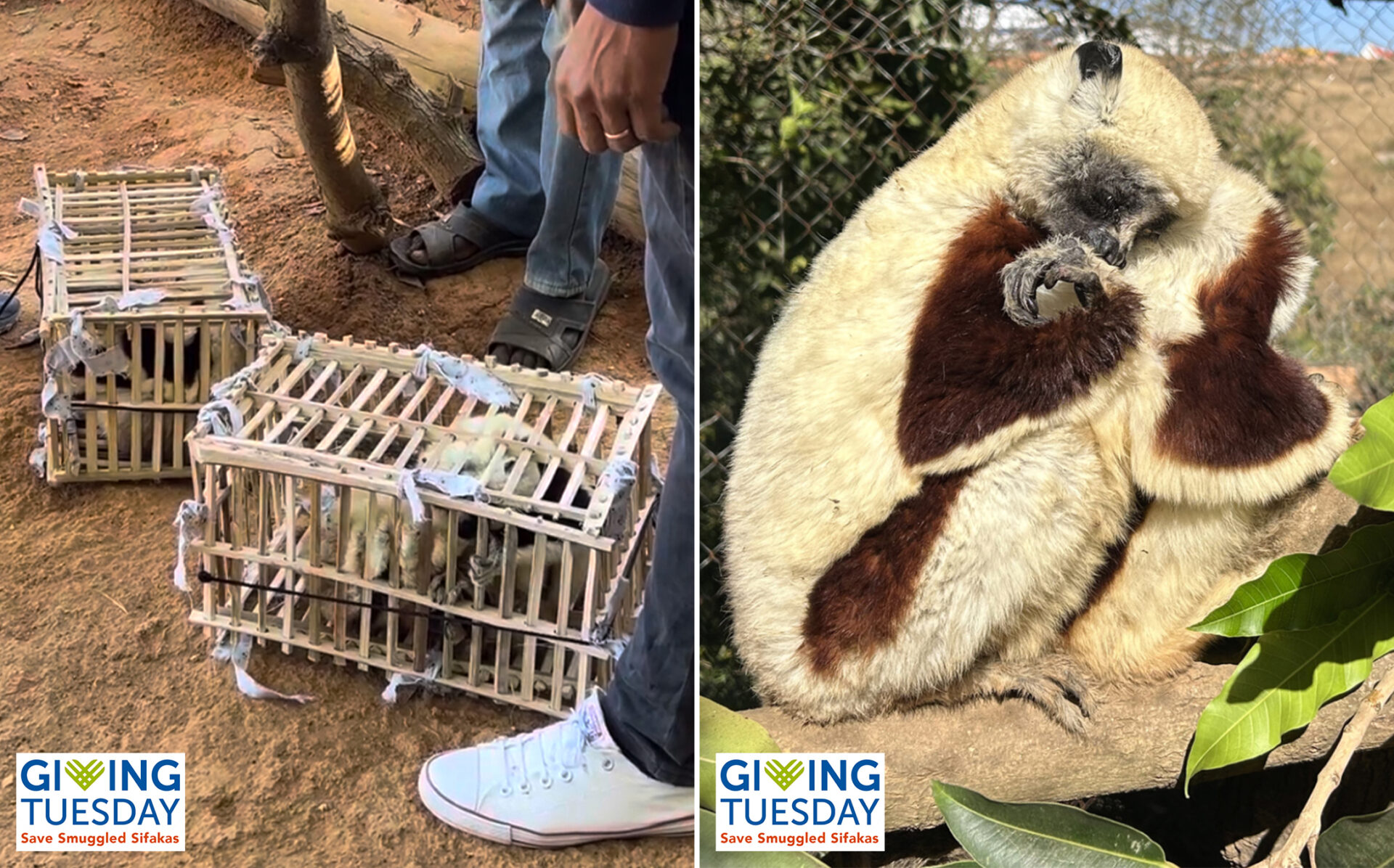
Left: In June 2025, four critically endangered Coquerel’s sifakas were found in cages inside a suitcase bound for Dubai. Right: Two of the rescued sifakas cling to each other after being released inside a safe enclosure at one of our Malagasy partner zoos. Photos courtesy of Britt Keith.
This #GivingTuesday, we’re raising funds to support a critical but heartbreaking aspect of the DLC’s partnership with Madagascar’s Ministry of Environment and Sustainable Development (MEDD): emergency care for Coquerel’s sifakas rescued from illegal wildlife trafficking.
The DLC is assisting MEDD with three groups of rescued animals: 4 sifakas found in cages inside a suitcase (3 survivors); a second shipment of 3 sifakas found caged inside a suitcase (3 survivors); and a recent seizure of 10 sifakas ready for transport outside the country (1 survivor).
This promotion has ended. Thanks to your generosity, we exceeded our Giving Tuesday goal, raising a total of $5,601 to help these sifakas. Thank you so much for your support!
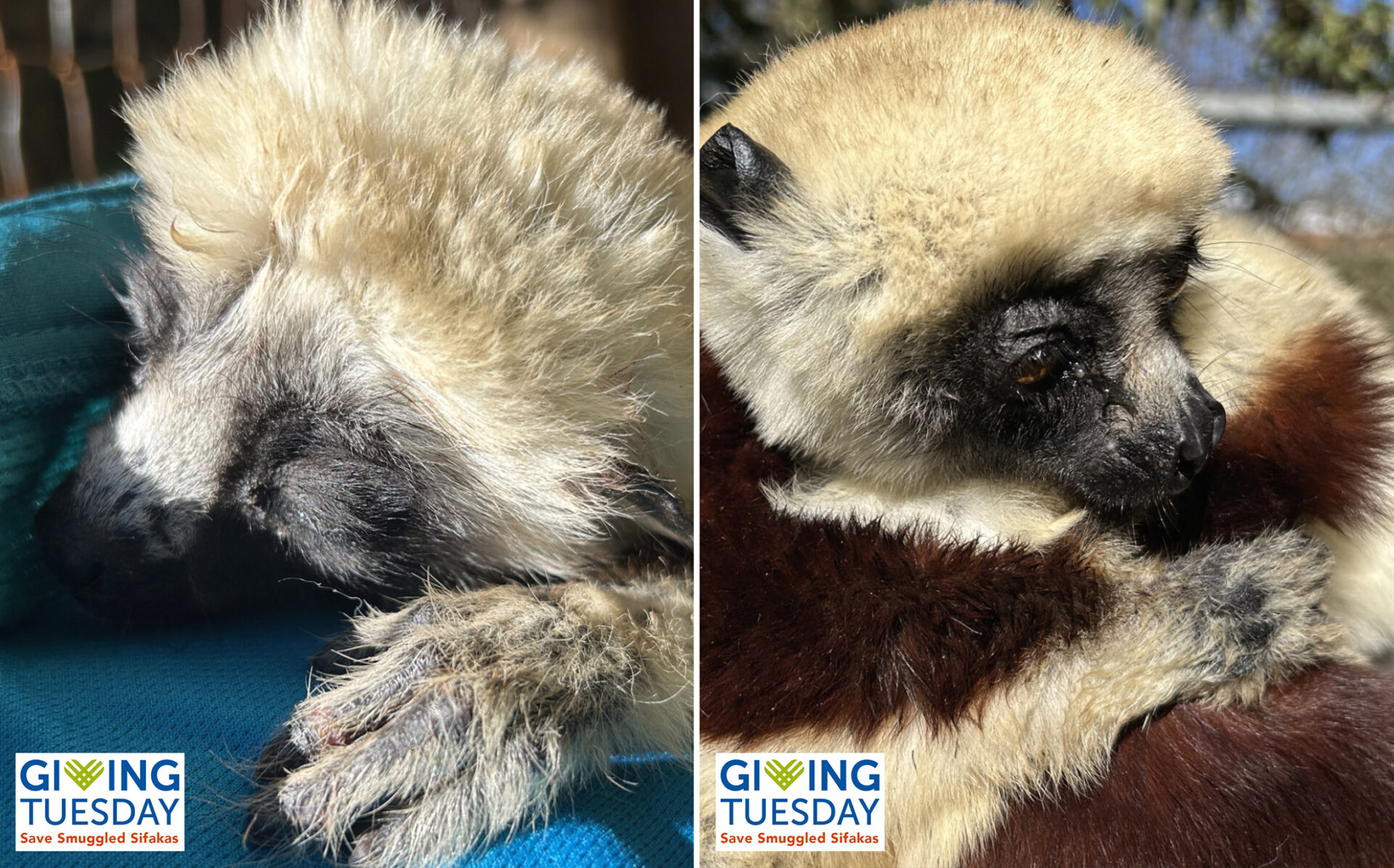
After being freed from their tiny bamboo cages, rescued sifakas cling to their caregiver (left, wrapped in a sweatshirt) and to each other (right) for warmth. Photos courtesy of Britt Keith.
Short-term goal: Help these sifakas survive
Fundraising target: $5,000
Emergency veterinary care ($23/day)
Due to the stress and trauma of trafficking, these sifakas will require specialized care, including quarantine and recovery in a secure environment.
Veterinarians in the area have been trained at the Duke Lemur Center as part of our months-long DLC-Madagascar Veterinary Internship program. “It’s very fortunate that these parks have access to veterinarians who have received clinical experience training with this very fragile species,” says DLC Executive Director Greg Dye. “We know they have the experience to help with this effort alongside other Malagasy vets.”
$23/day is the approximate cost of veterinary care for the entire group of rescued sifakas, as well as the veterinarians’ travel to each location where the confiscated sifakas are housed.
Specialized rehabilitation, including food and housing, is $15/day for general husbandry care like feeding, watering, and cleaning plus $2700 to build species-appropriate housing
Support these sifakas with holiday gifts that give back!
The DLC will allocate the entire purchase price of Coquerel’s sifaka Adopt a Lemur packages bought on Giving Tuesday—$100 for complete packages and $50 for virtual packages—toward the care of these rescued sifakas. This is an excellent way to support the smuggled sifakas and the zoos and veterinarians caring for them while also giving a meaningful gift to your loved ones for the holidays.
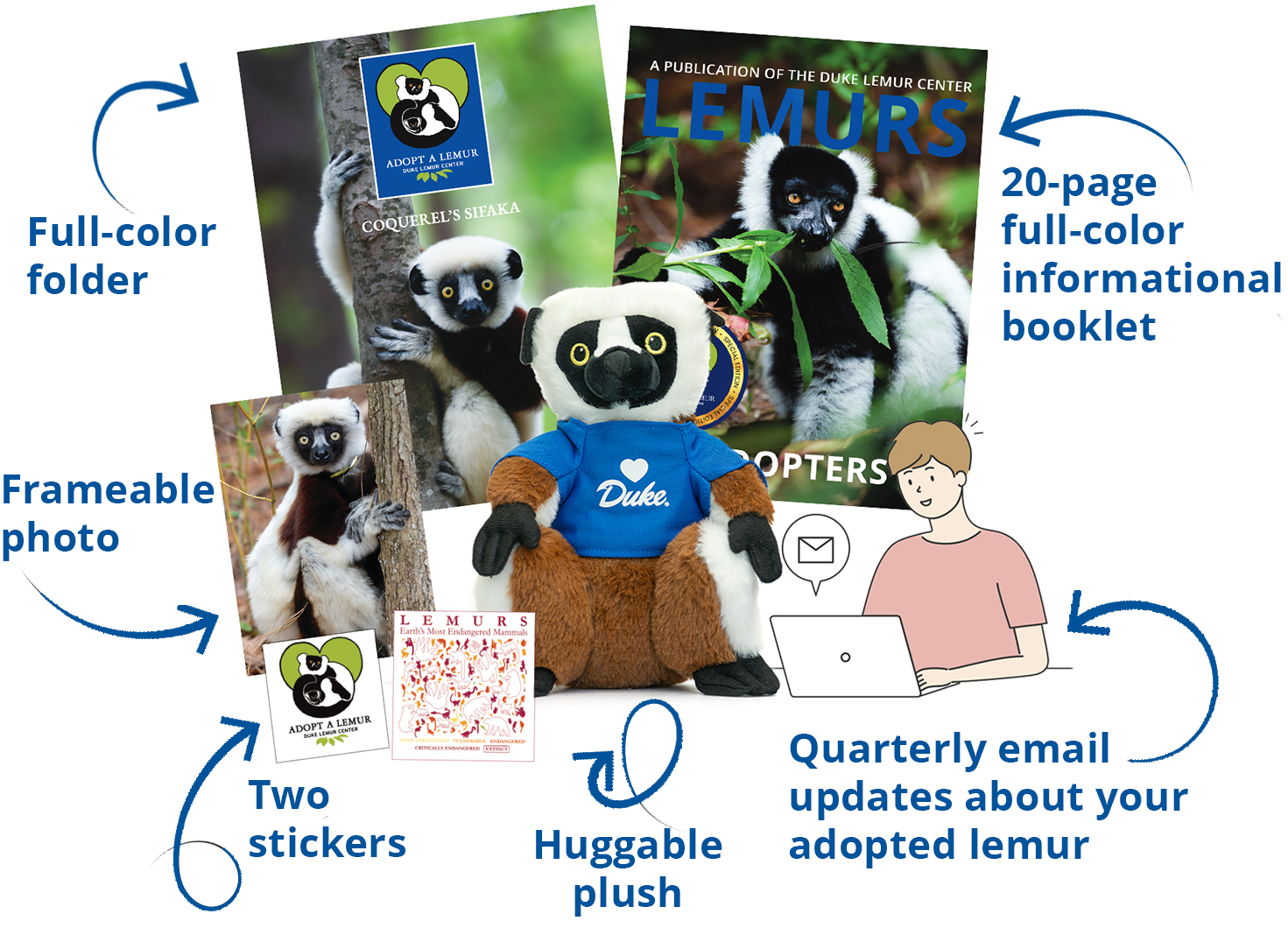
Symbolically adopt a Coquerel’s sifaka ($100 goes to saving smuggled sifakas when purchased on Giving Tuesday)
Virtual option—symbolically adopt a Coquerel’s sifaka ($50 goes to saving smuggled sifakas when purchased on Giving Tuesday)
Our fundraising target is $5,000. All donations are tax-deductible. Adopt a Lemur packages are not tax-deductible.
Long-term goal
If the survivors can’t be returned to the wild, the long-term goal is to incorporate these young sifakas into Madagascar’s conservation breeding plan for this critically endangered species.
Because of their young age and the traumatic events they have endured, unfortunately the rescued sifakas may not be able to return to the wild. If they cannot return to their natural habitats, they’ll be given permanent, safe placements in zoos and become a part of Madagascar’s brand-new Coquerel’s sifaka conservation breeding program, developed in collaboration with the Duke Lemur Center.
Any funds raised above what is needed for the animals’ immediate care, or future rescue needs, will be used to support the Coquerel’s sifaka conservation breeding program, which will be used to guide future animal transfers between Madagascar’s parks to support breeding recommendations that promote the long-term genetic diversity of the population.
“These young sifakas can have a huge long-term impact on increasing the genetic diversity of the sifaka populations in Madagascar’s accredited zoos,” says Greg. “These lemurs’ descendants could one day be reintroduced to Madagascar’s forests, enhancing or re-establishing wild populations where habitat is protected.
“It’s a way that at least some good can come from this devastating situation.”
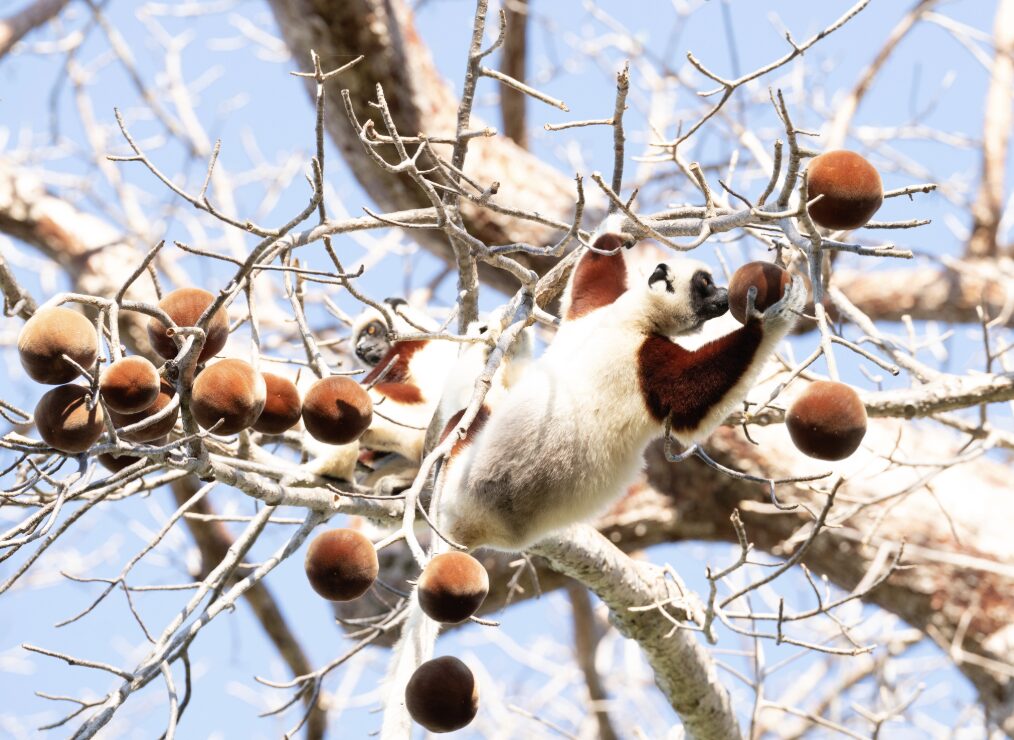
Trafficking has a serious, negative impact on wild populations and on the physical and psychological health of trafficked individuals. For these reasons and many others, the Duke Lemur Center is absolutely against all trade in pet primates, and against the holding of any prosimian (lemur, loris, bush baby, potto) as a pet. Pictured: Wild Coquerel’s sifakas eat baobab fruits along Madagascar’s northeastern coast.
How did the DLC become involved?
Lemurs are, unfortunately, frequent victims of the wildlife trade. In May 2024, authorities in Thailand rescued over 1,000 animals—including 47 lemurs—from animal trafficking. As various conservation groups, parks, and rescue centers worked to return these animals to Madagascar, the Ministry of Environment (MEDD) contacted DLC Colony Curator Britt Keith for logistical assistance, particularly with the care and safe transportation of the rescued lemurs.
In June 2025, Britt and DLC Assistant Curator Danielle Lynch—both of whom specialize in the care of Coquerel’s sifakas, a fragile species that requires incredibly specialized care—traveled to Madagascar on a routine visit to assist with Madagascar’s Coquerel’s sifaka conservation breeding program. Within hours of landing, they were called to assist one of our Malagasy partner zoos by leading emergency care efforts for four confiscated sifakas found in a suitcase bound for Dubai.
When additional shipments of sifakas were discovered this summer and fall, MEDD again reached out to Britt and the Duke Lemur Center for guidelines for the lemurs’ transport, emergency veterinary care, and housing.
“I’m very proud of the work our team, especially Britt Keith, is doing to support our Malagasy colleagues as they struggle to deal with this crisis,” says Greg. “We’re doing everything in our power to support the private parks who are housing and caring for these animals, and to support the veterinarians who are assessing and treating them. Together, we can ensure that they have the best chance of surviving this tragedy.”
What else is the DLC doing to help?
Trafficking, both for the illegal pet trade and for the luxury meat trade, has a serious, negative impact on wild populations and on the physical and psychological health of trafficked individuals.
Unfortunately, trafficking is just one of many problems facing Madagascar’s lemurs. “The DLC has partnered with the people and organizations of Madagascar for 40 years,” says Greg. “We’re committed to protecting lemurs in the long run, in addition to helping with an immediate, urgent need with this Giving Tuesday fundraiser.”
The DLC’s conservation programs in Madagascar include:
In-situ conservation programs supporting environmentally sustainable ways of life: fuel-efficient cook stoves (reducing fuel needed for cooking), reforestation, sustainable agriculture training (alternative crops, fish farming), green charcoal with bamboo, family planning and women’s reproductive health, protection of Marojejy National Park in collaboration with Madagascar National Parks, empowering local conservation committees and training community rangers—ensuring that law enforcement is locally led and benefits are shared
Education programs to raise awareness about the importance of lemurs and interest in environmental conservation: in-school visits and environmental activities, class field trips into the forests of northeastern Madagascar, teacher training in environmental education, urban outreach events and campaigns—including posters in restaurants and partnerships with hotel owners—to reinforce that lemurs should not be eaten
Research programs to help us better understand lemurs and their natural environment: fauna and flora surveys and research missions in SAVA (northeastern) region of Madagascar, landscape restoration, soil health and infectious disease research, logistical support and collaboration with visiting researchers
Ex-situ lemur conservation programs: in partnership with the Government of Madagascar: build local capacity via training of Malagasy zoo staff, produce a comprehensive lemur care manual in Malagasy and French, develop a standardized animal record system for use in Madagascar zoos, establish the foundation for cooperation and animal exchanges for breeding programs, and develop guidelines for the management of confiscated and illegally held lemurs
These projects are funded entirely through grants and donations.