
By Andrea Tejada, 2022 Communications Intern, and DLC Staff
Originally published in January 2023 in “The Women’s Issue” of the DLC annual magazine.
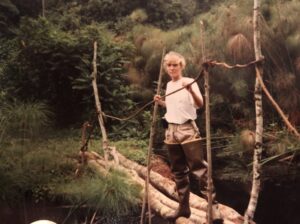
The Curator of the DLC’s colony, Britt Keith, MSc., in Uganda as a young zookeeper and researcher. Britt started in the zoo field when she was 16, having cleaned stalls at her local horse barn since the ripe old age of seven. “The Bronx Zoo got me hooked after I attended a summer internship,” says Britt. “It was just a couple of us young women in a sea of young men.” Photo courtesy of Britt Keith.
The fields of science, technology, engineering, and math (STEM) have evolved in many ways over time, and although many of the most prominent early leaders in these fields were men, today more women than ever are pursuing careers in STEM.
This fall, I sat down with four of the most seasoned female members of the Lemur Center staff, eager to learn more about their personal experiences and the changes they’ve seen their decades-long careers in the sciences.

From left to right: Meg Dye, Britt Keith, Chris Wall, and Cathy Williams.
Meg Dye, MSc. – DLC Curator of Behavioral Management and Welfare
Education: B.S. in Psychobiology, University of California, Santa Cruz; MSc. In Animal Welfare Ethics and Law, University of Edinburgh
Britt Keith, MSc. – DLC Colony Curator
Education: Associate’s Degree in Zoo Animal Technology, Santa Fe Teaching Zoo; B.S. in Wildlife Ecology, University of Florida; MSc. in Ecology, University of Miami
Christine (Chris) Wall, Ph.D. – DLC Assistant Director of Research and Research Professor Emerita of Evolutionary Anthropology, Duke University
Education: B.S. in Human Biology, Stanford University; M.A. and Ph.D. in Physical Anthropology, State University of New York, Stony Brook
Cathy Williams, D.V.M. – DLC Senior Veterinarian
Education: B.S. in Comparative Nutrition, University of California, Davis; D.V.M., UC Davis School of Veterinary Medicine
ANDREA: Early in your career, did you experience any discouragement or pushback?
CHRIS: I grew up in Florida in the 1960s, where my grandfather was a master solderer and helped put together the Apollo rockets. I loved spending time with him, and he and my family supported my interests in the sciences. The women’s liberation movement in the 1960s and ‘70s helped, too.
After college, I took classes at UC Berkeley with a prominent male anthropologist. I was interested in pursuing an advanced degree in human evolution, and I needed a letter from him for my graduate school applications. When I asked him, he said ‘I’ll write a letter for you, but I’m going to tell you something. The sum total of contributions by women to physical anthropology is’—and he held up his hand—‘zero.’ It was the first time anyone had ever spoken to me that way. I think because of all the early support I’d had, I could brush it off: ‘Well,’ I thought, ‘you’re old, so what do you know?’ And I did it anyway.
MEG: I’ll always remember working at the Monterey Bay Aquarium in high school, and a security guard asking me what I wanted to do when I went to college. I told him I wanted to work with dolphins, and he said, ‘That will never happen. There’s no way.’ And that cemented it for me: ‘No,’ I thought. ‘Now I will, because you aren’t going to tell me I can’t.’ It sounds like many of us have been motivated by that.
CATHY: I agree. Veterinary school is highly competitive, and I was told over and over that I wasn’t going to get in, that I wasn’t smart enough. Well, of course I had to prove them wrong! ‘I’ll show you,’ I thought. Growing up, my parents had never told me I couldn’t do something, so I felt empowered that I could.
BRITT: My mom was active in the women’s movements and ultimately, she was appointed Director of Women’s Studies at a college. She was like, ‘Hell no, no one’s going to tell you that you can’t do something! You go out and make sure you do!’
So like the rest of us at this table, I was never going to be outdone—I was going to sling that bale of hay, or that 50-pound bag of feed, just like a man would. There were a lot of men in the zoo field at the time and very, very few female mentors. It looked like I might never gain any ground. When I applied to grad school, my brother asked me, ‘What are you doing that for? What’s the point?’ So I proved them all wrong, and now here I sit.
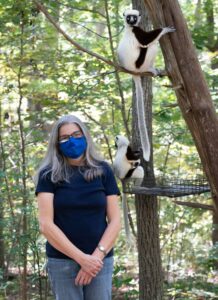
Chris Wall, Ph.D., joined Duke University’s Department of Evolutionary Anthropology in 1994, first as a post-doctoral researcher, then as a research professor. She has been a Senior Research Scientist at the DLC since 2018, and is currently the DLC’s Assistant Director of Research. “Many of my favorite research experiences developed in unexpected ways,” says Chris, “and I encourage students to embrace opportunities even if they don’t seem to fit perfectly within their career plans.” Chris’s current work combines research mentoring and STEM outreach. Photo by Sara Sorraia.
ANDREA: From the time that you began your career ‘til now, what changes have you seen in the field?
BRITT: In the early days, the zoo field was more of a physical labor job, whereas today it’s more scientific: We don’t just feed and clean. We’re interested in research, species survival plans, conservation, and so much more. We’re also actively recruiting men, because the field is now strongly dominated by women! When I started, it was overwhelmingly male. I’ve watched it change, and that’s really cool.
CATHY: I was in the first class at the UC Davis School of Veterinary Medicine that was split 50/50 between women and men; all classes prior to that had had a higher percentage of men than women. Today, the applicant pool is predominantly female and many veterinary schools are actively trying to recruit male students. I was right within that transition period.
CHRIS: I think there’s more awareness now that women and people of color weren’t dropping out of STEM fields. They were, at least in prior generations, never being introduced to STEM opportunities in the first place.
MEG: When I left the Shedd Aquarium to start consulting, I was one of only a handful of marine trainers who saw the opportunity to apply the same training techniques to terrestrial animals in zoos. At that time, each facility—Shedd, SeaWorld, and so on—had its own training techniques, and those were held very close to the chest. It wasn’t until the late 1990s that they started sharing and creating professional organizations.
Today, it’s much more open, and the trend is toward animal welfare. To be an AZA-accredited facility, you must have someone who specifically oversees a behavioral management program. That didn’t exist back in 2000.
CATHY: The field of animal welfare is taking off not just in the zoo field, but also in the agricultural field. More consumers are becoming aware of how their food is produced and demanding that animals lead a humane existence before they’re killed for food.
I also remember when the founders of the American College of Animal Welfare (ACAW) got a lot of pushback from veterinarians. The ACAW was told veterinarians’ role was to provide healthcare; there wasn’t a generally accepted understanding back then about the importance of an animal’s behavior, environment, and mental state. Today, there’s more focus on the overall well-being of an animal, and its physical health is just a part of that.
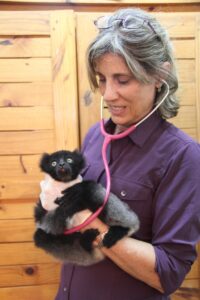
Cathy Williams, D.V.M., examines an infant indri in Madagascar. For the first 10 years of her career, Cathy honed her skills in medicine and surgery in traditional domestic animals, including cows, horses, and companion animals like dogs and cats. A long-standing love of wildlife and the environment led her to the Lemur Center in 1996. Photo courtesy of Cathy Williams.
ANDREA: What advice would you give to students interested in STEM careers, or to adults supporting them in the process?
BRITT: Adults, share your experiences. Talk to your daughters, your sons, your grandchildren. If you work in a STEM field, give outreach talks to school groups, classrooms, and clubs. This field is going to be more important than ever in the next 25 years, and sharing what we do, particularly as women, can go a long way toward shaping students’ ideas of what’s needed and what’s possible.
CHRIS: Academic departments and universities can be very hierarchical and competitive; there’s a pecking order; they’re set up as male systems, whether men are in charge or not. One of my role models tells young faculty to focus on what they want and need to pursue their passions, and to try not to focus on the political stuff. That can be difficult to do, and for women especially, it can be a hard line to walk—even more so if you feel the socio-political stuff is an implicit or explicit bias. There are points within our careers where a woman is in danger of thinking, ‘I can’t walk this line anymore. I need to do something else.’ Mentors within academia should be aware of that. How can we stop this from happening? What’s the best way to handle it?
CATHY: Think about what you find exciting and what really stimulates your interest and curiosity. There are many ways to be involved with animals and many ways to be involved in science. Follow your curiosity and be open different opportunities when they arise, even if you didn’t consider them initially.
MEG: If you’re a student hoping to get into the field of animal training and behavior, volunteer somewhere. You don’t have to have a zoo or aquarium in your hometown; you can volunteer at a veterinary clinic, an animal shelter, or a wildlife rehabilitation center. Do it and see if you like it, cleaning and shoveling and all.
For STEM fields more generally, just try them! Don’t be intimidated by STEM classes or STEM camps. I tell my girls—and I think this is easier advice now than it was when I was in middle school—you’ve just got to try it, because you don’t know what you’re going to like. There are so many opportunities in school, afterschool programs, and summer camps, and you might just find that you love engineering or computer programming. Don’t be scared.
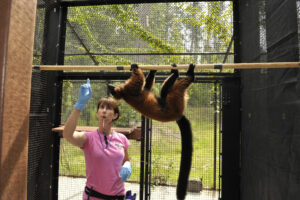
When she enrolled at the University of California, Irvine, Meg didn’t have a solid plan yet for her future. She became increasingly interested in marine biology and, after two years at UC Irvine, transferred to the University of California, Santa Cruz. She’d been drawn to UCSC’s Joseph M. Long Marine Laboratory, a facility for non-invasive research much like the Duke Lemur Center. “That’s where everything clicked,” Meg says. At the Long Marine Lab, Meg learned the principles of positive reinforcement training through her involvement with a sea lion cognition project. “I was introduced to training and given hands-on experience working with marine mammals, and the rest is history!”