Published on December 17, 2025.
A new study published in Sustainability shows that simple, hands-on training in gardening and chicken husbandry is transforming livelihoods in rural Madagascar—especially for women. The research, led by Duke University’s Duke Lemur Center, evaluated more than 500 farmers who participated in agricultural workshops and found widespread adoption of new techniques, increased food production, and greater economic resilience among participating households.

Farmers in Madagascar are innovating new skills and reaping the benefits. Photo credit: Riccardo Morrelas.
Women, who are often underrepresented in development programs, made up more than 60% of participants. Many became highly skilled vegetable growers, while men tended to focus on raising chickens. Both activities are critical in the rural communities, where families rely on small-scale farming to meet daily needs.
“Our goal is to create place-based solutions that support both people and the environment,” said lead author James Herrera, Director of Conservation at the Duke Lemur Center. “Improving food security and reducing pressure on forests go hand-in-hand.”
Hands-on training leads to real-world results
According to the study, about half of the farmers who trained in agroecology adopted new gardening methods that increased their vegetable yields. Roughly a third of participants in the chicken husbandry program successfully improved their poultry production.

Women work together in a reciprocal tradition, building community solidarity. Photo credit: James Herrera.
Participants consistently rated the workshops as valuable and easy to understand. One farmer shared, “It was wonderful and worthwhile. Everyone could learn from their teaching techniques.” Another added, “After the training, I bought chicks to put what I learned into practice.”
To encourage adoption, motivated farmers earn practical rewards such as watering cans, seeds, and tools. Those who complete the chicken workshop and build their own coops receive a rooster and three hens to start their flocks.
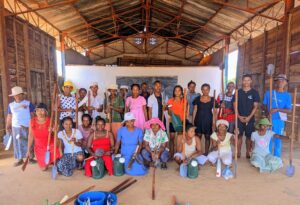
Photo credit: Rasoavanana Julice Rauchilla.
For many families, chickens serve as a financial safety net. One participant explained: “When my chicken has chicks, I can sell them to pay for my child’s school fees or to cover medical expenses. I don’t have to worry in case of difficulties.”
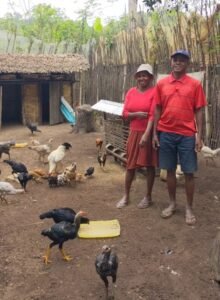
Raising chickens is important for local livelihoods. Photo credit: James Herrera.
Growing community resilience
The results highlight how gardening and poultry-rearing are foundational to rural livelihoods. By improving these skills, the program created measurable benefits for hundreds of households.
The study also points to opportunities for even greater impact. “While the outcomes were positive, the research shows that more inclusive outreach, more hands-on skills development, and more follow-ups can help us reach even more people,” said co-author Dania Nasir.
To expand participation, the team uses community meetings, flyers in public spaces, and door-to-door outreach—strategies that help reach vulnerable or isolated households. Because many participants learn best by doing, the workshops combine classroom lessons with multi-day practical sessions. The research team now revisits communities several times per year to reinforce skills, offer one-on-one support, and encourage farmers to help each other through reciprocal labor groups.
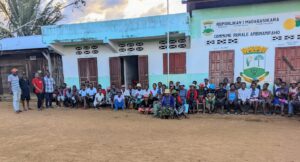
The word is spreading! Over 3,000 Malagasy farmers have joined the Duke Lemur Center network. Photo credit: Randriamarozandry Jean Roméo.
Scaling up: from gardens to restoration
As farmers gain confidence, many choose to join more advanced programs. More than 600 participants expanded into agroforestry and landscape restoration, combining tree crops with annual food crops. Over 300 women also learned new income-generating skills such as soap-making, producing cooking oil, sewing, and making plantain chips.
A partnership rooted in community
The Duke Lemur Center’s programs in Madagascar are supported by grants from General Mills, the Duke Bass Connections program, the Kathryn B. McQuade Foundation, and private philanthropy. A major focus is training the next generation of Malagasy conservation and development leaders. Most of the co-authors on the study are young Malagasy professionals who are returning to their hometowns to bring development. “To date, our teams reached nearly 3,000 farmers across more than 20 rural communities,” said study co-author Christine Rostella. These efforts continue to expand and transform livelihoods and landscapes.
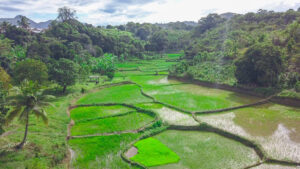
Agroecosystems in Madagascar. Photo credit: Riccardo Morrelas.
Want to learn more about the Duke Lemur Center’s conservation programs in Madagascar? Read more here!
The DLC’s conservation projects in Madagascar are run exclusively on grants and donor funding. Please consider making a tax-deductible donation today!