Although based at Duke University in Durham, North Carolina, the Duke Lemur Center hasn’t stayed put! With partnerships across the globe, the DLC’s reach and reputation as a world leader in lemur conservation and care are on full display.
(Read “One Place, a World of Impact: International Partnerships in Animal Care.”)
The DLC’s Colony Curator, Britt Keith, and other members of the curatorial team have been working with our zoological partners in Europe and our friends and colleagues in Madagascar’s Ministry of the Environment to support critical ex situ conservation programs that directly impact the future of several lemur species.
Thanks to an on-the-ground conservation program started 40 years ago by longtime DLC conservationists Andrea Katz and Charlie Welch, the Lemur Center has nurtured a strong relationship with many Malagasy communities and officials to advance the conservation of lemurs. Those relationships, built on trust and respect, are critical to the success of the DLC’s long-term conservation programs and emergency response to unforeseen events, as described below.
We are honored to play a small role in these initiatives and applaud the efforts of our European and Malagasy colleagues on the front lines of these crucial programs.
What is Ex Situ Conservation?
Ex situ initiatives address the conservation and care of lemurs living outside the forest in zoos, private parks, and conservation centers across the island. In situ conservation initiatives, on the other hand, focus on lemurs still living in their natural habitat (Madagascar’s forests).
Ex situ conservation measures complement in-situ methods in that they provide a genetic safety net (or “insurance policy”) against a species’ total extinction. These measures also have a valuable role to play in recovery programs for endangered species.
Advancing Lemur Care in Madagascar
Background and History
In 2017, the Government of Madagascar’s (GOM’s) Wildlife Department requested the assistance of the Duke Lemur Center to advance the state of lemur husbandry and breeding management in Madagascar’s zoos. On the island, lemur collections are held in 14 facilities licensed by the GOM, including two national zoos and 12 privately-owned zoos. Together these zoos care for 645 lemurs of 20 endangered species.
At the time, Madagascar had no national standards of animal care and management, and while some zoos were fairly well run, others exhibited inadequate housing and husbandry practices. And, because the GOM requires these zoos to accept and care for lemurs that are confiscated from people holding them illegally as pets or for illicit trade, housing and care were even more challenging. There was also little to no consistent record-keeping in place, and the origin of many lemurs was unknown. It was also rare for animal exchanges to occur for the purpose of improving genetic and demographic diversity in breeding programs. Madagascar could, and wanted to, do better with the DLC’s help.
Parc Ivoloina
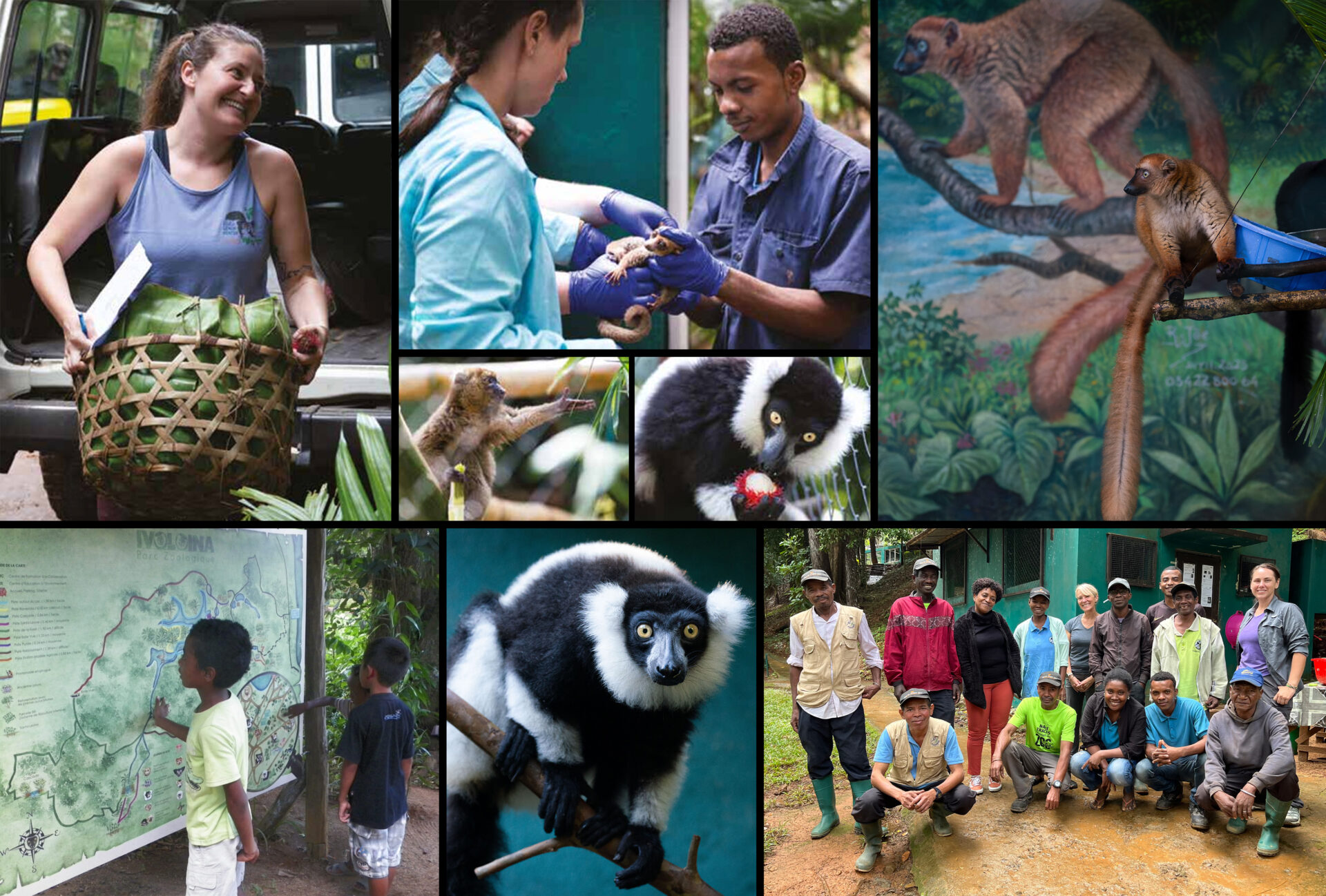
Located on 700 acres near the seaport town of Tamatave, Parc Ivoloina has partnered with the Duke Lemur Center since 1987, when DLC husband and wife team Charlie Welch and Andrea Katz began working with Ivoloina staff to develop the park into a nationally recognized center for conservation, conservation breeding, and environmental education.
DLC husbandry staff have regularly traveled to Madagascar to work side-by-side with keepers at Parc Ivoloina. During these weeks- and months-long trips, DLC staff have lived onsite and helped train zoo staff on animal husbandry, health monitoring, and breeding and birth season management.
Parc Ivoloina is supported by the Madagascar Flora and Fauna Group (MFG), a consortium of zoos and other institutions committed to supporting conservation in Madagascar. The DLC has been a founding and managing member of the MFG since it was formed in 1988.
Coquerel’s Sifaka Conservation Breeding Program
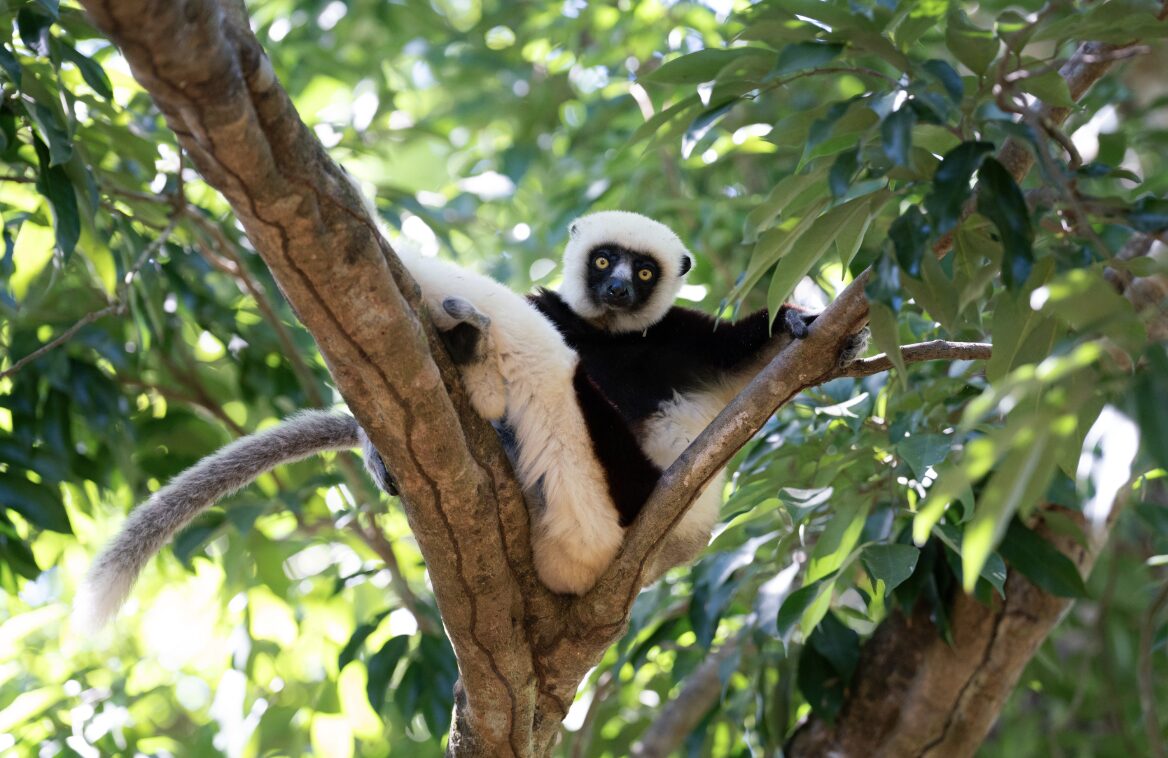
In 2025, 10 Coquerel’s sifakas reside in Europe and 53 reside in the USA. In addition, 34 Coquerel’s sifakas live in four private parks in Madagascar. Since 2023, the DLC has been collaborating with these parks and Madagascar’s Ministry of the Environment and Sustainable Development to develop a studbook and Species Survival Plan for these sifakas. The goal? To protect this species from extinction by maintaining captive populations of lemurs that one day may be the best candidates for reintroduction to Madagascar’s forests, to reinforce or re-establish wild populations. Pictured: A free-ranging Coquerel’s sifaka at Lemurialand in Nosy Be, Madagascar.
Coquerel’s sifakas are among the most endangered primates on Earth, with wild populations declining 80% over the last 30 years due to habitat loss. Breeding programs in the USA and Europe form a safety net that guards against the species’ total extinction, should wild populations continue to crash. And breeding programs in Madagascar, combined with protecting forests and studying wild populations, will play a crucial role in recovery and reintroduction programs.
In 2023, the Duke Lemur Center and Madagascar’s Ministry of the Environment and Sustainable Development (MEDD) entered an Accord of Collaboration concerning the status of Propithecus coquereli (Coquerel’s sifakas) in private parks in Madagascar. For the foreseeable future, the DLC will be an active and collaborative partner with MEDD and four private parks with the development of a Coquerel’s sifaka studbook and Species Survival Plan.
Each summer, Colony Curator Britt Keith and Assistant Curator Danielle Lynch travel to Madagascar to observe and verify the lemurs in each park. They also assist in onsite data collection, deliver the microchips and scanners needed for accurate animal identification, and share sifaka-specific information and husbandry practices with zoo managers and veterinarians.
Back in Durham, Britt and Danielle use the data they gather in Madagascar to create a cooperatively managed Species Survival Plan, with breeding pairs chosen to maximize genetic diversity within the captive population.
In September 2026, the first-ever Madagascar studbook and conservation breeding program for any species will be launched for the Coquerel’s sifaka. This, plus the births of three European sifaka infants, is a testament to the long-term relationships, trust, and capacity-building that the DLC and its European and Malagasy partners have created in the name of lemur conservation.
“This triangle of cooperation and dedication between Europe, Madagascar, and the USA—all in the name of the Coquerel’s sifaka—builds on the hope that we can save these incredible, fragile animals,” Britt says. “We will not let this species be lost from the incredible biodiversity found nowhere on Earth but Madagascar.”
Emergency Response
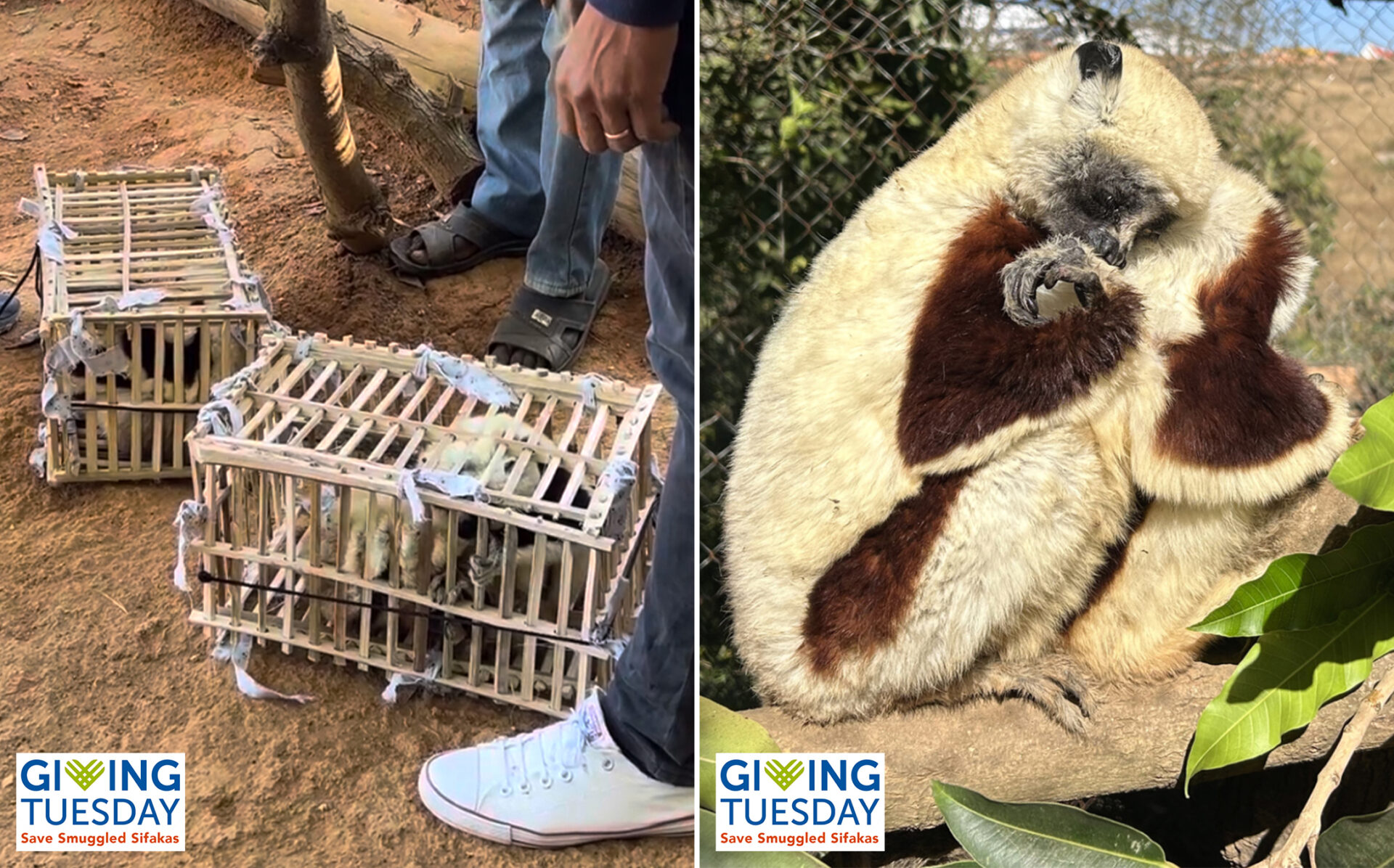
Left: In June 2025, four critically endangered Coquerel’s sifakas were found in cages inside a suitcase bound for Dubai. Right: Two of the rescued sifakas cling to each other after being released inside a safe enclosure at one of our Malagasy partner zoos.
In May 2024, authorities in Thailand rescued over 1,000 endangered animals—including 47 lemurs—from animal trafficking. As various conservation groups, parks, and rescue centers worked to return these animals to Madagascar, the Malagasy Ministry of the Environment (MEDD) contacted Colony Curator Britt Keith for logistical assistance, particularly with the care and safe transportation of the rescued lemurs.
In June 2025, Britt and DLC Assistant Curator Danielle Lynch—both of whom specialize in the care of Coquerel’s sifakas, a fragile species that requires incredibly specialized care—traveled to Madagascar on a routine visit to assist with Madagascar’s Coquerel’s sifaka conservation breeding program. Within hours of landing, they were called to assist one of our Malagasy partner zoos by leading emergency care efforts for four confiscated sifakas found in a suitcase bound for Dubai.
When additional shipments of sifakas were discovered this summer and fall, MEDD again reached out to Britt and the Duke Lemur Center for guidelines for the lemurs’ transport, emergency veterinary care, and housing. As of December 2025, the DLC is actively supporting MEDD in providing emergency veterinary care, food, and housing for these three groups of rescued Coquerel’s sifakas.
To Europe, Two by Two
Click the image to read the full article.
Coquerel’s Sifakas (Propithecus coquereli)
In the early 1970s, the DLC established its conservation breeding program for the critically endangered Coquerel’s sifaka . Over the decades, the program grew into the most successful breeding program in the world of any species of sifaka, and for years the DLC has been working with partner zoos in the U.K. and Germany to expand this breeding program to Europe.
In 2021, a half-decade of planning finally came to fruition: Four pairs of DLC sifakas were shipped to zoos in Chester, Berlin, and Cologne in a historic expansion of the Coquerel’s sifaka conservation breeding program. They became the first members of their species ever to set foot on European soil—marking the beginning of a new chapter in lemur conservation.
18 months later, Sofena was born at Chester Zoo in Cheshire, England—the first-ever successful Coquerel’s sifaka birth outside Madagascar and the USA. “The birth of a Coquerel’s sifaka in Europe is a real landmark moment for conservation,” said Mike Jordan, Chester Zoo’s Director of Animals and Plants, in a press release in 2023.
Two additional male Coquerel’s sifakas were shipped from the DLC to Germany in 2024.
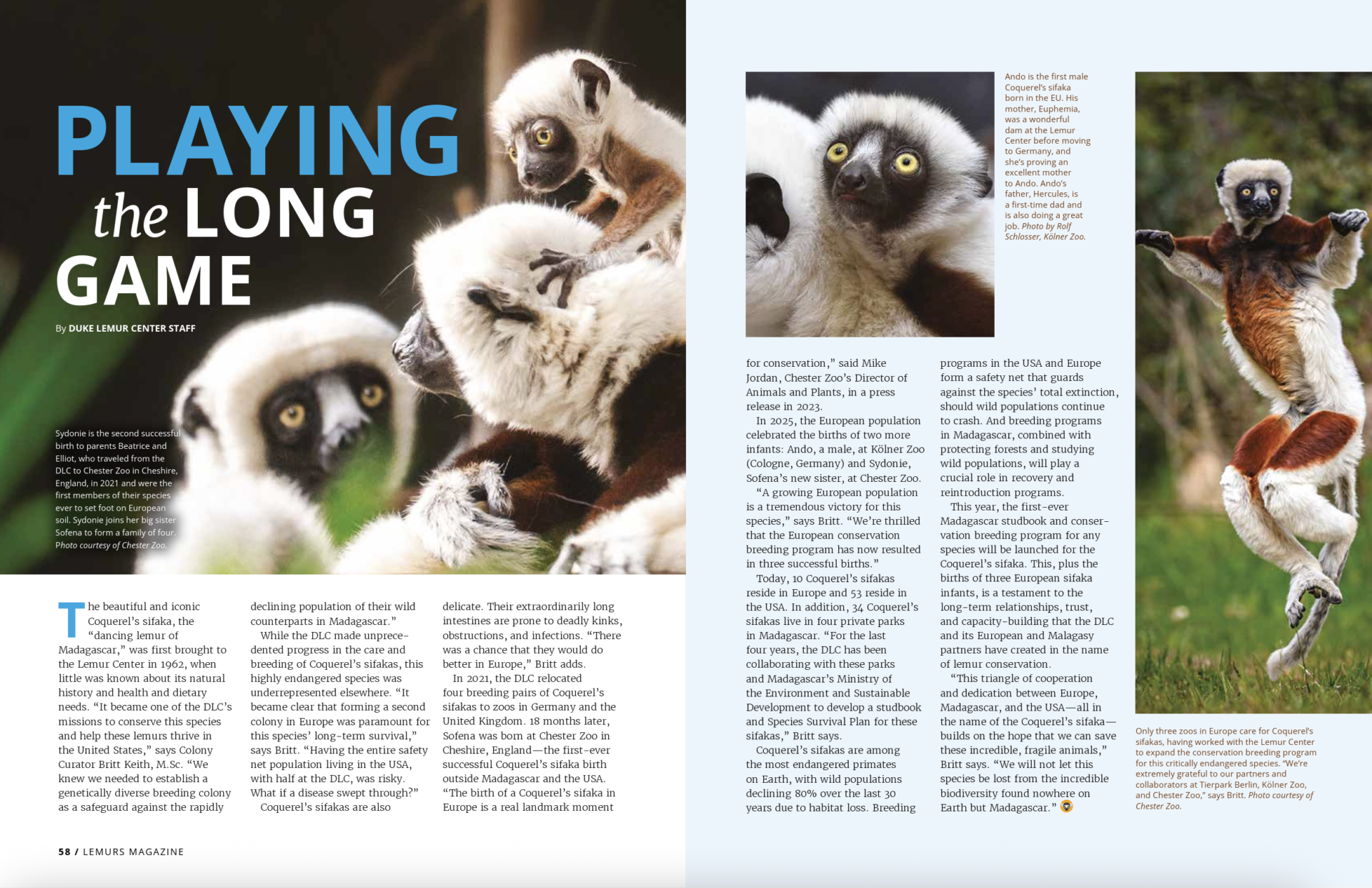
In 2025, the European population celebrated the births of two more infants: Ando, a male, at Kölner Zoo and Sydonie, Sofena’s new sister, at Chester Zoo. (Read “Playing the Long Game.”)
“A growing European population is a tremendous victory for this species,” says DLC Colony Curator Britt Keith. “We’re thrilled that the European conservation breeding program has now resulted in three successful births.”

A critically endangered mongoose lemur free-ranges at the Duke Lemur Center.
Mongoose Lemurs (Eulemur mongoz)
In 2024, two breeding pairs of critically endangered mongoose lemurs were sent to Tierpark Berlin to boost the European population of this critically endangered species.
“The European population of mongoose lemurs was overaged and male-biased before the shipment took place,” says Andreas Pauly, head veterinarian at Tierpark Berlin. “The Duke Lemur Center was ready to help and took over the matching of two mongoose lemur pairs.”
Two mongoose lemurs (Javier and Zoe) were sent to the DLC from the Lemur Conservation Foundation, one (Natasha) was sent to the DLC from the Philadelphia Zoo, and the fourth (Nacho) was born at the DLC. All four departed from the Lemur Center and arrived in Berlin in November 2024.