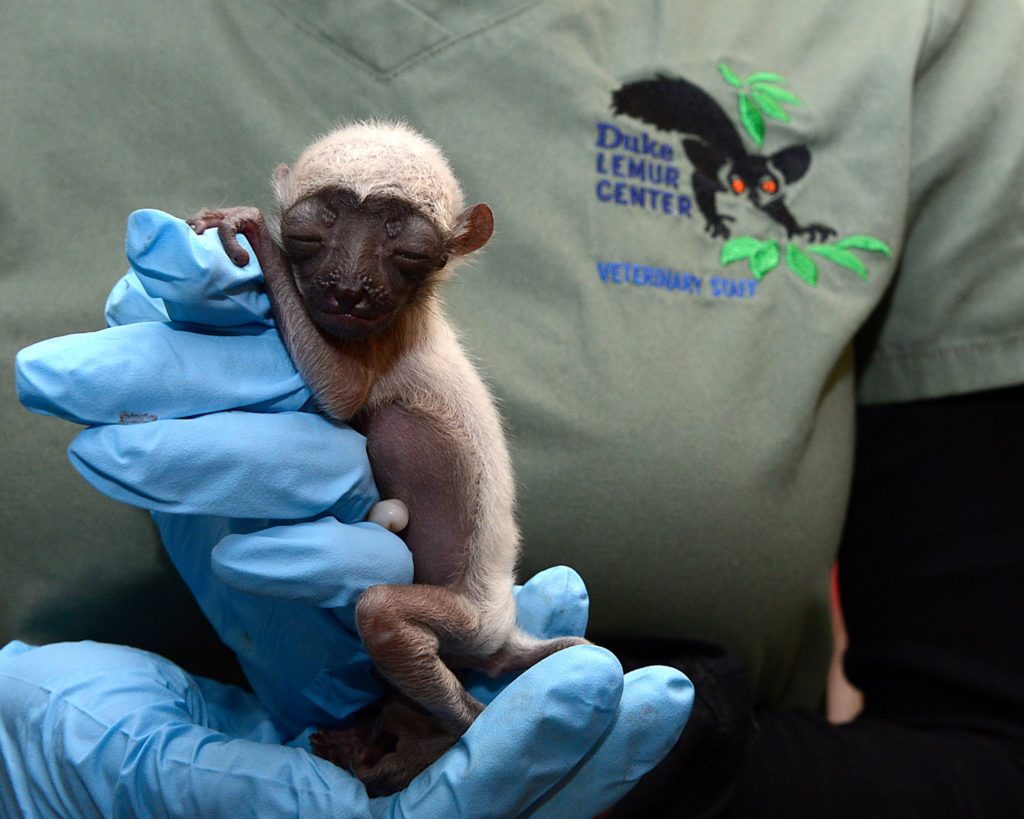
Conservation breeding programs are critical for lemur conservation, and the Duke Lemur Center maintains the world’s largest “genetic safety net” for these endangered primates. Here in Durham, NC, we’re proud to have celebrated more than 3,405 births through our conservation breeding program since our founding in 1966.
North America
The Duke Lemur Center is accredited by the Association of Zoos and Aquariums (AZA) and works within a network of other AZA-accredited institutions nationwide to develop and adhere to Species Survival Plans (SSPs), which use carefully planned conservation breeding programs to create a genetic safety net for rare and endangered species.
SSPs outline the breeding plans for each species as determined by a team of experts, which selects breeding pairs of males and females based on how genetically valuable their offspring would be to the captive population. The goal of each SSP is “to ensure the sustainability of a healthy, genetically diverse, and demographically stable population for the long-term future.”
Because we work within a network of excellent and responsible zoos, conservation partners, and other facilities, breeding plans are managed cooperatively. This means that, if the breeding recommendations aren’t in-house, we may send one of our lemurs to another facility for breeding or even receive a new male or female to pair with one of our lucky residents. For example, our new female crowned lemur, Sanura, was recently transferred from the Cleveland Zoo to the DLC because the SSP had determined that she’d be a good genetic match for Zuberi, one of our resident males. In this way, facilities across North America (and even around the world) all work together to build and maintain a genetically viable population of each species we care for and breed.
Because of the continuing pressures of population growth, poverty, and forest habitat destruction, it’s a very real possibility that some species of lemur could go extinct in the wild. If they do, then those species’ survival will be based solely on animals surviving within human care.
This is why genetic diversity among our lemurs is so important. The more genetically diverse a population is, the more resilient it is, the healthier it is, and the better it can adapt to environmental pressures — crucial factors in the fight to protect lemurs from extinction.
Madagascar
At the invitation of the Government of Madagascar, one of the DLC’s newest conservation initiatives is to develop a conservation breeding program for Madagascar’s zoos, and to help the island’s zoos and wildlife parks establish best practices in lemur care. In doing so, the DLC has the opportunity to improve the care and welfare of over 600 lemurs representing 20 endangered species, housed in 14 licensed zoos across Madagascar. This initiative may protect these species from extinction by maintaining a population of lemurs that one day may be the best candidates for reintroduction to Madagascar’s forests, to reinforce or re-establish wild populations. The Duke Lemur Center is uniquely qualified to build and manage such a program, given our long history caring for lemurs and our 40+ years’ conservation and research experience in Madagascar.
In 2023, the Duke Lemur Center and Madagascar’s Ministry of the Environment and Sustainable Development (MEDD) entered an Accord of Collaboration concerning the status of Propithecus coquereli (Coquerel’s sifakas) in private parks in Madagascar. For the foreseeable future, the DLC will be an active and collaborative partner with MEDD and four private parks with the development of a Coquerel’s sifaka studbook and Species Survival Plan.
Europe
The beautiful and iconic Coquerel’s sifaka, the “dancing lemur of Madagascar,” was first brought to the Lemur Center in 1962, when little was known about its natural history and health and dietary needs. “It became one of the DLC’s missions to conserve this species and help these lemurs thrive in the United States,” says Colony Curator Britt Keith, M.Sc. “We knew we needed to establish a genetically diverse breeding colony as a safeguard against the rapidly declining population of their wild counterparts in Madagascar.”
While the DLC made unprecedented progress in the care and breeding of Coquerel’s sifakas, this highly endangered species was underrepresented elsewhere. “It became clear that forming a second colony in Europe was paramount for this species’ long-term survival,” says Britt. “Having the entire safety net population living in the USA, with half at the DLC, was risky. What if a disease swept through?”
Coquerel’s sifakas are also delicate. Their extraordinarily long intestines are prone to deadly kinks, obstructions, and infections. “There was a chance that they would do better in Europe,” Britt adds. “We needed to find out.”
In 2021, the DLC relocated four breeding pairs of Coquerel’s sifakas to zoos in Germany and the United Kingdom. 18 months later, Sofena was born at Chester Zoo in Cheshire, England—the first-ever successful Coquerel’s sifaka birth outside Madagascar and the USA. “The birth of a Coquerel’s sifaka in Europe is a real landmark moment for conservation,” said Mike Jordan, Chester Zoo’s Director of Animals and Plants, in a press release in 2023.
In 2025, the European population celebrated the births of two more infants: Ando, a male, at Kölner Zoo (Cologne, Germany) and Sydonie, Sofena’s new sister, at Chester Zoo.
“A growing European population is a tremendous victory for this species,” says Britt. “We’re thrilled that the European conservation breeding program has now resulted in three successful births.”