
Blue-eyed black lemurs (Eulemur flavifrons) are a social, female dominant species.
In captivity, this species is most often housed as male-female pairs, breeding pairs and their offspring, or related male-male pairs. Mixed species pairs or trios have been successful and provide companionship when a compatible individual of the same species isn't available. In addition to the above-mentioned groupings, the DLC has had success housing a mother-daughter pair and as companions with other Eulemurs such as common black lemurs, crowned lemurs, mongoose lemurs, and collared lemurs. The most common housing arrangement at the DLC is as male-female pairs or small family groups.
Blue-eyed black lemurs have been housed successfully in mixed-species enclosures at the DLC and at a variety of zoos. Individuals and groups of this species tend to establish themselves as dominant over other species in the enclosure. Group dynamics should be closely monitored as this dominance can cause issues, primarily at feeding times, occasionally requiring groups or individuals to be separated to eat. Species that blue-eyed black lemurs have shared enclosures with include ring tailed lemurs, Coquerel's sifakas, and ruffed lemurs.
If your institution is interested in a mixed-species exhibit or is curious about what has worked at other facilities, please refer to the AZA Prosimian TAG's Mixed-Species Manual.
The largest family group of this species at the DLC in recent years was a family of 5 individuals. The group consisted of a breeding pair and their 3 offspring. Individuals under a year of age are considered infants and should remain in their natal group. Some breeding pairs are more tolerant of offspring remaining in the group for multiple years while others may evict offspring sooner.
The DLC has seen dams evict their year-old offspring when the young are removed from the group for their annual exam. As a result protocols have been modified to avoid this conflict by separating all individuals in a group until everyone can be put back together. Attention should be paid when removing family members for veterinary procedures or for other reasons. Animals being out of the group for even an hour or two can result in aggression from group members when the animal is returned and may end with the animal that was removed being evicted.
Introductions and Re-introductions:
It is important that introductions are conducted in a manner that is safe for all animals and humans involved. It is also important to remember that flexibility is a key component of any introduction. Some introductions are best done in a smaller area that is easy to intervene if necessary while others are more likely to succeed if animals have more space during the introduction period.
Whenever possible, start an introduction with a period of side-by-side visual and olfactory contact with limited tactile contact (a howdy setup). This initial period allows familiarity to develop but is short enough to avoid negative behaviors from forming. This period can range from one to a few days or longer, depending on the situation. If staffing allows animals are introduced within a day or two of being housed side by side. Olfactory exchange (switching enclosures or scent-marked items) prior to introducing animals or groups can sometimes ease aggression. When no sustained aggression is observed in side-by-side housing and when animals rest close to each other along the wire between enclosures, short duration, full contact introductions are started.
At the DLC, animals are fed prior to introductions with left over food removed before the introduction starts. It is important that the introduction is done by staff that are trained on how to handle and restrain animals in case there is a need to intervene. Staff should be trained on lemur behavior and what to look for during introductions.
Affiliative behaviors to look for include nose greeting, soliciting grooming, mutual grooming, scent-marking, and occasionally play. Unless animals immediately come together to groom and are completely comfortable with each other, the first day introduction usually lasts about an hour with staff observing the entire time. If the introduction is uneventful and the initial signs are encouraging management may decide to keep it going longer. On the other hand, behaviors such as swishing tails, chasing, frequent displacement, eye squinting or side eyeing, tongue flicking, biting, animals fighting and balling up, or hair pulls are cause for concern and potential injury. In these cases, daily, short duration (about an hour), constant supervised introductions are the best bet.
Once the individuals show relaxed behavior such as eating, sleeping, sunning, and cuddling, direct supervision may be replaced by frequent checks. Eventually animals are left together overnight. This species may go together nicely from the first introduction or it may take a few days before staff is comfortable leaving them together full time. It is fairly common for Eulemur introductions to go well enough that the pairs stay together full time from the first introduction.
Introduction Examples:
1.1 Presley and Kidman, companion pair
- Jan 30, 2017: 0.1 Kidman moved into cage next to 1.0 Presley. He spent the day resting in the cage next to Kidman. Kidman and Presley showed no aggression toward each other and have shown interest in each other.
- Feb 7, 2017: Kidman and Presley were introduced in outside cages at first then given inside access also. Initially, Presley was only focused on humans in the hallway observing the intro. When non-essential observers moved down the hall he immediately stopped his obsessive wrist marking and went over to Kidman. They both calmly approached each other after 4 minutes and began grooming each other. The intro was very calm, neither individual was stressed or anxious around the other. They had several great mutual grooming sessions throughout the day. There was no aggression when food was scattered around cages either. They will remain together overnight with 3 cages in and out.
1.1 Quinn and Leigh, new breeding pair
- April 25, 2019: Pair moved side by side.
- April 30,2019: Leigh and Quinn were introduced. The start of the intro was very slow. Leigh seemed anxious to get to Quinn however Quinn would actively move away and was uninterested in being in the same stall as Leigh. By noon, the two were asleep on the same shelf (opposite ends, not touching). Throughout the day they seemed to get closer, sharing the same cage but never touched. At the end of the day, they were curled up in a lemur ball and they stayed together overnight.
1.1 Hiddleston and Wiig, new breeding pair
- May 4, 2015: Pair moved side by side. Wiig was reaching through the wire caging toward Hiddleston. Both individuals were pacing (young, both left family groups) but settled down later in the day. They were seen near each other along the wire.
- May 5, 2015: Pair introduced. Wiig was still a bit “shell shocked” after being separated from her family group and she spent most of the day hunkered down in shift doors. No grooming seen between the pair, but no aggression either. There was some tentative sniffing. They were seen on the ground together eating at one point. He was very polite and kept his distance. They stayed together for the night.
Behavioral Traits:
The DLC sees a higher level of aggression in this species toward humans then other species. Of 14 individuals, 3 are worked protected contact (PC) due to aggressive tendencies or previous unprovoked bites. Please see the DLC’s Protected Contact Protocol below. Several other individuals, primarily females, exhibit aggression toward staff and are often worked PC as a precautionary measure. Behaviors commonly seen from our aggressive individuals include but are not limited to:
- Lunging at humans
- Stalking humans as they pass by
- Tongue flicking
- Squinting eyes
- Side eye glances
- Grinding teeth
- Excessive wrist marking in males
- Reaching through cage wire to grab, pinch, scratch staff
Blue-eyed black lemur groups often have seasonal increases in aggression with increases in hunger and food related aggression during the hot, summer months. This results in tension within the group and increased aggression toward humans. Females tend to become more aggressive after having offspring at the DLC. When a dam is worked up she may displace aggression towards infants. Aggression toward infants can include huffing or vocalizing at an infant and grabbing or jostling the infant. Due to the sensitivity and higher level of aggression this species exhibits, they are often provided larger enclosures and more space than other Eulemurs at the DLC.
Forms of aggression seen in this species toward each other:
- Chase, grab, cuff, lunge, and bite
- Hair pull
- Grinding teeth
DLC’s Protected Contact Protocol
Purpose: to ensure human and animal safety.
Procedure: Individual animals or groups at the DLC are managed as Protected Contact (PC) if they have a known history of biting or attacking staff, researchers, volunteers, or tour participants when there is no indication the animal is protecting itself or other group members and is not provoked in any identifiable way. Animals may also be designated as PC if they display unprovoked aggressive behavior that, in the estimation of management staff has the potential to escalate to more harmful behaviors. This policy does not pertain to animals that are aggressive or bite during capture or handling procedures, which is considered provoked aggression.
When an animal is designated as PC the following protocol is instituted to ensure the safety of staff, volunteers, interns, and researchers as well as the animals in question.
- All PC animals have “Protected Contact Only. Stop Do Not Open” signs posted on the outside of every cage the animal or group members have access to.
- The animal(s) must be shifted into a secure location away from anyone entering the cage, with all shift doors closed and secured. Only permanent trained staff are allowed to shift PC animals.
- The staff member may then enter any of the cages where the animal does NOT have access to in order to feed, clean and change water. Once the staff member exits and secures the caging that was serviced, the animal(s) is again given access to those cages.
- In the event that an animal cannot be shifted into a secure location and it is necessary to enter the same space as the animal the staff member MUST have a secondary back-up person with them at all times while in the cage protecting them with a net. The secondary back-up is a staff member who is signed off on all levels of Animal Handling. If such staff is unavailable, then another staff member may be utilized at the discretion of the Point of Contact for the day.
- A current list of all PC animals is maintained and updated as necessary by the Primate Technician Supervisor.
Blue-eyed black lemurs are seasonal breeders with the peak breeding months in North America being November and December with subsequent births in March and April. Decreasing daylight is the environmental cue that stimulates the onset of the breeding season.
In captivity, female E. flavifrons reach sexual maturity as early as 1 ½ years of age and males at 2 1/2 years of age. It is ideal to leave juveniles with their natal group for several years as long as dams and sires remain dominant over their offspring. Precautions must be taken to avoid mating between parents and offspring as offspring mature. It is thought that gaining experience with younger siblings and infants in their natal group better prepares juveniles for success rearing their own young.
The DLC has had to separate offspring from parents during breeding if the adult male is being prevented access to the breeding female by juveniles either through aggression or the offspring are simply in the way. Often the offspring are separated for a day or overnight, returning to their parents the next day, post breeding. We recently had a juvenile male that was rivaling his father for dominance during breeding season and prevented the adult male from approaching the breeding female. After many attempts at keeping the group together the young male had to be removed from his family.
Physical and behavioral changes occur in both males and females during breeding season.
Males: Prior to breeding season an increase in testicular size occurs in males, their fur becomes greasy and pungent, and time spent scent marking their enclosures and females increases. Male scent marking includes palm and wrist marking, head rubbing, and rubbing the anogenital region over objects. When a female is coming into estrus or is receptive males show focused interest in females and less interest in food, keepers or conspecifics, or increased time watching females and following, sniffing, grooming, mounting or copulating.
Females: It can be difficult to detect physical changes in females during the breeding season. However, with careful, regular observation, changes noted may include more a intense pink color or swelling of the vulva. Staff should familiarize themselves with the baseline appearance of a breeding female’s genitals for comparison if physical changes occur. Photographs are a useful tool to track a female’s progression during a cycle or for reference each year during breeding season. It is recommended that keepers habituate females to allow regular observations of the vulva. This may be achieved by training the female to cling to the cage wire or to stand on a branch in a position that her vulva can be seen. A flashlight can be helpful for detecting visible changes. Records should be maintained to chart a female’s estrus cycle. The DLC checks and records females estrous status 3 times a week during the breeding season and daily once a female begins to cycle. Depending on the female, some, all, or none of these physical indicators may be present. If none of these physical changes are noticeable then behavioral observations become essential.
Copulation may not be observed by staff and when it is, it is often difficult to determine whether it is successful. The male may mount the female multiple times before achieving successful copulation after which both individuals auto groom their genitals. The lack of observed copulation does not indicate that the pair is behaviorally incompetent. Copulation may occur in the evening or early morning when less activity is occurring around the animal enclosure. Male blue-eyed black lemurs produce sperm plugs after a successful copulation. In the wild, sperm plugs prevent other males from copulating with the female for several hours or days until it falls out naturally. Note in the animals' record if a sperm plug is found on the ground or observed inside the female. Breeding is assumed to have occurred the day prior to seeing a sperm plug. Sperm plugs are not always found, however. They may fall into drains or substrate and be discarded. In large enclosures sperm plugs are usually not found.
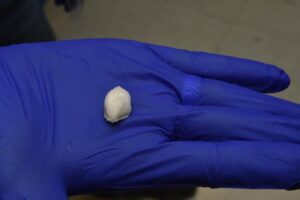
Sperm Plug
Behavioral cues during breeding season may be obvious or subtle. Females may be nicer and more tolerant of their male companion while in estrus. A female may share a food bowl when normally the female would displace the male. The breeding pair may separate themselves from offspring. A female may even allow her male to be dominant over her while in estrus.
Tracking a female’s estrous cycle allows husbandry staff and managers to predict when a female will be in estrus. Females can have up to three estrus cycles during a breeding season with ~33 days between estrous cycles. If mating is observed the staff can re-examine the female at her typical inter-estrus interval to get an indication of whether the female may be pregnant. Weight gain is not a suitable method for determining pregnancy in this species. Females should be palpated and/or receive an ultrasound by the veterinary staff about halfway through a suspected pregnancy to confirm pregnancy. Veterinary staff and management can better estimate when parturition should occur if breeding was observed. The gestation length in this species is 124-130 days.
Each female is different and therefore parturition plans are adjusted to fit an individual female's needs. The DLC's standard parturition protocol is for females to be separated from her mate or family members when an infant is first found. E. flavifrons have a high infant mortality rate and low total captive population size, hence, each infant is incredibly valuable to the population. Therefore, in some cases an expectant female is separtated from her mate and/or family the day before her early due date. This practice has been successful at the DLC but parturition plans should be tailored to the specific female. See DLC Parturition Protocol below.
Births can occur both day or night with night births being most common. Prior to parturition the female may become restless and exhibit pacing, increased genital grooming, squatting and tail lifting in a manner that resembles defecating. Females also become more aggressive toward group members to keep them at a distance. When the female’s water breaks, she vigorously grooms herself and soiled surfaces. Birth should occurs within 30 minutes of contractions starting. Females typically sit on their haunches during birth although they may shift or change their position numerous times. Females immediately groom infants dry, use their molars to sever the umbilicus, and typically consume the afterbirth. Females most commonly give birth to singletons but twins are possible.
Captive females who lose an offspring may have a post-partum estrus and give birth to a second infant within the span of a year. The DLC prevents out of season births using contraception or by separating the male and female if the female starts cycling soon after losing an infant.
Maternal Care and Infant Development:
Infants should cling tightly to dam's ventral abdomen from birth. Females often hunch over the baby keeping them warm and allowing them to nurse. If an infant falls off its mother and the mother does not try to retrieve it management intervention and veterinary involvement is necessary to encourage maternal behavior and rule out problems with the infant or dam. If no health problems are detected and the infant isn't cold, then the infant and dam can be housed in a kennel or very small cage to encourage maternal behavior. The enforced proximity may stimulate females to care for and successfully raise their infants. Institutions should evaluate any factors that may encourage or discourage maternal care and make appropriate management changes. Examples of factors that may impact maternal care include: loud noises, high traffic areas, proximity to other groups or species, and exposure to conspecifics.
Pay close attention to health problems in the infant such as low body temperature, long or difficult labor leading to infant stress or weakness, infant not starting to nurse because the dam is moving around too much for the infant to nurse, etc. Often infants don't gain weight or start nursing because they are cold or there were problems with the delivery which cause the infants to be weak or experience fetal stress during delivery.
Infants are carried transversely on their mothers’ lower abdomen. Twins typically orient in different directions, so their heads are opposite each other. Newborns must cling to and locate the female’s nipples on their own since mothers can only minimally support or guide them. Females spend most of the first days postpartum huddled over their infant in a manner that places the infant in a position that facilitates nursing. If an infant falls off its mother, it will likely not be retrieved. Maternal care consists mainly of staying still so teh infant can nurse, huddling over the baby to keep it warm, and grooming.
For about the first week postpartum, the mother may be assertive at keeping family members away from herself and the infant. Vocal threats are generally sufficient although persistent individuals may be threatened with head lunges or chased. Previous offspring are permitted near the dam and infant before the female’s mate.
Infant Development:
Eulemur infants are born fully furred with eyes open. The infants immediately cling their mother’s fur. Immediately after giving birth females spend an hour or so cleaning the infant and consuming the afterbirth. During this time, and for the next few hours, infants may be seen crawling all over the mother’s belly and back. Soon however, the infant should locate one of the mother’s nipples and settle down to nurse.
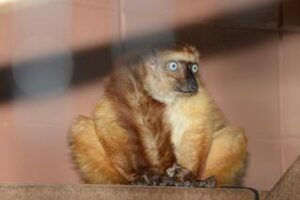
Dam in ideal nursing position
It is usually possible to make a visual determination from the position of the mother and infant that the infant is in good nursing position. The female should be in a hunched posture, sheltering and covering the infant with only the top of the infant’s head visible at a location near the mother’s armpit. It is not ideal for females to be restless or moving a lot shortly after birth as it prevents the infant from nursing. Note that sounds of nursing can be deceiving and are not always a sign of effective nursing. The infant weighing protocol which is described below is critical to monitor infant health.
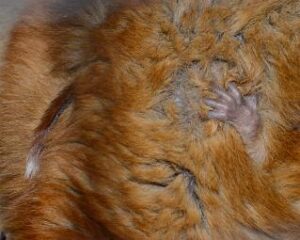
Infant is barely visible, only a hand and tail can be seen.
Infants and dams are generally caught the first or second day and both given a physical exam by the veterinarian at which time the infant is sexed and weighed (if the infant is examined the first day, it is usually several hours after discovery, not immediately). It is very important to have a day one or day two weight to compare with weights on subsequent days to determine if the infant is nursing. During the examination, the infant should be alert with eyes bright and wide open (not droopy) and it should be vocalizing loudly when off the dam—even when just a few hours old. During the exam the mother is checked for milk, however, note that a nipple without milk usually indicates that the infant has been nursing, while full glands on both sides, may indicate that the infant has not been nursing. Newborns may nurse only on one side for the first few days, so it is not uncommon for the nursed gland to be empty and the un-nursed gland to have milk.
On the second day of life, infants are once again weighed. It is normal for the infant to have dropped in weight somewhat, but a loss of more than two or three grams is cause for alarm. Infants should be watched closely during the day to make sure that they are nursing and appear strong. Infants should be weighed again on days 3, 5, and 7, and should be showing weight gain each of these days. Starting at week two and continuing until 4 weeks of age, infant are weighed twice a week provided they are gaining weight well. From 4 to 12 weeks of age, infants are weighed once weekly. At 3 months of age weighing decreases in frequency to once every 2 weeks and then to monthly after infants are 6 months old. Training animals to sit on a scale for treats will make obtaining regular weights easier for the care staff.
For the first few weeks, infants are rather inactive, staying nestled against their mother’s chest and abdomen. Initial exploration of the environment is visual; the infant can be seen gazing intently at nearby objects and conspecifics. Three week old infants of Eulemur begin manually touching objects within their reach. At five weeks, infants’ locomotor skills have improved, and they begin transferring to their mother’s back; at six-eight weeks they take brief excursions off her. Leaving the security of their mothers’ body to fully explore their environment is a gradual process. Infants begin mouthing and tasting solids when four to six weeks old and may be eating solids regularly at ten weeks.

Infant Weights and Temperature:
Body temperature can range from 96- 99 degrees. Eulemur infants must be removed from the dam for weighing and to get a temperature. This can be achieved through training voluntary infant removal/return or by gently restraining the dam to remove the infant. Please see details of infant removal for weighing under Weighing Schedule Section. All supplies such as the scale, weighing container with a stuffed animal, and thermometer should be ready so the procedure occurs smoothly and quickly.
Species Mean Birth Weight (in grams)
Average birth weight is 79g. The lowest birth weight to survive at the DLC was 55g
Duke Lemur Center Parturition Protocol For Eulemur
Pregnant females on "baby watch" should be checked first thing in the morning at the early shift (6:30am) and the final thing before leaving at the end of day (4:30pm). Dams with newborn infants should also be checked by the early shift staff on days 2 and 3.
Feeding
At birth, increase the dam’s diet to 1.25 standard diets.
After sire/sibling intros, food must be scattered in multiple locations to ensure the infant has adequate access to food items.
Quiet Zones
As a rule, dams with new infants should be disturbed as little as possible during the first week after birth. Some females may become agitated by people observing and may need longer times of restricted staff access to minimize risks to the infant. E. flavifrons is a sensitive species and often observations take place from a greater distance. The primary and secondary area keepers, supervisors, and veterinary staff if needed, have principal responsibility for monitoring the dam and infant.
Staff are encouraged to see and gain experience in dam/infant behavior but are urged to check in with primary or secondary care taker for any special concerns before visiting the new infant.
During the first week, do not bring guests, friends, or family to areas with new infants. After that, small groups of well-supervised visitors may briefly observe groups with infants.
Day One
1) Determine the status of the dam and the infant. The dam and infant are physically separated from the other group members when staff finds a female with a new infant. If due dates are known, certain females may be separated from the group a day or two prior to her birth window. The dam and infant should remain physically separated (within visual contact) from group for 48-72 hours. In some circumstances the separation may be shorter or longer.
2) Begin a log and record observations. The DLC has a document for infant observations to keep track of position of the infant, if nursing is seen/suspected, and a dam’s response to her infant. On the first day, an infant should cling to the dam’s lower abdomen in a horizontal position or position themselves upright when nursing. They should not be moving around a lot or vocalizing when on the dam. If the infant seems restless, is seen moving around a lot or is on the dam’s back, neck, or legs, it is a sign that it is not able to find the nipple. An active infant is a tired, hungry infant.
3) Weigh the infant. Weights are best done several hours after birth rather than immediately upon discovery of the infant. If veterinary staff is present, coordinate the weighing with them so that they can examine the infant and dam. If no veterinary staff is present, we contact the veterinarian on call to see if they wish to come in for the weighing, otherwise the veterinarian is informed of the infant’s weight, condition, nursing behavior, etc. *Several of our females are managed as “hands-off” and and we do not weigh their infants due to risk of injury to the infant from dams during or immediately after handling. The decision is made by the DLC's Curator.
4) The veterinarians evaluate weights and examine the infant even if all appears to be going well. Infants may appear fine from a distance during observations but may be weak or lethargic on physical exam. It is important to have a day 1 birth weight to compare to weights on subsequent days for evaluating whether the infant is nursing. Veterinarians will check the dam for milk and the presence of vaginal discharge, and perform an abdominal palpation to ensure uterine involution is occurring as normal.
5) Normal parameters for newborns:
· Healthy infants are alert and vocalize when removed from the dam, their eyes are bright, and eyelids are fully open. Droopy eyelids are a bad sign and indicate a weak infant.
· Getting a rectal temperature is at the discretion of the veterinarian. Normal temperature is 96-99 degrees F; temperatures below 96 degrees F indicate hypothermia and measures need to be taken to slowly warm the infant.
Days Two-Seven
1) Continue frequent observations on the dam and infant throughout the day.
2) Weigh the infant on days 2, 3, 5, and 7 and report weights to the Veterinary Department. If an infant has not nursed normally, it will become so weak it can no longer hold on and will eventually drop from the dam. Prior to actually falling from the dam, the infant may show other signs of weakness such as head lolling or clinging in abnormal positions on the dam. By this time the eyelids are usually droopy and the infant appears “dull”. These signs should be reported immediately- this is not a “wait and see” situation.
*It is important to note that several E. flavifrons infants have been “lazy” babies and don't cling to the dam well with their hind legs, resembling a weak infant. These infants have been seen clinging loosely to dam’s lower abdomen. On exams nothing abnormal is found and these infants gain weight and develop normally.
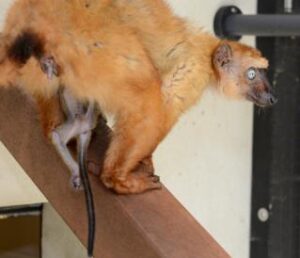
"lazy baby"
3) Re-introductions with other group members may occur during the first week if weights, nursing, and dam/infant behavior are all normal. Otherwise, waiting a few more days may be advisable until any concerns are resolved.
· If possible, feed the dam and group before the first introduction; otherwise wait until the introduction is over before feeding.
· When introducing the dam and infant to others in the group, observe continuously for at least the first hour. If all goes well, hen observe for a few minutes at set intervals determined by Curator or Assistant Curator.
· On the first and second day of introductions it may be prudent to separate the dam with the infant from the group overnight. If the dam becomes agitated during separation, report it to the supervisor.
Two concerns during introductions are:
- Another group member may take the infant from the dam and keep it for extended periods. Generally, as long as observers are present and the dam and animal carrying the infant are calm, an infant can remain off the dam for up to 1 hour to see if dam retrieves it. However, this is not a normal behavior for this species so must be observed closely. If the dam tries to retrieve her infant and cannot do so, staff may have to intervene to return infant to the dam.
- Group members that have had no visual contact with the infant during the early days following birth may not recognize it as their own and become aggressive or kill the infant. Be prepared to intervene quickly if necessary. Group members should always have visual access to the dam and new infant whenever separated to prevent injury to the infant when group members are reintroduced.
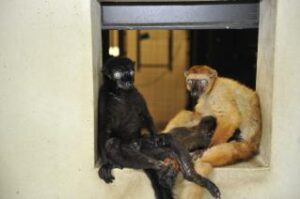
Week Two through Four
1) Begin weekly weights for the infant. However, depending on weight gain in the first week, and any concerns about infant’s condition, the Veterinary Department may decide that more frequent weights are necessary.
2) In some instances, reintroduction of the sire and other group members may be staggered (i.e. sire introduced first) and done gradually. This may take several days to accomplish, but unless there are concerns during the introductions, the goal is to have the entire group reunited by the time the infant is about 2 weeks old.
· There may be circumstances that advance or postpone this schedule. Introductions may be done slowly, an hour or two the first day, then increasing each day until group dynamics are considered stable. Compatible groups, where dominance of the dam is clear, may not require gradual introductions.
· Continue observations intensively at first, then switch to frequent checks.
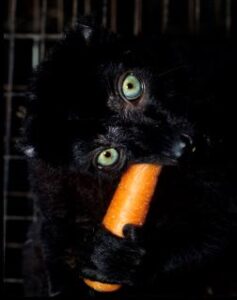
The standard diet at the DLC for blue-eyed black lemurs has been modified over the years to increase fiber and reduce starch and simple sugars due to the tendency of this species to become diabetic later in life. The current diet is fruit free. Fruit free diets have had the additional benefit of reducing food aggression seen in family groups during feeding times.
Our practice is to feed twice a day. Food is commonly offered scattered around the enclosure. For this species, scattering food in many different places and heights around the enclosure is key to ensuring all group members have access to food. Several pairs or individuals at the DLC must be separated at feeding to provide submissive animals time to eat.
E. flavifrons tends to be a food motivated species so using part of their diet in enrichment devices to encourage foraging works well. Some of the enrichment items used include slow feeders, kongs, holey rollers, paper bags, cardboard boxes, etc. When using enrichment devices, be sure to provide more than the number of individuals in a group to avoid aggression.
DLC standard diet per animal:
45g Mazuri leaf-eater primate diet-mini biscuit, 15g Mazuri primate maintenance biscuit (softened with water), and 8 0z (3/4 cup) Vegetable Mix
The produce offered daily is a mixture of at least 3 types of vegetables. Approved vegetables include:
· Carrot
· Cauliflower
· Broccoli
· Cabbage
· Celery
· Corn (limited amounts only)
· Sweet potato (limited amounts only)
· Tomato
· Cucumber
· Onion, green and red
· Greens: kale, collards, romaine, iceberg lettuce, etc.
· Peppers
· Radishes
· Beets (may cause feces to become red)
· Turnips
Browse:
Native fresh browse is offered daily in the spring and summer months. The leaves and flowers of the species listed below are approved:
· American Sweet gum (Liquidambar styraciflua)
· Tulip Poplar (Liriodendron tulipifera)
· Eastern Redbud (Cercis canadensis)
· Mimosa (Albizia julibrissin)
· Winged Sumac (Rhus copallina)
· Muscadine grapes and grape vine (Vitis rotundifolia)
· Lespedeza (Lespedeza cuneata)
· Honeysuckle (Lonicera japonica)
· American Hornbeam, aka Ironwood (Carpinus caroliniana)
*Females that have given birth get a 25% diet increase on the day of birth and the diet continues to increase based on the infant's weight gain.
As with many lemur species, blue-eyed black lemurs are susceptible to obesity under human care. Special care should be taken to avoid over-feeding and to provide appropriate nutrition.
Adult Weighing Schedule:
-Every other month
-Every month if over 20 years old
-More frequently if directed by veterinary staff
Weight Range:
-Adult blue-eyed black lemur ideal weight range is 2100-2600g
-Infant weight range at birth is 60-90g
Weighing Schedule for Eulemur infants:
-Week 1: weigh at days 1,2, 3, 5, 7
-Weeks 2-8: once weekly
-Months 3-6: every 2 weeks
-Over 6 months: once a month
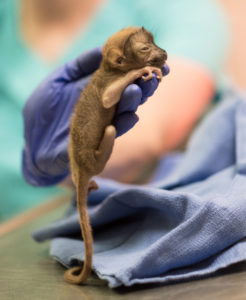
The DLC has a strict weighing schedule for infants to monitor their weight gain during the critical first week of life. It is very important to get weights on infants to determine if infants are nursing normally.
Infant Weighing Process:
- Restrain dam
- Remove infant
- Weigh infant
- Return infant to dam
- Put dam and infant in a kennel for a few moments after infant is returned
- Return dam and infant back into their enclosure
The dam and infant are given time together in a kennel after being handled to settled and ensure the infant is in a good riding position and clinging on the dam properly before the dam starts jumping around her enclosure.
The supplies needed for infant weighing should be kept in the area and ready for use to make sure the process is done quickly. Keep a small scale sensitive enough for infant weights, a weighing container with a small stuffed animal for the infant to cling to and a clean kennel nearby. The weighing container and stuffed animal should be kept clean between uses. Make sure the scale has working batteries! Nothing is worse than having a dam and infant in hand and realizing the batteries in the scale are dead.
During the first three days when an infant is weighed, all staff involved wear a clean lab coat, face mask, and gloves. Nearby observers must also wear a face mask.
Evaluating Changes in Animal Weight:
· Weight changing in adults by more than 10% since the previous weight (usually a month period of time) should be investigated further. Increases are as important to report as decreases if the animal is above the normal acceptable range for the species.
· Verify if the change is accurate by reweighing the animal. Re-tare the scale and repeat the weight. If it is still dramatically different consider repeating the weight with a different scale.
· Weigh animals at the same time of day to minimize variation in weight associated with varying amounts of gut-fill (full stomach or bowels) or a full bladder.
· Check historic weights to see what normal weight fluctuations are for the animal. Look at the previous 3-4 years checking for seasonal or monthly variations as well the normal ranges for the individual. Example: some lemur species drop weight in the summer months or warm periods of the year, others during breeding season.
· Is the animal eating all of the diet presented? Does it have to compete with its cage mate for food? Is it only eating fruits/vegetables and not chow? Is it eating everything in sight but still losing weight, etc?
· Are there recent changes in the animal’s group structure or social situation? Are there growing infants in the group competing for food, did the animal recently loose or gain a cage mate, was it recently moved to a new cage?
· Please include information on the most recent 3 weights and dates the weights were taken as well as how much and what parts of the diet are being eaten when reporting weight changes to the veterinary department or requesting a diet change.
*Keep in mind seasonal and individual fluctuations in weights. Some individuals are larger and their weight might suggest it is overweight but their Body Condition Score (BCS) is normal. Individuals may also exhibit seasonal changes in their weight that are not indicative of health concerns.
Evaluating Stool Consistency:
Similar to weight fluctuations, normal lemurs have stools that range in consistency from soft to firm. When are soft stools a concern?
First, it is important to know that soft or cow patty consistency stools are not a problem in captive Eulemur. Be aware that stool falling onto concrete floors spread out (splats) a lot more than stool falling onto mulch or grass.
Second, the most common cause of loose stools in Eulemurs at the DLC are 1) stress, and 2) captive diets which don’t contain the high levels and variety of fiber found in wild diets but contain more simple sugars and easily digestible carbohydrates.
Loose stools are not a concern if:
· They are sporadic or occasional in occurrence.
· The animal is eating and acting normally.
· The stool is normally formed but has a mucous covering.
· If there is reason to believe the animal is experiencing stress (handling, commotion in the housing area, recent animal moves, construction nearby, etc.)
· Soft fruits were fed the previous day (juicy seeded fruits are the biggest offenders- melon, grapes, peaches, plums, etc.)
· NOTE: beets and some browse will turn the stool red and can easily be mistaken for blood
Loose (watery) stools are a concern if:
· They occur persistently, ie: several days in a row or intermittently several weeks in a row.
· The animal is not eating or is acting abnormally.
· The animal has persistent weight loss.
· Vomiting is occurring in conjunction with the diarrhea.
Bringing in stool samples to the DLC veterinary staff:
· We check with the veterinary department before bringing in a sample.
· Fresh samples (<30 min old) are preferable as it is possible to find some parasites that don’t show up on older samples. · Label the sample bag with 1) the animal’s name 2) the date It is not uncommon to find undigested chunks of food, such as sweet potato or carrot, in the feces of this species. Certain food items also alter the coloration of fecal output.
Blue-Eyed Black Lemur (Eulemur flavifrons) Species Survival Plan (SSP)
As of December 2019, there were 67 animals at 20 institutions worldwide.
16.15.0 (31) animals in 10 institutions in the North American region
13.13.0 (26) animals in 9 institutions in the European region
5.5.0 (10) animals in 1 institution in the African region

Eulemur flavifrons is a Red SSP Program. A Red Species Survival Plan® (SSP) Program has a population size between 20-49 individuals, are managed among three or more participating AZA institutions and retain less than 90% gene diversity at 100 years or 10 generations. Populations that do not meet these minimum criteria, but has an IUCN designation of Critically Endangered, Endangered, or Extinct in the Wild a population may in some cases be considered a Red SSP Program.
Challenges facing the E. flavifrons SSP:
- Few animals in the N. American population
- Small global captive population
- Aging population
- Potential that if females do not breed by a certain age, they may not be able to in the future
- No surviving 2019 infants in the N. American population
- Only 3 N. American institutions house breeding age females
As of October 2020 the DLC housed 6.9.0 (15) animals in 7 groups:
- 3 groups of 1.1 non breeding pairs
- 1 pair of 0.2 mother/daughter
- 0.1 housed with 1.0 E. coronatus as companion
- 1 breeding family group of 1.2 breeding pair and offspring
- 1 breeding family group of 2.1 breeding pair and offspring
AZA Prosimian Taxon Advisory Group (2011). Prosimian Taxon Advisory Group Mixed Species Exhibit Manual. Association of Zoos and Aquariums, Silver Spring, MD. pp 124.
AZA Prosimian Taxon Advisory Group (2013). Eulemur Care Manual. Silver Spring, MD: Association of Zoos and Aquariums.
Blue-eyed black lemur (Eulemur flavifrons) Fact Sheet. c2015. San Diego (CA): San Diego Zoo Global; [accessed 2020 Jan 16]. http://ielc.libguides.com/sdzg/factsheets/blue-eyed_black_lemur.
Peggy Hoppe. International Studbook for the Blue-Eyed Black Lemur, Eulemur flavifrons (2020). Indianapolis Zoo, Indianapolis, IN