Message from the Director
I am excited to share this year’s list of accomplishments with you, as our team has yet again gone above and beyond to maintain our standard of excellence with the care of the lemurs and to advance all aspects of our mission. Despite the challenges and distractions created by the cuts in federal funding, our team remains united, and their commitment has not waivered as we face these challenges head on.
Thanks to your generous support, we are determined to not just “get by” during these tough times, but to thrive.
I hope you share our pride and know we are sincerely grateful for all that you have made possible.
Greg Dye
Executive Director
November 12, 2025

Mitsiky, a critically endangered blue-eyed black lemur, is the only infant of her species this year in human care, in any facility in the world. She was named by donors Cindy and Tom Cook through the DLC’s new Ultimate Adoption Program. Photo by Lead Primate Technician Madison A.
Animal Care
We celebrated 15 lemur births, including eight fat-tailed dwarf lemurs (Cheirogaleus medius) and the ONLY blue-eyed black lemur (Eulemur flavifrons) born in captivity anywhere in the world.
New free-ranging protocols were developed and implemented to reliably bring all free-ranging lemurs into their building habitats at the end of each day. The lemurs were taught to respond to an auditory cue by utilizing positive reinforcement training. The new practice of bringing animals in reliably each afternoon was an overwhelming success: We’ve had no failures, with 100% success in securing animals into the animal care buildings before end of each day. This year, the program was expanded to include Coquerel’s sifakas, blue-eyed black lemurs, and mongoose lemurs. Conservatively, 800+ recalls have been completed since the start of 2025 with 70+ individual lemurs.
Our animal care team continues to grow. This year we welcomed and trained six new animal care technicians.

Ripley (top photo and lower left in white crate) was transferred from the DLC to Zoo de Granby as part of the black and white ruffed lemur species survival plan. Her new mate, Ziggy (lower right in tan crate), was transferred to Zoo de Granby from the San Antonio Zoo. Fun fact: Ripley and Ziggy aren’t related, but they share the same birthday: May 12, 2020! Photos courtesy of Air Canada.
Data Management and Registrar
We hosted The Zoo Museum (ZooMu) Network Cyber Infrastructure (CI) workshop onsite at the Duke Lemur Center. This two-day workshop brought together experts from zoos, museums, collection systems, and biodiversity informaticists to address key challenges in data sharing, interoperability, and long-term accessibility amongst zoological institutions and natural history museums.
Through dynamic breakout sessions and working groups, attendees developed actionable strategies, including a roadmap for data interoperability, defining core data fields for standardization and exploring pilot initiatives to test collaborative solutions. The discussions helped chart a clear and practical path forward, ensuring that this community remains at the forefront of innovation in data sharing and collaboration across zoos and museums.
Key outcomes included advancing the adoption of FAIR (Findable, Accessible, Interoperable, Reusable) principles, identifying standardized identifiers to improve cross-institutional data tracking leveraging platforms like GBIF for broader data integration.
Registration was submitted for Duke Lemur Center and the DLC Museum of Natural History (DLCMNH) with the Global Biodiversity Information Facility (GBIF), an international network and data infrastructure funded by governments worldwide, dedicated to providing open access to biodiversity data for all forms of life on Earth.
In collaboration with the DLCMNH Digital Collections Manager, we have published four datasets to date. These include our Egypt fossil collection, the lemur osteology collection, a detailed description of the DLC BioBank, and a comprehensive checklist of every species ever held at the DLC. By publishing this checklist, the DLC became the first zoological institution to make such data publicly available through GBIF.
Animal transfers to and from the Duke Lemur Center are an important part of our operations and to our role in following breeding recommendations as a part of the species survival plan. Transfers in 2025 included:
21 total transfers
17 animals including 9 species were transferred to five institutions, including one intercontinental shipment to Zoo de Granby in Canada. (Read more about Ripley’s transfer to Zoo de Granby, and her new mate Ziggy, in Zoo de Granby’s and Air Canada’s press releases.)
Four animals, spanning three different species, were received from four different institutions.

On May 17, we celebrated the nearly 40-year career and upcoming retirement of Conservation Coordinator Charlie Welch! We’re proud to share this video of the presentations of the evening as well as a full transcript of the speakers’ remarks. What a lovely evening it was, and thanks to our sponsors and individual donors whose special gifts significantly offset the costs for the event.
Development
We celebrated the retirement and incredible career and conservation achievements of Charlie Welch. Hosted through a donor event in May at Duke University’s Karsh Alumni and Visitors Center. The event enlisted support for the newly established Charles Welch and Andrea Katz Fund, which continues to grow and is nearing an important goal of achieving $300,000 in gifts and pledges. See the evening’s presentations here.
The largest gift commitment in the Duke Lemur Center’s history was formally documented in October: a $9 million future estate gift from a couple who has supported us with annual gifts since 2018. This eventual gift will be designated 50% toward Madagascar Programs and 50% toward our General Fund. We are in discussions with the donors to create endowment agreements so their generous gift, will support the DLC in perpetuity.
Amid budget cutbacks, DLC volunteers—who already give generously of their time and talents—stepped forward boldly to the DLC’s need and request for new gifts. They made new and very generous monetary contributions that have been so important to our budget this year! Their support through the Adopt a Lemur program’s new “Ultimate Adoption package” raised $60,000 in new gifts and commitments while also bringing attention to the DLC’s appeal for donations. Read this adoption story about Spock and this adoption story about Elisabet and Doris.
In partnership with Duke Travels, we planned and led (Oct. 27–Nov. 15) our first Africa-Madagascar cruise through Thalassa Journeys. We are hosting the largest number of guests in our history for this journey. This partnership with Duke Travels has been a huge success in building relationships with existing DLC supporters while also introducing the Duke Lemur Center to individuals who are eager to learn about the importance of lemurs and all the flora and fauna of Madagascar, and the conservation work that is critical to their survival.
Our Priorities, a concise list of giving opportunities, was created to guide our supporters and prospective donors toward the gifts that can make the most impact for the Duke Lemur Center. These priorities, such as multi-year pledges, major and naming gifts, and endowments to secure our financial future, will be promoted through DLC communications during the year-end appeal and thereafter, and through the Made for This Duke Campaign.
This year, we worked together with Duke Development Communications to produce video content to create and share compelling stories of our impact with donors within the next year and beyond.
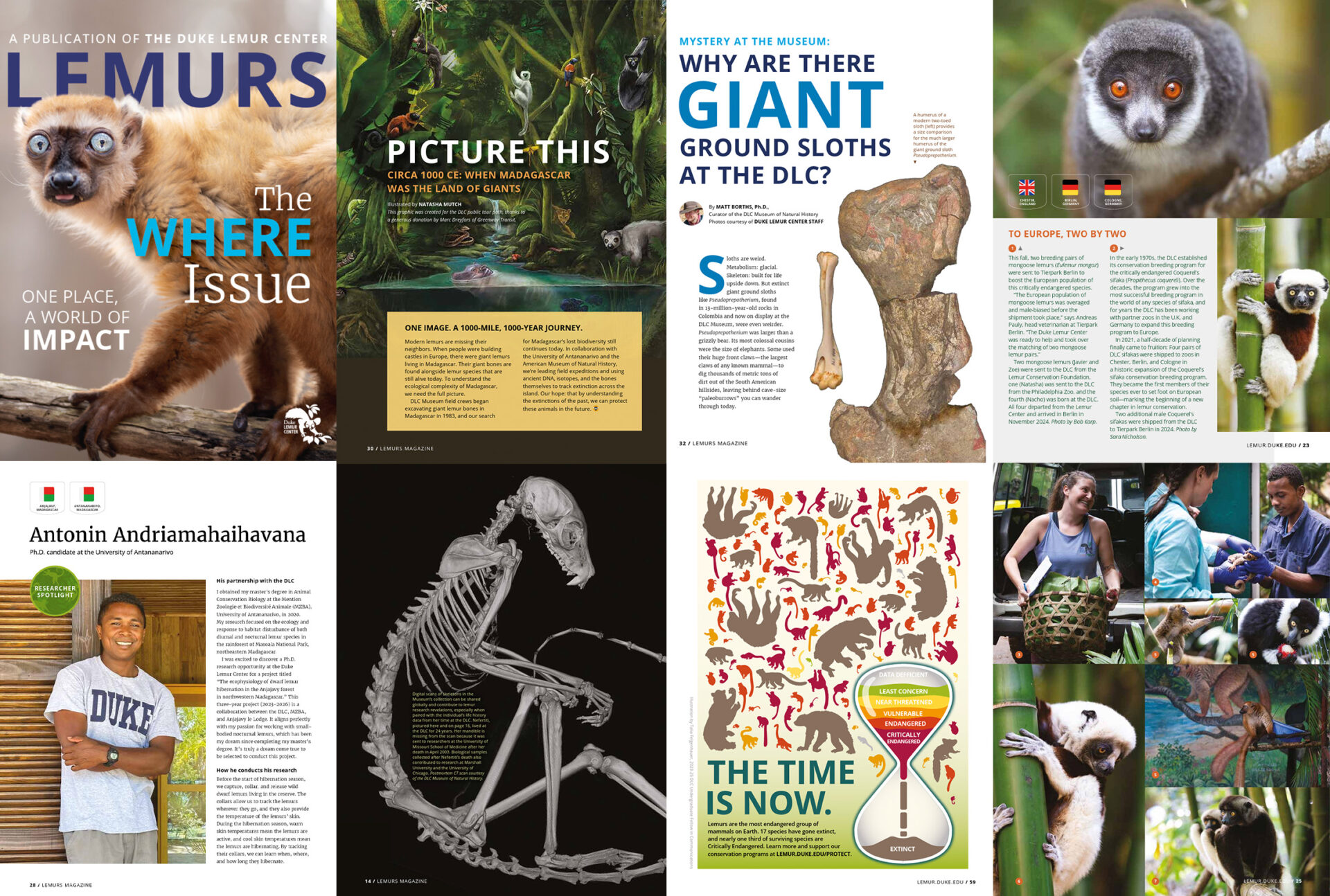
In this year’s magazine, we highlighted the work we do around the globe, from North Carolina to Madagascar and everywhere in between.
Education and Outreach
We increased gross revenue by 30% ($200,000) by expanding our capacity for tours.
We hosted over 21,000 visitors on educational tours and programs—an increase of approximately 2,000 visitors from 2024!
With generous donor support, we were able to develop and pilot a brand-new internship program for four high school students from Durham Public Schools.
Friends and followers from around the world connected with the DLC’s work through hundreds of videos, photos, and updates posted to social media, all featuring the DLC’s work lemurs and our work in Durham and Madagascar. Our Instagram and Facebook accounts have a combined 104,000 followers, and our YouTube channel has gotten 1.8 million views for a total of 19,300 hours of watch time.
Who could have imagined that a small collection of mixed primates brought to Duke Forest in 1966 would grow into a global force in lemur care, research, and conservation? In our annual magazine, dubbed The “Where” Issue, we highlighted the work we do around the globe, from North Carolina to Madagascar and everywhere in between.
We partnered with CYLNDR Studios, a Los Angeles-based video production company, to create “Closer Than You Think”. “Closer” highlights the critical importance of lemur research, as well as the urgent need to protect lemurs and Madagascar. The piece, which was created at no charge to the DLC, won GOLD in its category at the 2025 New York Festivals Advertising Awards.
In partnership with First Flight Agency and John Vaughan of Story Focused Media, we created the five-minute video “I Do Science,” which shows how the DLC’s non-invasive research program benefits lemur care and conservation, and can even help humans too! The video was produced at no charge to the DLC.
We completely revitalized the Adopt a Lemur program, creating brand-new materials, packages, and ordering options as well as a line of custom plushes. Thanks to an expanded partnership with Duke Stores, all plushes and Adopt a Lemur packages are available for online purchase. In partnership with the Development and Animal Care teams, we also created a brand-new Baby’s First Year: Ultimate Adoption Package that allows donors to symbolically adopt and name an infant at the DLC.

New custom plushes, modeled here by actor and Duke alumnus Ken Jeong, are paired with our fully revitalized Adopt a Lemur packages. Photos by Sara Sorraia.

After the retirement of longtime facility and maintenance magician Wes Phillips, volunteers have donated even more of their time checking and maintaining the DLC’s free-range enclosures. Pictured: The double fenceline along Natural Habitat Enclosure #4. Photo by Greg Dye.
Facilities and Maintenance
The DLC honored the career of Wes Phillips, who retired after 17 years as the Center’s facility and maintenance magician. He was a key figure in the Center’s revitalization, designing and fabricating many of the animal housing systems for our small-bodied nocturnal animals as well as initiating and implementing many projects that greatly improved the Center’s buildings and grounds.
While we search for our next maintenance specialist, we are so grateful to handful of volunteers who are donating additional time to help manage ongoing projects around the Center. Their efforts are keeping the aye-ayes well-stocked with worm feeders and our forest enclosures well-maintained and safe for the free-ranging lemurs.
Thanks to the extraordinary efforts of the DLC’s animal husbandry and education teams, as well as Duke Facilities, the remaining three free-range forest enclosures that were damaged in the severe storm in August 2023 have been repaired and are back online with the lemurs enjoying them.
Our garden team, in a continuing partnership with Virginia Highlands Community College, planted another patch of winged sumac that was germinated at VHCC. Developing a grove of winged sumac, which is a daily staple of the Coquerel’s sifakas’ diets, that can produce enough browse each year to feed the Center’s sifakas year-round is a priority due to increased development in the area.
Thanks to a donor, our garden team was able to expand our onsite, organic food forest to include jujube trees. Food grown in the food forest is used to feed the lemurs.
Thanks to a donor, we now have cameras in all indoor aye-aye habitats and one outdoor habitat. This helps our animal care team get a complete picture of how the aye-ayes spend their days, even after our team completes theirs.

Sheri Taylor works with volunteer Kristin in the DLC’s food forest. Photo by Sara Sorraia.
Internships and Student Experiences
Thanks to the extraordinary efforts of our team, especially Staff Specialist Sheri Taylor, we were able to host 17 groups of community volunteers this year. These groups were primarily from local businesses and student organizations who volunteered their time to help us with large-scale grounds projects around the center.
Our team of volunteers has grown to over 250 individuals who donated almost 10,000 hours this past year and helped support every aspect of our operations. Thank you!
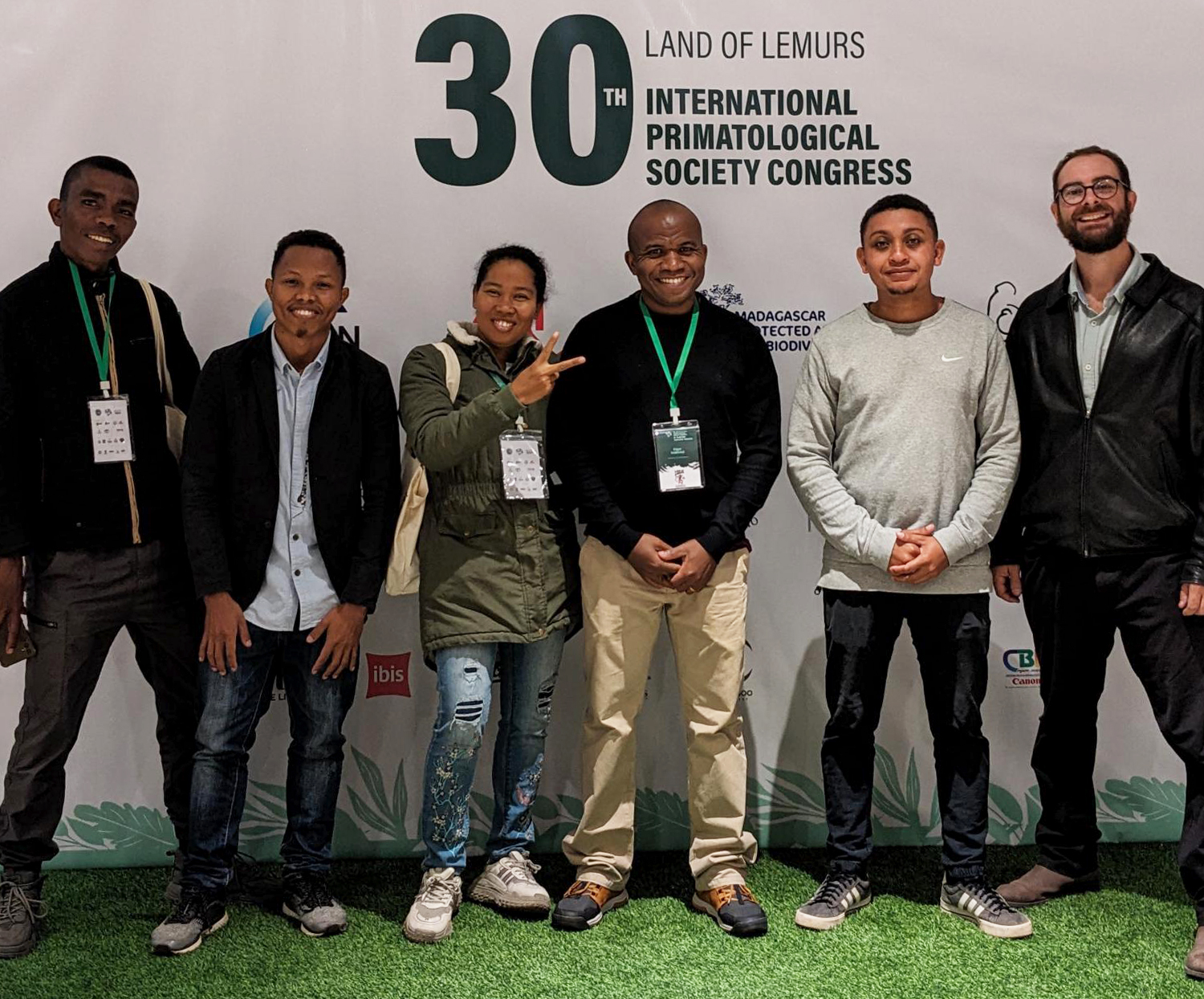
DLC-SAVA Conservation team members Evrard Benasoavina, Candidier Dimbiranijaonina, Dr. Marie Rolande Soazafy, Edgar Rabevao, Romeo Bezaralahy, and Dr. James Herrera presented papers at the IPS Congress in Antananarivo. Photo courtesy of James Herrera.
Madagascar Conservation
In-situ Conservation Programs
We published four high-impact research articles on our conservation projects in Madagascar:
“Functional Traits and Phylogenetic Effects Drive Germination of Lemur-Passed Seeds” (Ecology and Evolution, February 2025)
“Impact of Price Shocks and Payments on Crop Diversification and Forest Use among Malagasy Vanilla Farmers” (Biological Conservation, February 2025)
“Effect of Land Use on Hantavirus Infection Among Introduced and Endemic Small Mammals of Madagascar” (Ecology and Evolution, April 2025)
“Ecological and Human Use Traits Shape Lemur-Tree Interaction Networks across Human-Modified Landscapes” (Global Ecology and Conservation, October 2025)
More than 2,500 farmers are engaged in sustainable agriculture to protect forests where lemurs thrive.
Our reforestation program has restored trees on over 500 acres, bringing back biodiversity with diverse partners and communities.
Almost 2,000 women were reached through our reproductive health program, providing critical health services to vulnerable communities who are the true stewards of lemur habitat. This brings the total to over 9,200 women reached!
Over 1,700 children have participated in environmental education activities, including lesson plans about lemurs, making school gardens, and taking trips to the national park.
Six members of the DLC-SAVA Conservation team were selected to present papers at the 30th International Primatological Society (IPS) Congress in Madagascar. After years of research and preparation, they were honored to share their results with the international community!
Dr. James Herrera accepted the position of Director of Conservation. James previously served as the DLC-SAVA Program Coordinator, where he led a range of conservation initiatives. In his new role, he will split his time between Durham and Madagascar, continuing to lead our dedicated team on the ground in Madagascar—including longtime Project Coordinator Lanto Andrianandrasana, who remains based in the SAVA region.
Ex-situ Conservation Programs
In Madagascar, we made tremendous progress with our multi-year project to develop a collaborative captive breeding program for Coquerel’s sifakas in partnership with Madagascar’s Ministry of the Environment and four private parks. This year, progress was made in helping to establish better animal records and tracking by adding tracking devices (microchips) to 11 captive Coquerel’s sifakas at Nosy Be for the Madagascar studbook mission. By using the same chip technology that we use at the DLC, the Malagasy parks can ensure the identity of each animal in their care, which is a critical component in building a well-managed collaborative breeding program and will allow for animals to be moved between parks to maintain the genetic diversity of this species.
Our colony curator and one of our assistant curators helped to assess and care for several confiscated sifakas that were discovered in a suitcase by airport officials and brought to a private park in Ivato. The animals required several days of intensive care and observation, and hope to be introduced to the park’s population of Coquerel’s sifakas.
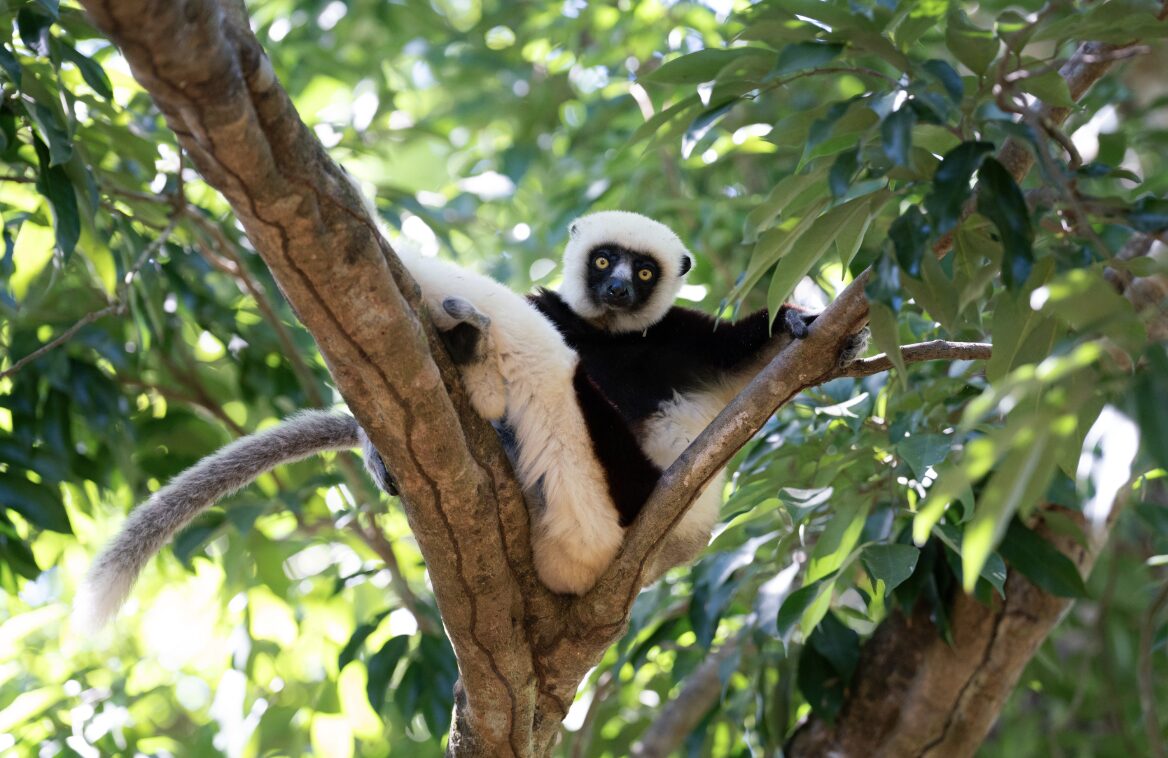
A free-ranging Coquerel’s sifaka at Lemurialand in Nosy Be, Madagascar. This year, we microchipped 11 Coquerel’s sifakas at Lemurialand as part of the Madagascar studbook mission. Photo by Sara Sorraia.

Museum Curator Dr. Matt Borths and Digital Collections Manager Kate Neely working in the collections at the Turkana Basin Institute in Kenya. Photo courtesy of Matt Borths.
Museum of Natural History
Museum staff brought over 450 visitors behind the scenes during our monthly Open House events, and over 350 elementary, high school, and undergraduate students met their fossil ancestors through class visits or community events.
Thousands of fossil and osteological specimens are now posted on the international biodiversity database website GBIF. Now, researchers from around the world can access our specimen data, asking new questions about primate diversity through time. More specimens are being added to the GBIF library every week. (Additional details in the “Data Management and Registrar” section above.)
Museum researchers conducted fieldwork in northern Kenya, searching for evidence of the earliest apes, and fieldwork in Wyoming, tracking down 50 million year-old lemur-like primates that once lived near the Rocky Mountains. The projects brought new fossils and research collaborations to the museum.
DLC fossil specimens were involved in newly published research, like a new species of puma-sized carnivore from Egypt, new species of giant soft-shell turtles, and evidence of cavities in early monkeys.

We completed our first large-scale collaborative study of mouse lemur aging and age-related cognitive decline, with potential translational value to the study of human aging and Alzheimer’s disease. Pictured: 13-year-old Virginia Creeper is the oldest gray mouse lemur in the DLC’s colony. Photo by David Haring.
Scientific Discovery
DLC research collections (living colony, BioBank, and fossil collection) contributed to at least 34 scientific manuscripts published in peer-reviewed journals.
The DLC received National Science Foundation (NSF) funding to support infrastructure for the collection of frozen tissues (BioBank) that we make available to the research community. This is especially timely, as we had a 198% increase in BioBank usage in 2025 compared to the previous 5 years!
DLC Research completed its first large-scale collaborative study of mouse lemur aging and age-related cognitive decline, with potential translational value to the study of human aging and Alzheimer’s Disease. This research focus will continue, with funding proposals already submitted for the upcoming year.
Malagasy Ph.D. student Antonin Andriamahaihavana and DLC Research Scientist Dr. Ana Breit concluded a successful field season utilizing the DLC’s new research station in Anjajavy, Madagascar! This was the 1st time that the DLC housed wild dwarf lemurs through the hibernation season (March-September) to study fine-scaled behavioral and respirometry parameters of this unique form of metabolic suppression. The six dwarf lemur residents were released back to the forest as the dwarf lemur world was rousing from hibernation and preparing for breeding season.
Research activity for 2025 is still underway, but the dataset is complete for 2024 and indicates that 96% of the animals in the DLC colony participated in research!

One of our most rewarding partnerships is our Malagasy Veterinary Internship Program, a grant-funded program that enables us to host talented Malagasy veterinarians at the Duke Lemur Center to focus on various aspects of lemur medicine. This fall, we’re enjoying hosting Dr. Jonia Rasolofoniaina (pictured in the DLC veterinary hospital) for training in lemur medicine and surgery. Photo by Sara Sorraia.
Veterinary Care
Thanks to generous support from the FS Foundation, we had the privilege of hosting Dr. Jonia Rasolofoniaina, a skilled veterinarian from Madagascar, to participate in our Malagasy Veterinary Internship Program, which provides specialized training in lemur medicine and surgery.
Throughout the year, we provided hands-on clinical training in lemur medicine through two- to four-week externships for 16 veterinary students and one zoo and wildlife resident veterinarian from veterinary schools nationwide.
We welcomed numerous regional undergraduate students for facility tours and shadowing opportunities with our veterinary team, offering them valuable exposure to the field of veterinary medicine.
Supervising veterinarian Dr. Julie Ter Beest and Dr. Fidisoa Rasambainarivo (East Carolina University) co-authored an updated chapter on Prosimian Medicine for the upcoming 11th edition of Fowler’s Zoo and Wild Animal Medicine, scheduled for publication in 2026.
