The Lemur Center’s story begins in 1963, when Peter Klopfer, a Duke University professor of biology, was charged with criminal trespass while participating in a civil rights demonstration at a restaurant. As his case worked its way through to the Supreme Court, friends and colleagues donated money for his legal defense.
In an interview in 2020, Peter described what happened next:
“When my case began to cost money, my friends and colleagues set up a defense fund and contacted my former teachers and friends at Yale for contributions.
One of those who contributed was John Buettner-Janusch. John was on the faculty at Yale, and although we’d never met and he didn’t know me, he was committed to civil rights.
When he came down [to Durham] to give a lecture—and, although I didn’t know it at the time, to be considered for an appointment at Duke—I went to the lecture and introduced myself, so I could thank him personally. He expressed an interest in my work, so I brought him to the site of my Duke zoology behavior station where I had my animals. I had a herd of deer, goats, turkeys, and all kinds of different animals within a 40-acre enclosure.
John was impressed by what he saw. He told me that one of the reasons he couldn’t stay at Yale was because they wouldn’t give him space for his lemurs. He would much rather have the animals outdoors in facilities such as mine. Would I consider letting him bring the lemurs out to the behavior station if he, in turn, allowed me to use the lemurs for my behavioral work?
I said, ‘By all means, come, and we’ll form a partnership.’ And that’s how we met, and that’s how the Lemur Center got started.”
Bill Anlyan, then dean of the Duke University School of Medicine, granted a large swath of Duke Forest to the project, and the National Science Foundation provided the funds to build a “living laboratory” where lemurs and their close relatives could be studied non-invasively.
In 1966, the nascent DLC—then called the Duke University Primate Center—was founded on 80 wooded acres (later expanded to 100 acres), two miles from the main Duke campus. John’s colony of lemurs was relocated from Connecticut to North Carolina, and over its history, the DLC has housed, cared for, and made available for non-invasive study nearly 4,000 animals across 39 species including lemurs, lorises, and tarsiers.
The scientific endeavors at the DLC have also expanded. The DLC’s non-invasive research spans a remarkable array of disciplines, from behavior and genomics to physiology and paleontology; and the Center is recognized as a global authority on lemur veterinary medicine. Conservation biology is also a major focus, providing the conceptual and operational bridge between the living collections of the DLC and its conservation activities in Madagascar.
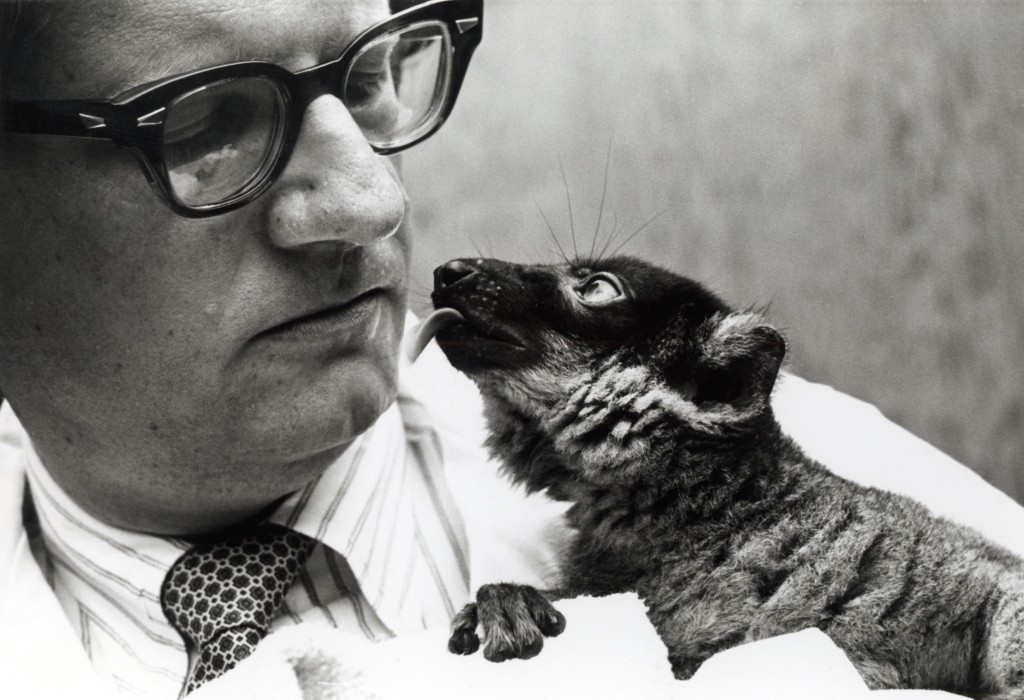
The DLC was established in 1966 as an opportunistic collaboration between two researchers: John Buettner-Janusch of Yale University (pictured), who was studying biochemical genetics in lemurs; and Peter Klopfer, a Duke University biologist studying maternal behavior in mammals. Together, the two biologists conceived the idea of establishing a primate facility in Duke Forest that would combine their research perspectives in order to explore the genetic foundations of primate behavior. Photo courtesy of Duke University Archives.
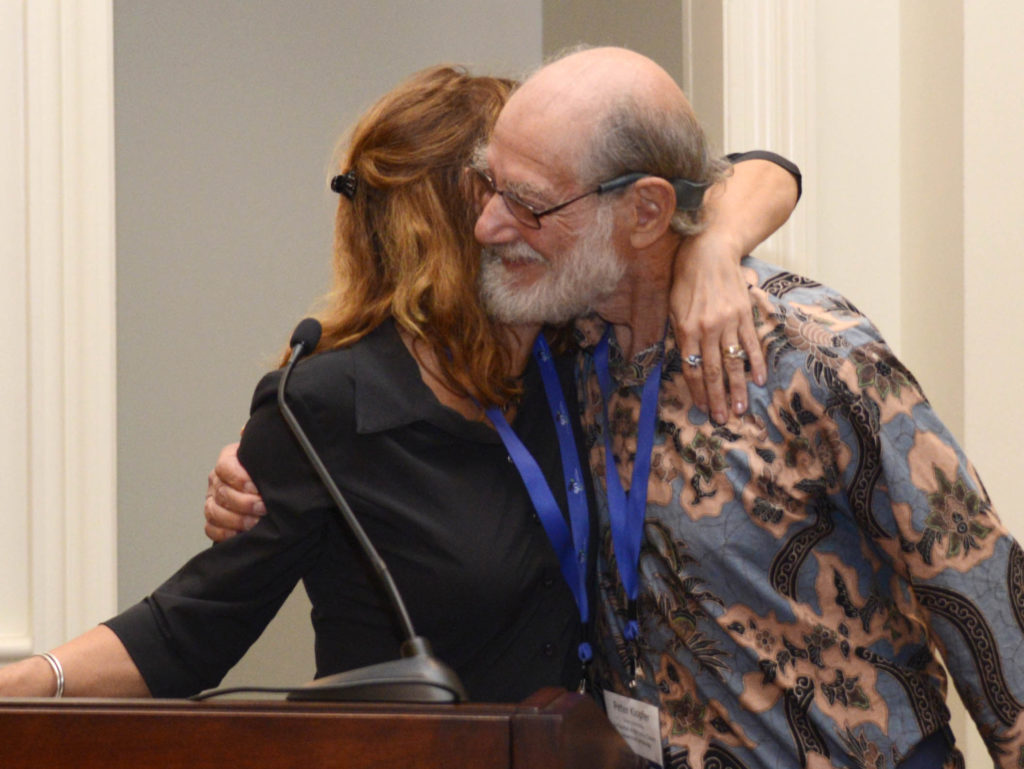
Peter Klopfer is embraced by DLC Director Anne Yoder at the Lemur Center’s 50th Anniversary Scientific Symposium in 2016. Klopfer, biologist and co-founder of the DLC, was a member of the search committee that hired Buettner-Janusch onto faculty at Duke. “B-J” accepted the position, on the condition that the University provide accommodations for his lemurs and other primates.

Former DLC Director Elwyn Simons, widely regarded as the founder of modern primate paleontology, and English anthropologist and conservationist Dame Alison Richard observe troop of black and white ruffed lemurs at the DLC in 1987.